
The cost follows the scope: how many servers, sites, applications and accounts are covered, how much faces the internet, the response terms you want and the compliance evidence you need. We do not publish a rate card. After a free first call we take the inventory and send a written quote that lists each item covered.

Cybersecurity Services in Massachusetts
Managed security, statewide
Cybersecurity services in Massachusetts: the short answer
Cybersecurity services in Massachusetts help a business keep its systems patched, watched, tested and documented to the standard state law expects of anyone holding residents' personal information. Kief Studio does that work for companies of 5 to 200 people across the state: managed security monitoring, vulnerability management, authorized penetration testing, and help getting systems to meet 201 CMR 17.00 and HIPAA.
We are engineers based in the Worcester and Shrewsbury area. We also build and host software and infrastructure, so we look at your systems the way the people who built them would. We are reachable 24/7, with response and restore times set in the agreement. Boston firms work with us remotely, and we come on site anywhere in the state when seeing the setup in person will change the plan.
Security is process and care. Nobody can honestly promise that a business will never be breached, and we will not. What we put in writing is the work: what we watch, how often we patch and test, who is told what when something looks wrong, and the records that show it was done.
- Focus: Cybersecurity services for Massachusetts businesses of 5 to 200 people, and for IT providers who need a security engineering partner.
- Services: Inventory and exposure mapping, hardening and patching, monitoring of the systems we run, vulnerability management, authorized penetration testing, and evidence for 201 CMR 17.00 and HIPAA.
- Approach: We list every system first, scope the work in writing, follow the safeguards state and federal rules name, and report what we found and fixed in plain language.
- Best for: Massachusetts firms that hold client, patient or employee data and want an engineering team responsible for keeping their systems in order.
Kief Studio is led by Amelia S. Gagne, co-founder and CEO, a full-stack developer, strategist and fine artist who has worked in tech since 2012, and Brian S. Gagne, co-founder and CTO, an engineer, systems architect and Cisco Certified Ethical Hacker (CCEH) who has been building production systems since 2006. About the studio.
Kief Studio, Shrewsbury, MA 01545. [email protected]
What cybersecurity services cover for a Massachusetts business
For a company without a security department, the useful part of a security service is the routine that nobody inside has time for. Someone notices the admin account that a former contractor can still use, the test site that was never taken down, the server three months behind on updates, and the backup that has never been restored. Then someone fixes it and writes down that it was fixed.
We name the systems in the agreement instead of promising to cover everything. For most Massachusetts clients the work includes:
- An inventory of servers, cloud accounts, websites, applications, domains and admin logins, with what each one exposes to the internet.
- Hardening and patching on a schedule, with emergency patches for flaws that are being exploited in the wild.
- Monitoring of the systems we run, and a written path for who acts, who decides and who gets told when an alert matters.
- Vulnerability scans ranked by your real exposure, each fix verified after it is made.
- Penetration tests of applications, APIs, cloud accounts and networks, always with written authorization and an agreed scope.
- Backups kept away from the systems they protect, with restores tested.
- A quarterly report in plain language, and the records your written information security program and your auditors will ask for.
What the FBI's 2025 complaint data shows for Massachusetts
Massachusetts residents and businesses filed 22,936 complaints with the FBI's Internet Crime Complaint Center in 2025 and reported $410,924,066 in losses. Measured per person, the state ranked fifth in the country, at 320.6 complaints per 100,000 residents (FBI, 2025 IC3 Annual Report).
Ransomware shows who gets hit. The same report counts more than 3,600 ransomware complaints nationwide in 2025, and among the more than 1,400 that came from businesses outside the critical infrastructure sectors, the most common were legal services at 18 percent, contracting services at 17 percent, and engineering and architectural firms at 10 percent. Law offices, contractors and design firms are found in every corner of Massachusetts, and they are rarely too small to be worth an attacker's time.
The FBI also notes that reported ransomware losses usually leave out lost business, staff time, files, equipment and outside recovery help, so the real cost to a firm runs higher than the figure it reports. Its own advice reads like a checklist of routine work: offline backups that are encrypted and cannot be altered, no default passwords, least privilege on admin accounts, multi-factor sign-in, logging of network traffic, segmented networks, and timely patching of internet-facing systems. That list is most of what we do every week.
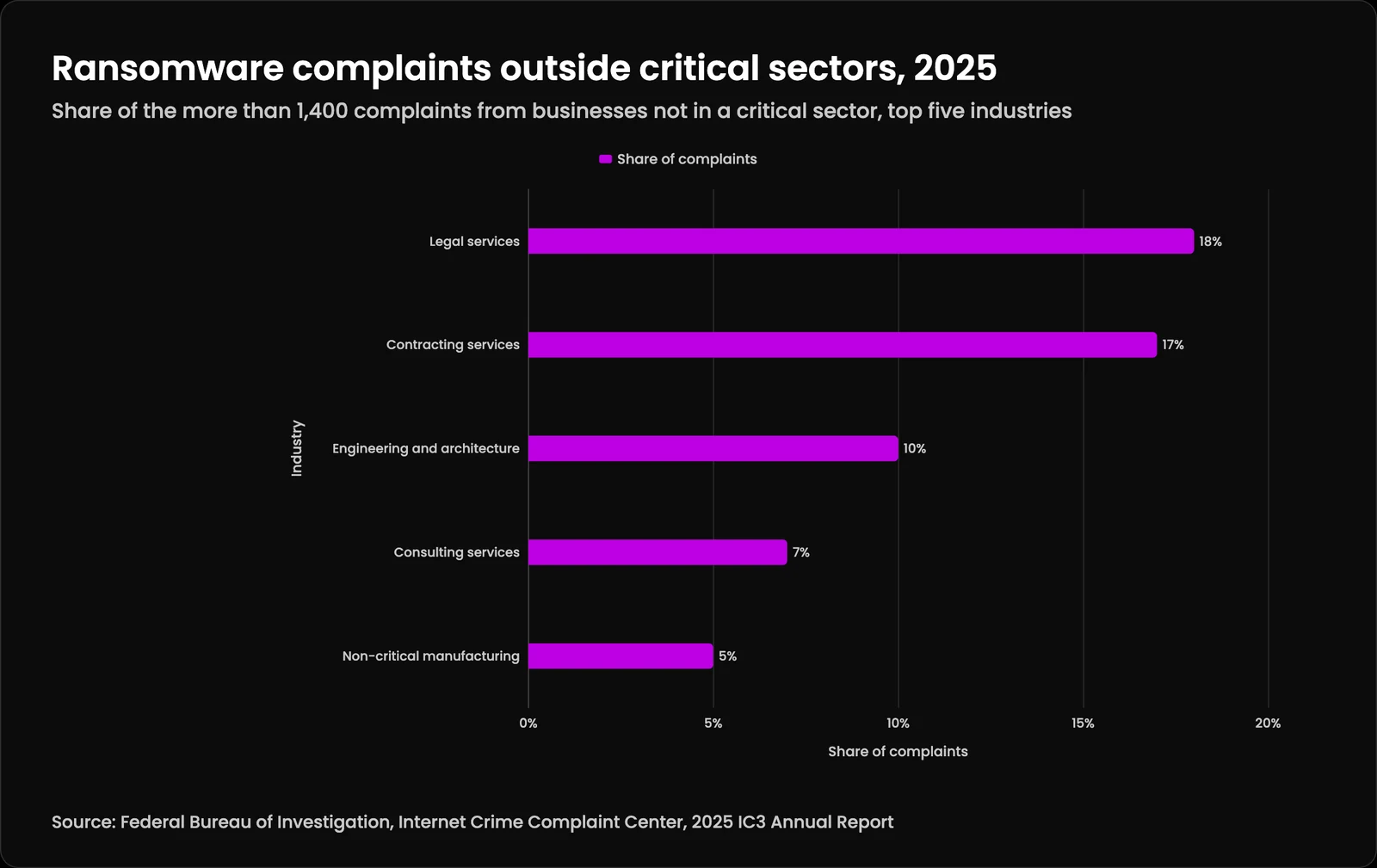
| Industry | Share of complaints |
|---|---|
| Legal services | 18% |
| Contracting services | 17% |
| Engineering and architecture | 10% |
| Consulting services | 7% |
| Non-critical manufacturing | 5% |
201 CMR 17.00 and Chapter 93H: what Massachusetts expects
Massachusetts sets a floor for any business that owns or licenses personal information about a resident, wherever the business is based. Under 201 CMR 17.03 the written information security program has to include, among other things, an assessment of reasonably foreseeable internal and external risks, preventing terminated employees from reaching records, contracts that require service providers to maintain safeguards, regular monitoring that the program works, a review of its scope at least once a year, and documented responses to any breach with a review afterward (201 CMR 17.03).
Section 17.04 adds technical requirements for systems connected to the internet: encryption of personal information sent over public networks or wirelessly and stored on laptops and portable devices, reasonable monitoring for unauthorized access, reasonably up-to-date firewall protection and security patches, malware protection, and training staff on the security system (201 CMR 17.04).
If personal information is exposed, Chapter 93H requires notice to the Attorney General, the Director of Consumer Affairs and Business Regulation and the affected residents. The notice to the state must give the number of residents affected, the steps taken, and whether the business maintains a written information security program (M.G.L. c. 93H, Section 3). When Social Security numbers are involved, the business must offer credit monitoring for at least 18 months at no cost to the resident (M.G.L. c. 93H, Section 3A). The state publishes the notices it receives; Brian Gagne reads through that list in Massachusetts data breach statistics.
We are not lawyers, and your lawyer decides what applies to you. Where we help is making the systems match what the program says and keeping the records that prove it.
HIPAA compliance in Massachusetts: making the systems match the rule
Practices, clinics, therapists, home care agencies and the vendors that serve them carry federal duties on top of the state's. The HIPAA Security Rule requires an accurate and thorough assessment of the risks and vulnerabilities to electronic protected health information, security measures that reduce those risks to a reasonable and appropriate level, and procedures to regularly review records of system activity (45 CFR 164.308). A Massachusetts practice also holds residents' personal information, so 201 CMR 17.00 applies to the same records.
Where we are experts is getting a practice's systems to match what HIPAA requires: the risk analysis tied to the real systems, access limited by role, encryption, logging that someone actually reviews, and tested backups. We guide you through the rest in plain terms, and when a question needs a lawyer or an auditor, we will tell you. Our HIPAA and compliance page covers that work in full.
Penetration testing for Boston and statewide firms
NIST describes penetration testing as security testing in which evaluators mimic real-world attacks to find ways around a system's security features (NIST glossary, citing SP 800-115). A scan lists what might be wrong; a test shows what someone could actually reach, so the fixes go where they matter.
Every test we run starts with written authorization from the owner of the systems, a defined scope, a time window and agreed rules. We test what you authorized, which for most clients means the website or customer portal, its APIs, cloud accounts and the internet-facing network. The report ranks each finding by real impact, explains how to close it in steps your team or ours can follow, and we retest to confirm each fix. A test makes the most sense before a launch or major change, before a customer security questionnaire or audit, and on a regular schedule once a system holds client or patient data. More on scope and method is on our penetration testing page.
How an engagement starts, and working beside your IT provider
We begin with an inventory, because a quote given before anyone has looked is a guess. We list what you run, where it runs, who can reach it and what it exposes, and we bring you the urgent findings first. You approve each fix before we make it. From that list we write the scope, the monitoring and testing schedule, the response and restore times, and a price, and we report each quarter on what changed.
Plenty of Massachusetts companies already have an IT provider or an in-house person they trust. You do not have to replace them. In a co-managed setup we take the servers, applications and cloud accounts they do not cover and agree in writing who handles what. IT providers can also bring us in under their own name through our MSP partner program for monitoring, testing, hardening and infrastructure work.
How to judge a cybersecurity company in Massachusetts
Lists of firms are easy to find and hard to use. These questions sort providers faster, and we expect to be asked them too:
- Which systems are in scope, by name, and which are not?
- What are the response and restore times, and are they in the contract?
- Will you sign a contract that holds you to safeguards for our data, as 201 CMR 17.03 expects of service providers?
- Who can see our data and logs, and where are they stored?
- Is the team that tests our systems separate from the one that certifies them, and do you keep those roles apart?
- What do we keep if we leave: accounts, configurations, records and reports?
- Does anyone promise we will never be breached? A careful provider describes its process and leaves promises out.
Security work across Massachusetts from Central Mass
Kief Studio is based in the Worcester and Shrewsbury area and works with businesses across the state, from Springfield and Lowell to Boston, where we serve clients remotely and meet in person when it helps. Our Massachusetts page explains how we work statewide.
Closer to home, see managed IT services in Worcester and managed IT services in Shrewsbury. If you are building software that will hold personal data, the page on software development in Massachusetts covers how we design for it.
Cybersecurity services in Massachusetts: the facts we work from
- In 2025 the FBI's Internet Crime Complaint Center received 22,936 complaints from Massachusetts with $410,924,066 in reported losses, and the state ranked fifth at 320.6 complaints per 100,000 residents. Source: FBI, Internet Crime Complaint Center, 2025 IC3 Annual Report
- Of more than 1,400 ransomware complaints from businesses outside critical infrastructure sectors in 2025, 18 percent came from legal services, 17 percent from contracting services and 10 percent from engineering and architectural services. Source: FBI, Internet Crime Complaint Center, 2025 IC3 Annual Report
- 201 CMR 17.03 requires a written information security program that includes assessing foreseeable internal and external risks, contractual safeguards for service providers, regular monitoring and a review of the security measures at least annually. Source: 201 CMR 17.03, Duty to protect and standards for protecting personal information
- A breach notice to the Massachusetts Attorney General and the Director of Consumer Affairs and Business Regulation must include the number of residents affected and whether the business maintains a written information security program. Source: Massachusetts General Laws, Chapter 93H, Section 3
- When a breach involves Social Security numbers, the business must offer credit monitoring for at least 18 months at no cost to the affected resident. Source: Massachusetts General Laws, Chapter 93H, Section 3A
- The HIPAA Security Rule requires an accurate and thorough assessment of the potential risks and vulnerabilities to electronic protected health information. Source: 45 CFR 164.308, Administrative safeguards
- Massachusetts had 6,100 information security analysts in May 2025, with a median annual wage of $136,550. Source: U.S. Bureau of Labor Statistics, OEWS May 2025, Massachusetts
- Kief Studio is based in the Worcester and Shrewsbury area, works with businesses across Massachusetts remotely, and is reachable 24/7 with response and restore times set in the agreement.
What we do alongside it
Managed security monitoring
Someone is watching, and they know your stack.
Penetration testing
Authorized attacks, so you find the hole first.
Vulnerability management
Finding issues is easy. Closing them is the job.
HIPAA and compliance consulting
Pass the audit because the system is actually hard to attack.
Threat detection and response
Alerts that come with a next step.
Zero trust architecture
Trust the user after you check, not because they are inside.
Also read: Kief Studio across Massachusetts; Managed security monitoring; Penetration testing; HIPAA and compliance consulting; Managed IT Services in Worcester, MA; Managed IT Services in Shrewsbury, MA; Massachusetts data breach statistics (Brian Gagne).
Cybersecurity services in Massachusetts: common questions
How much do cybersecurity services cost for a small business?
How much should a penetration test cost?
A penetration test is priced by its scope: how many applications, APIs, cloud accounts and network addresses are tested, how deep the testing goes, and whether a retest is included. A narrow test of one web application is a different job from a full external and cloud review, so we agree the scope in writing first and price from it.Is pentesting illegal?
Penetration testing is legal when the owner of the systems has authorized it in writing and the tester stays within the agreed scope. Testing systems without that permission is unauthorized access. We do not start any test without a signed scope from the system owner.What are the three types of penetration testing?
The three most often named are network testing, web application testing and social engineering testing, though lists vary and some add wireless or physical tests. For most Massachusetts small businesses the systems worth testing first are the website or portal, its APIs, cloud accounts and the internet-facing network.What is 201 CMR 17.00?
201 CMR 17.00 is the Massachusetts regulation that sets minimum standards for protecting residents' personal information. It requires a written information security program with risk assessment, service-provider contracts, monitoring and annual review, plus technical controls such as encryption, patching and malware protection for systems connected to the internet.What is required to comply with HIPAA?
HIPAA compliance requires privacy, security and breach notification safeguards for protected health information. On the security side that starts with an accurate and thorough risk assessment, security measures that reduce the risks found, and regular review of system activity records. We help make the systems match those requirements and guide you through the rest.How much does cybersecurity pay in Massachusetts?
Information security analysts in Massachusetts earned a median annual wage of $136,550 in May 2025, and the state had 6,100 of them, according to the Bureau of Labor Statistics. Those figures are one reason small firms usually hire a security service instead of a full-time specialist.Do you have an office in Boston?
No. We are based in the Worcester and Shrewsbury area. We serve Boston businesses remotely, since the systems we look after are reached over secure connections, and we meet on site when it helps.Can you work with the IT company we already have?
Yes. We often cover the servers, applications and cloud accounts an existing provider does not, with a written split of duties, and IT providers can also hire us under their own name.
Sources
- FBI, Internet Crime Complaint Center, 2025 IC3 Annual Report
- 201 CMR 17.03, Duty to protect and standards for protecting personal information
- Massachusetts General Laws, Chapter 93H, Section 3
- Massachusetts General Laws, Chapter 93H, Section 3A
- 45 CFR 164.308, Administrative safeguards
- U.S. Bureau of Labor Statistics, OEWS May 2025, Massachusetts
Notes
Notes on Massachusetts
Notes from the studio for businesses in Massachusetts, newest first.
27 notes on Massachusetts

Automate
AI Consulting in Massachusetts: What to Expect and Ask
AI consulting in Massachusetts for a small business: what the work includes, what you should have running at the end, and which state rules apply.
 Brian Gagne

Protect
Small Business Cybersecurity Cost in Massachusetts
Small business cybersecurity cost explained for Massachusetts owners: what drives it, what to pay for first, breach costs, and in-house vs outsourced.
Brian Gagne
Protect
AI Audit Trail: What to Record When AI Acts for You
An AI audit trail proves what an AI did, who approved it and that the record is unchanged. What to record, how to protect it, how long to keep it.
Brian Gagne
Protect
AI Governance Framework for a Massachusetts Small Business
An AI governance framework for a Massachusetts small business: owners, an AI inventory, data rules, approvals and reviews, mapped to NIST AI RMF and ISO 42001.
Brian Gagne
Automate
AI for Contractors in Massachusetts: Estimates to Invoices
AI for contractors in Massachusetts: drafts for estimates, follow-ups, scheduling, change orders and invoices, with the owner approving what goes out.
Brian Gagne
Automate
AI for Real Estate Agents in Massachusetts: Rules First
AI for real estate agents in Massachusetts: where it saves hours, and the fair housing, staging and recording rules that decide how to use it.
Brian Gagne
Automate
AI Tools for Small Business in Massachusetts by Job
AI tools for small business in Massachusetts by job: email, books, content and customer replies, plus state AI rules and training grants.
Brian Gagne
Automate
AI for Accounting Firms in Massachusetts: A Safe Start
AI for accounting firms in Massachusetts: what to automate first in tax season and how to fit AI into your FTC and IRS security plan.
Brian Gagne
Protect
Private AI for Massachusetts Businesses: What It Means
Private AI for Massachusetts businesses: what private means in practice, where your data goes, and three ways to get it, from business accounts to self-hosting.
Brian Gagne
Support
Massachusetts Technology Grants for Small Businesses in 2026, Plus Loans and Free Help
Massachusetts technology grants for small business, checked on official pages: who qualifies, what each pays for, status and dates, plus loans and free help.
 Amelia Gagne

Protect
The Massachusetts Data Privacy Act: Where It Stands and What a Small Business Should Do Now
Did the Massachusetts Data Privacy Act pass? Its status as of October 22, 2026 from the Legislature's records, and what a small business should do now.
Amelia Gagne
More on Massachusetts

Protect
What AI Security Means for a Small Business
AI security for a small business: what it is, what never to paste into AI tools, whether your data is safe, deepfake voice fraud, and practical first steps.
Amelia Gagne
Support
IT Onboarding Checklist for New Employees: A Small Business Guide
An IT onboarding checklist for small businesses: accounts by role, encrypted devices, MFA, first-day training, the 30 day review and Massachusetts rules.
Brian Gagne
Protect
Compliance vs Security for a Small Business: What Massachusetts Owners Should Actually Build
Compliance vs security for a small business: what security compliance means, why a passed checklist is not the same as being hard to breach, and what to build.
Amelia Gagne
Build
How a White-Label Development Partner Works With an Agency
How a white label development partner works with a Massachusetts agency: client communication, IP assignment, logins, hosting, standards and red flags.
Amelia Gagne
Build
A Massachusetts Online Store for a Small Business: A Platform or a Custom Build
A Massachusetts online store for a small business: platform or custom build, by category and criteria, with sales tax, PCI DSS, accessibility and exit costs.
Amelia Gagne
Support
What Does a Massachusetts Website Cost a Small Business in 2026?
What drives Massachusetts website cost for a small business in 2026: public wage data, what you pay for, upkeep owners forget, and why a site matters with AI.
Amelia Gagne
Automate
Near Me Searches Didn't Go Away. Your Site Still Answers Like a Brochure From 2019.
Near me searches still drive local work, but the click is now a quick check on a phone. What people look for, what Google says, and what your page must answer.
Amelia Gagne
Build
Ghost Inventory in Metrc: Why Your POS and the State Disagree
Why ghost inventory appears between your POS and Metrc, what Massachusetts and other states require, and how to fix and prevent a discrepancy the right way.
Amelia Gagne
Automate
Local SEO Is the Best Marketing You're Not Doing. Start With Your Google Business Profile.
A complete Google Business Profile is the cheapest local marketing there is. What Google says on ranking, reviews and AI answers, and what to fix this week.
Brian Gagne
Protect
Identity and Access Management for AI Browser Agents
Identity and access management for AI browser agents: give each agent its own identity, scope it to one task, require approvals and log who acted for whom.
Brian Gagne
Protect
Network Security Monitoring: Detecting AI Browser Anomalies
Network security monitoring for AI browser agents: baseline each agent, alert on new destinations and odd outbound data, and watch app logs for hosted agents.
Brian Gagne
Automate
Short Staffed? How Automation Bridges the Workforce Gap in Massachusetts
How a short-staffed Massachusetts business can use automation to close the workforce gap: what to automate first, how to measure it, and training grants.
Brian Gagne
Protect
Browser Extensions vs. Agentic AI: What Massachusetts Users Need to Know
How browser extensions and AI agents in the browser differ, what can go wrong with each, and the controls a Worcester area business should set up first.
Amelia Gagne
Protect
2026 Predictions for AI Agents and Web Safety: What Held Up
We made 2026 predictions about AI agents and web safety. What the record shows in October 2026, what we got wrong, and how a small business should prepare.
Amelia Gagne
Protect
Prompt Injection Attacks Explained: How Massachusetts Users Can Stay Protected
How prompt injection tricks AI browsers and assistants, why it can't simply be patched, and the steps Massachusetts users and businesses can take today.
Brian Gagne
Protect
How Safe Are AI Browsers? AI Browser Safety Risks for Massachusetts Users
AI browser safety for Massachusetts users and small businesses: prompt injection, data leaks, risky extensions, unapproved actions, and what to do this week.
Amelia Gagne