


Brian GagneCo-founder and CTO, Kief Studio
- Published
- 15 min read

TL;DR: AI consulting in Massachusetts should leave a 5 to 50 person business with one workflow running that your own staff can operate, a written plan for what comes next, and your data handled the way state law expects. If all you get is a report, you bought half the job.
AI consulting in Massachusetts gets sold a lot of different ways. Search for it and you find ranking lists, job boards and big strategy firms. What you mostly don't find is an answer to the question an owner actually has: if I hire someone for this, what happens, and what do I have when they leave?
That is what this page is for. I'll walk through what AI consulting includes, how a good engagement runs step by step, what you should hold at the end, how to pick a firm, and the Massachusetts rules that apply whether or not anyone mentions them.
What does AI consulting actually include?
Start with the job the title grew out of. The Bureau of Labor Statistics says management analysts, the occupation that covers management consultants, "recommend ways to improve an organization's efficiency." Their listed duties include gathering information about the problem, interviewing staff and observing the work, developing solutions, and "confer with managers to ensure changes are working." (BLS Occupational Outlook Handbook, August 2026 (opens in a new tab))

Good AI consulting is that same work with one more tool on the bench. Sometimes AI is the answer. Sometimes the answer is a cleaner process, or a feature in software you already pay for. A consultant who never says that is selling, not consulting.
For a small business, AI consulting usually comes in four parts.
Discovery: watching how the work really moves
Someone sits with the people who do the job. Who answers the phones, who keys in the orders, who chases the invoices. They write down each step and mark which ones follow rules most of the time. Those are the candidates.
A plan you can read in one sitting
The output is a short written plan: which workflow to try first, which to leave alone, and why. Our note on what a technology advisor does for a small business covers what that plan should look like.
The build
Advice alone takes nothing off anyone's desk. The build connects AI to your real systems, tests it on your messy data, checks what it produces, and gives a person a way to step in when the model is unsure. Our note on quality gates for bad AI output covers the checks that matter here.
The handoff
Somebody on your team learns to run it. They know what it does, what it sends back for a human, and who to call when a vendor changes something. This is the part that gets skipped most, and it decides whether the project is still alive in six months.
Getting your team on board
Start small. A lot of people find AI intimidating, so we don't open with the technology. We ask about their day: which tasks do you do over and over, which ones eat the most time, which ones are easy to get distracted from, and which ones are hard to finish for one reason or another. The repetitive work on that list is usually the first thing to automate.
Once a few small wins land and the team sees the time come back, people get on board quickly. That's when we ask them to write down what a normal day at their desk looks like. With that record in hand, the team can judge for themselves which tasks AI should take on next, and good AI consulting leaves that decision with them.
How does an AI consulting engagement run, step by step?
Every AI consulting firm names the stages differently. Strip the labels off and a sound AI consulting engagement for a small business runs roughly like this:

- A first conversation. You describe the work that eats your week. A good consultant asks more questions than they answer and tells you early if AI is the wrong tool.
- Discovery. Interviews, a look at the systems you run, and a list of where your data lives. Expect questions about customer records before anyone touches them.
- A baseline. How long the work takes today, how often it goes wrong, and who does it. Without this, nobody can tell you later whether anything improved.
- One workflow, defined. Pick one. Write down what good output looks like so a person could check it.
- The build and a test on real data. Not a demo on clean samples. Your actual intake emails, your actual PDFs.
- A human path. Anything the model is unsure about goes to a named person on your side.
- Go live and measure. Compare against the baseline. Fix what the numbers show.
- Handoff, or ongoing support. Either your team runs it, or the consultant keeps running it and reports to you. Both work. You just need to know which one you bought.
Here is a hypothetical example. A 15 person accounting office in Framingham spends hours every week sorting client documents that arrive by email. Discovery shows most of them fall into a short list of types. The first build sorts and files them and flags anything odd for a staff accountant. It does not touch tax advice. The office measures the hours before and after, and decides what to do next.
What should you have at the end of AI consulting?
I've been a developer for more than twenty years. Amelia and I were building with AI before most people had heard of it, back when you were careful who you mentioned it to, because people either thought it was impossible or were afraid of it. We were automating business work long before that, and we spent years building our own platform, LTFI, which has been running in production for more than 18 months. Our time now goes into making its results better. From that side of the table, this is where I'd push hardest. Assume the AI will one day read something it shouldn't trust, and that a service it depends on will change without warning. The work should be built for that day, and you should be able to see that it was. At the end of a first round of AI consulting, you should be able to hold these things:
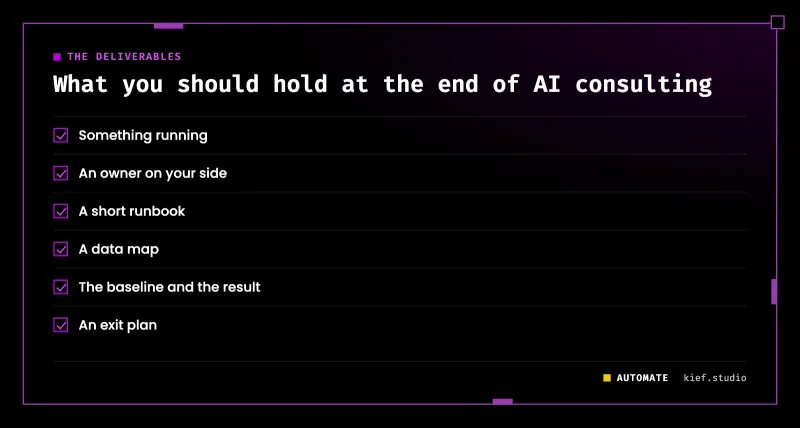
- Something running. One workflow doing real work every day, not a slide that says it could.
- An owner on your side. A named person who approves changes and handles what the system sends back.
- A short runbook. What it does, what it must never touch, what to check each week, and who to call.
- A data map. What the AI reads, what it writes, and where your customers' personal information goes. Our note on least privilege for AI agents explains why the "never touch" list matters.
- The baseline and the result, side by side, in plain numbers you measured yourselves.
- An exit plan. What you keep, in what format, if you part ways.
A report from AI consulting is useful. It is not the deliverable. My wife and Kief Studio's co-founder and CEO, Amelia, wrote a sharp piece on this: the moment an AI system becomes the client's (opens in a new tab), meaning your team can run and improve it without the consultant in the room.
How much does AI consulting cost?
Most published numbers for AI consulting come from firms quoting their own rates, so start with neutral ones. Federal ceiling rates for labor categories with "artificial intelligence" in the title had a median of about $194 an hour, with the middle half between $142 and $258, in GSA's CALC+ data (opens in a new tab) in November 2026. Wage data from the Bureau of Labor Statistics (opens in a new tab) puts what an employer pays for the underlying skills at roughly $70 to $120 an hour. Amelia shows the math, plus project fees, retainers and fractional work, in what it costs to hire an AI consultant (opens in a new tab).
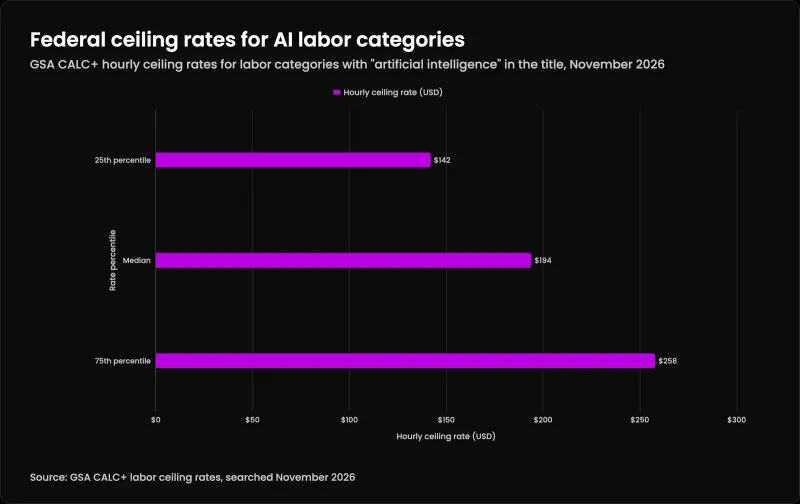
| Rate percentile | Hourly ceiling rate (USD) |
|---|---|
| 25th percentile | $142 |
| Median | $194 |
| 75th percentile | $258 |
Those are market reference points, not our rates. Kief Studio prices AI consulting to the business in front of us, after a free first conversation about what you need and what you already have. A focused job, or one that builds on systems you already run, often comes in well under a general figure.
What moves the price of AI consulting, in short:
- Advice only, or advice and build. A written plan is bounded. A build touches live systems and needs testing.
- How many systems it connects. Each login and each integration adds design, testing and upkeep.
- How clean your data is. A customer list spread across three spreadsheets gets cleaned before anything else.
- Personal information. If the work touches Massachusetts residents' personal information, the security work is part of the job, not an extra.
- Who runs it after launch. Ask whether the price includes running the system or whether that is a second bill.
How do you pick an AI consulting firm in Massachusetts?
Regulators are watching AI claims. Announcing its Operation AI Comply sweep, the Federal Trade Commission's chair said "there is no AI exemption from the laws on the books." (FTC, September 2024 (opens in a new tab)) Massachusetts said much the same, as you'll see below. So hold anyone selling AI consulting to plain answers.
Questions to ask an AI consulting firm before you sign
- What would you tell me not to automate? Someone who has done the work has a list.
- What do I have running at the end, and who on my team runs it? If the answer is a document, you know what you're buying.
- What happens when the model is unsure? You want a named person and a path, not "it learns."
- How will we measure it? Listen for a baseline taken before the build.
- Where does my customers' personal information go, and how do you protect it? A Massachusetts firm should know 201 CMR 17.00 by name.
- Who owns what you build, and what do I keep if we part ways? Your data and your workflows should leave with you.
- Which AI providers do you work with, and why? A neutral consultant can explain why a model fits your job and is not paid to pick one.
- Do you work from a public framework? The NIST AI Risk Management Framework, released January 26, 2023, is "intended for voluntary use," and NIST says it is being revised. (NIST (opens in a new tab)) Its core "is composed of four functions: govern, map, measure, and manage." (NIST AI RMF Core (opens in a new tab)) A consultant who works from something public gives you something you can check.
Amelia goes deeper in how to evaluate AI tools without getting sold (opens in a new tab), and our note on AI that works versus AI that sounds impressive covers the same instinct from the build side.
Does an AI consulting firm need to be local?
Not for the build. Most of that is remote. Discovery is different. Watching the front desk in Lowell or the shop floor in Springfield often changes what the first project should be. A firm that can show up for that first look, and knows the state rules, saves you a round of corrections.
Which Massachusetts rules apply to AI consulting work?
None of these rules is written about AI consulting. They apply anyway, because AI touches the same data and makes the same kinds of claims as any other tool. This is general information, not legal advice. Check the specifics with your own counsel.

Chapter 93H and 201 CMR 17.00: personal information
Massachusetts law defines personal information as a resident's first name and last name, or first initial and last name, combined with a Social Security number, a driver's license or state ID number, or a financial account or card number. (M.G.L. c. 93H, section 1 (opens in a new tab)) If that data is breached, the business has to notify the attorney general, the director of consumer affairs and business regulation, and the affected residents "as soon as practicable and without unreasonable delay." (M.G.L. c. 93H, section 3 (opens in a new tab))
The regulation under that law, 201 CMR 17.00, says "every person that owns or licenses personal information about a resident of the Commonwealth" shall keep a written security program with administrative, technical and physical safeguards. (Mass.gov, 201 CMR 17.00 (opens in a new tab); Cornell LII, 201 CMR 17.03 (opens in a new tab)) That program is often called a WISP. Amelia wrote the full walkthrough of Massachusetts WISP requirements under 201 CMR 17 (opens in a new tab), so I won't repeat it here.
Your AI consulting firm is a service provider
Here is the part owners miss. The regulation defines a service provider as "any person that receives, stores, maintains, processes, or otherwise is permitted access to personal information through its provision of services." (Cornell LII, 201 CMR 17.02 (opens in a new tab)) If your consultant, or the AI tool they set up, can see that data, it likely fits.
The rule then requires you to oversee service providers by "taking reasonable steps to select and retain third-party service providers that are capable of maintaining appropriate security measures," and by "requiring such third-party service providers by contract to implement and maintain such appropriate security measures." (Cornell LII, 201 CMR 17.03 (opens in a new tab)) In plain words: picking an AI consulting firm is a security decision, and the contract should say how they protect your data.
The Attorney General's AI advisory
On April 16, 2024, Attorney General Andrea Joy Campbell issued an advisory saying the state's consumer protection, anti-discrimination and data privacy laws "apply to AI, just as they would within any other applicable context." Among the practices it lists as potentially unfair or deceptive: "Falsely advertising the quality, value, or usability of AI systems." It also says "AI developers, suppliers, and users must take appropriate steps to safeguard personal data utilized by AI systems." (Massachusetts Attorney General, April 2024 (opens in a new tab); National Consumer Law Center, April 2024 (opens in a new tab))
"Users" means you. That is one more reason for AI consulting to start with where the data goes, before anything connects. Our note on the Massachusetts Data Privacy Act tracks the broader privacy bill and what a small business can do now.
What does the state offer before you hire anyone?
The state does not run AI consulting for you, but it does help pay for training, and training first makes any AI consulting you buy later more useful, because your people know what to ask for. I wrote up the Massachusetts AI training grant routes for employers (opens in a new tab) if you want help paying for staff training, and our note on Massachusetts technology grants and free help covers the wider list.
Frequently asked questions
How much does an AI consultant cost?
Neutral reference points: federal ceiling rates for AI labor categories had a median of about $194 an hour in GSA CALC+ data (November 2026), and BLS wages put the employer cost of the underlying skills at roughly $70 to $120 an hour. The real price depends on advice or build, how many systems it touches, your data and who runs it after launch. Kief Studio quotes each business on its own needs, and a focused job often costs less than a general figure suggests.
What exactly does an AI consultant do?
An AI consultant studies how work moves through your business, picks the tasks AI can reliably help with, plans and builds or oversees the build, and makes sure someone on your team can run it. Good AI consulting also tells you what not to automate.
How do I hire an AI consultant?
Write down the one job that eats the most hours. Talk to two or three AI consulting firms. Ask what you will have running at the end, who on your team runs it, how they protect personal information under 201 CMR 17.00, and what you keep if you part ways. Put the data protection terms in the contract.
Are there AI consulting firms in Massachusetts?
Yes, from global strategy firms in Boston to small studios in Central Massachusetts. For a 5 to 50 person business, the better question is whether the firm builds and supports what it recommends, and whether it knows the state's data rules. Kief Studio is one option, based in the Worcester and Shrewsbury area.
Do I need AI consulting or should I train my team first?
If you have someone curious with a few hours a week, start with training, and check the state grant routes that help pay for it. Bring in AI consulting when a specific, repeating job is ready and nobody has time to build it.
Does AI consulting have to follow 201 CMR 17.00?
The rule applies to anyone who owns or licenses Massachusetts residents' personal information, and it requires you to oversee service providers who can access it. If your AI consulting firm or its tools can see that data, treat them as a service provider and put security terms in the contract. Ask your counsel about your case.
What is the difference between AI consulting and buying an AI tool?
A tool does one thing the way its maker designed it. AI consulting starts from your workflow and data, decides whether a tool fits, and connects it so it works with what you already run. Sometimes the answer is a tool you already own.
Where we fit
Kief Studio is based in the Worcester and Shrewsbury area and works with businesses across Massachusetts. If you are close by, our guide to hiring an AI consultant in Worcester and our Worcester page cover the local side, and our Massachusetts page covers the rest of the state.
Amelia and I were putting AI to work in business before the first public AI chatbots took off in late 2022, and we do both halves of AI consulting. Our technology advisory is help deciding what to build, what to buy and what to skip, written as a plan in plain language. It is vendor-neutral, and a slide deck is never the deliverable. Our AI implementation takes an AI idea out of the demo and into daily work, where input is messy, services fail, and a person checks the cases the model is unsure about.
The work follows the steps on this page: pick the workflow, define what good output looks like and measure how it runs today; build it with retries, error handling and quality gates on every output; keep a human path for anything the model is unsure about; then run it for you on LTFI (opens in a new tab), the private system we host and run, which works with any model provider, so nothing is installed on your side. We build systems that remove bottlenecks, not people. Your team drives the work, and the system hands them the exceptions that need a human decision.
Some clients hire us to keep an eye on all of it. Their website updates, hosting, analytics, marketing, social posts and search work for Google and AI answers are simply handled, and they get a report every two weeks or every month, whichever they asked for. We work independently because we've been doing this a long time, and we often know what a client needs before they ask. We gather the data from every channel and use it to improve their rankings and reach. We build, automate, protect and secure what they run, and they reach out when they want something extra.
First conversation is free. No commitment.
Co-founder and CTO, Kief Studio