


Brian GagneCo-founder and CTO, Kief Studio
- Published
- Updated
- 14 min read

TL;DR: AI for accounting firms is safe to start when it begins with one tax season chore, such as client document intake or chasing missing forms, inside the written information security plan you already owe the FTC. Treat the AI provider as a service provider under contract, keep return data in approved tools, and have a person approve every output.
AI for accounting firms in Massachusetts gets pitched two ways: as the thing that will replace your practice, or as a free assistant you can paste a client file into. Neither is a plan. What a ten-person practice in Burlington or a solo preparer in Sturbridge needs is a short list of work the AI can take off staff in February, and a clear answer to what the IRS and the FTC already expect before any client data goes near it.
That is what this note on AI for accounting firms covers: the work worth handing over first, the rules that already apply, a six step start, and the questions to ask any tool before you sign.
What can AI for accounting firms take off your staff during tax season?
Most of the hours that disappear between January and April are not tax work. They are the work around it: collecting documents, chasing people, keying numbers from one place to another, and writing the same three emails a hundred times. That is where AI for accounting firms earns its keep, and every item below produces a draft or a flag for a person, not a decision.

Client document intake
Clients send W-2s, 1099s, brokerage statements and K-1s as photos, PDFs and forwarded emails. Client document intake is a natural first use of AI for accounting firms: each file is read when it arrives, labeled by form type, year and client, filed in the right folder, and checked against last year's list. The preparer opens a return with the documents sorted instead of spending the first twenty minutes looking for them.
Chasing missing documents
Once intake knows what arrived, it knows what did not. The AI drafts the reminder ("we have your W-2 and mortgage statement, we are still missing the 1099-B from your brokerage account") and a staff member approves the batch before it goes out. This is the least glamorous part of tax season automation and often the one staff thank you for.
Reconciliation prep and AI bookkeeping
For write-up and bookkeeping clients, AI bookkeeping tools can suggest categories for bank transactions, match deposits to invoices and list what does not tie out. A bookkeeper still reviews the matches and owns the close. The win is that the review starts from a short exceptions list instead of a full bank feed.
First drafts of letters, memos and answers
Engagement letters, extension notices, organizer cover letters and the "what does this IRS notice mean" email. The model writes the first version from your templates and the client file; a person edits and sends it. A second use is internal: an assistant that answers staff questions from your own procedures. Our note on building an AI knowledge base for staff questions covers how that works and where it breaks.
What stays with people: positions on a return, advice, the signature, and any judgment a client will hear as the firm's opinion.
Why are small firms looking at AI now?
Two reasons: more businesses are using it, and fewer people are entering the profession.
On use, the Census Bureau's Business Trends and Outlook Survey put AI use at 19.8% of businesses nationally as of May 3, 2026. (U.S. Census Bureau, May 26, 2026) The newest release, collected October 19 to November 1, 2026, puts the national rate at 24.2%. (U.S. Census Bureau, Business Trends and Outlook Survey, November 2026) A Census working paper on the survey's AI supplement found Professional, Scientific, and Technical Services, the sector that includes accounting practices, at 34% firm-weighted use, with 37% expecting to use AI within six months. (Census Center for Economic Studies working paper CES 26-25, April 2026)
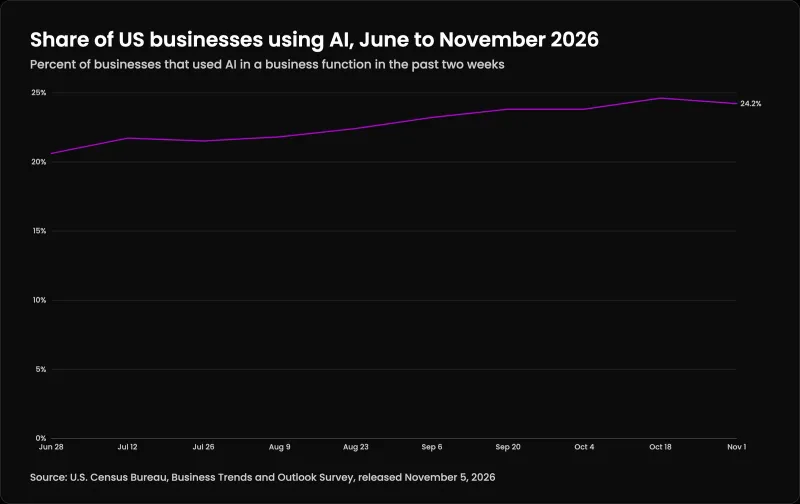
| Survey period ending | US businesses using AI |
|---|---|
| Jun 28 | 20.6% |
| Jul 12 | 21.7% |
| Jul 26 | 21.5% |
| Aug 9 | 21.8% |
| Aug 23 | 22.4% |
| Sep 6 | 23.2% |
| Sep 20 | 23.8% |
| Oct 4 | 23.8% |
| Oct 18 | 24.6% |
| Nov 1 | 24.2% |
On people, schools awarded 55,152 accounting bachelor's and master's degrees in the 2023 to 2024 academic year, down 6.6% from the year before, according to the AICPA's 2025 Trends report. (Journal of Accountancy, October 27, 2025; Accounting Today, October 27, 2025) Enrollment in accounting programs did rise about 12% over the 2024 to 2025 school year, by National Student Clearinghouse counts, so the pipeline may be turning, but slowly.
Massachusetts has its own version of the CPA staffing shortage on the record. The Senate's fact sheet for S.2946, a bill to add experience-based routes to the CPA license, cites testimony about "a growing demand for CPA services at a time when the supply of CPAs has been shrinking." (Massachusetts Senate fact sheet, February 5, 2026) The Senate passed it 37 to 0 on February 12, 2026, and it was referred to House Ways and Means on February 17. (Massachusetts Legislature, bill S.2946)
Put those side by side. The work is not shrinking, and the bench is thin. The practical case for AI for accounting firms is giving the people you have more hours for the work only they can do. We wrote about that pressure in how automation helps short-staffed Massachusetts businesses.
What do the FTC Safeguards Rule and IRS Publication 4557 expect from AI for accounting firms?
No new AI rule is needed for this. The obligations already on your desk cover it.

Under federal rules, "an accountant or other tax preparation service that is in the business of completing income tax returns" is a financial institution. (16 CFR 314.2(h)(2)(viii), via Cornell LII) The IRS puts it plainly: under the GLBA and the Safeguards Rule, "tax and accounting professionals are considered financial institutions, regardless of size," and a requirement of the rule "is implementing and maintaining a WISP," a written information security plan. (IRS Publication 5708, Rev. 8-2024)
IRS Publication 4557, Safeguarding Taxpayer Data (Rev. 6-2024), lists what the plan has to do, including: designate a qualified individual to run the program, implement multi-factor authentication "for anyone accessing customer information on your system," and "select service providers that can maintain appropriate safeguards, make sure your contract requires them to maintain safeguards, and oversee their handling of customer information." (IRS Publication 4557, Rev. 6-2024)
If your firm does not have that plan written yet, start there. Our guide to the security plan for tax and bookkeeping offices walks through it, and Amelia, our CEO, covers the state side in Massachusetts WISP requirements under 201 CMR 17 (opens in a new tab).
Your AI provider is a service provider
This is the line that matters most. The Safeguards Rule tells you to oversee service providers by "requiring your service providers by contract to implement and maintain such safeguards" and by "periodically assessing your service providers based on the risk they present." (16 CFR 314.4(f), via Cornell LII) The FTC's own guide adds that "your contracts must spell out your security expectations." (FTC, FTC Safeguards Rule: What Your Business Needs to Know)
In AI for accounting firms, the model provider that reads client files is a service provider. A free personal chat account has no contract you negotiated. That alone answers most questions about where client data can go.
The provider's promises count too. The FTC's technology office has said model-as-a-service companies have a "continuous appetite for data," that a company which breaks a promise not to use customer data "to train or update their models" may be liable under the laws the FTC enforces, and that "there is no AI exemption from the laws on the books." (FTC Office of Technology, January 9, 2024) Get the training answer in writing and reread the terms each year.
Return information has its own rule
Section 7216 of the tax code makes it a misdemeanor for a preparer to knowingly or recklessly disclose return information, or use it for anything other than preparing a return. (26 U.S.C. 7216, via Cornell LII) The regulations allow some disclosures to other preparers in the United States for "auxiliary services in connection with the preparation of any tax return," and require the taxpayer's consent for others. (26 CFR 301.7216-2(d), via Cornell LII) Where a given AI tool fits in that scheme is a question for your own tax counsel before you send it a return.
Massachusetts adds 201 CMR 17
If you hold personal information about Massachusetts residents, 201 CMR 17.03 requires a comprehensive information security program and, separately, "taking reasonable steps to select and retain third-party service providers" that can protect it, with the safeguards required "by contract." (201 CMR 17.03, via Cornell LII) Same idea as the federal rule, and the AI sits inside both. MyRHC's Massachusetts reference (opens in a new tab) collects the state rules in one place.
How do you start AI for accounting firms without breaking your security plan?
One workflow, written down, measured. Then the next.
A six step start on AI for accounting firms
- Pick one workflow. Frequent, rule based and easy to check: document intake, missing document reminders, or reconciliation exception lists. Time it today with a stopwatch on ten real files, so you can tell in April whether the AI helped.
- Add the AI to the written information security plan. Name the tool, what data goes in, who may use it, and who your qualified individual is for it. Two paragraphs is enough to start.
- Write the firm's AI policy. Which tools are approved, what data never goes into a personal account, and what every output needs before it leaves. The AICPA published a small-firm generative AI policy template in April 2026 noting that "generative AI has the potential to improve efficiencies with routine tasks." (AICPA, April 29, 2026) Amelia's guide to building an AI policy for your team (opens in a new tab) is a good companion.
- Sign the contract before the data moves. Training, retention, access and location in writing, plus the safeguards the Safeguards Rule asks you to require.
- Set the approval rule. Name who approves each kind of output. Reminders might go to the admin lead; anything with a number a client will rely on goes to a preparer or the bookkeeper of record.
- Keep the record. Which tool ran, on which client, what it produced, who approved it and when. That record is what oversight looks like on paper.
Scope matters in AI for accounting firms, too. An assistant that can open every client folder for every user is a bigger risk than one scoped to the files a task needs. Our least privilege playbook for AI agents is the checklist.
A hypothetical start: a six-person tax and bookkeeping practice in Southborough might start with intake in January. The AI reads each upload, labels it, compares it with last year's documents and drafts a reminder for anything missing. The office manager approves the reminders each morning. In May, the firm compares hours spent on intake with last season and decides whether reconciliation prep comes next.
Why do AI quality checks matter so much in accounting?
Because a model can be confidently wrong, and a wrong number on a return or a reconciliation looks exactly like a right one.

NIST calls this confabulation: "the production of confidently stated but erroneous or false content (known colloquially as 'hallucinations' or 'fabrications') by which users may be misled or deceived." (NIST AI 600-1, Generative AI Profile, July 2024) The profession's own guidance keeps the responsibility with people. The AICPA's October 2026 guidance on AI in audits says "auditors remain responsible for appropriate supervision, review and audit conclusions." (AICPA, October 13, 2026) The same logic applies in a small tax and bookkeeping office.
The AI quality checks that matter in AI for accounting firms are mostly arithmetic and comparison, which is good news, because a computer can run them before a person ever looks:
- Totals tie. Extracted W-2 boxes add up, and the reconciliation balances to the statement.
- Numbers trace. Every figure in a draft points back to the document and page it came from.
- Year over year. A large swing from last year gets flagged, not smoothed over.
- Nothing sends itself. Each output waits for a named person's approval.
Our note on AI quality gates that stop bad output explains how to build these, and the knowledge base page on AI quality gates has the short version.
How should a firm judge AI tools?
Most pitches for AI for accounting firms lead with a feature list. Skip it and ask every vendor the same questions:
- Will training, retention, access and location go in the contract, along with the safeguards your plan requires of service providers?
- Is multi-factor authentication required for everyone who can reach client data?
- Can you limit which clients each user and each AI agent can see?
- Does every output go to a person for approval, and can you set who approves what?
- Is there an exportable record of inputs, outputs and approvals?
- If you leave, do your data, templates and history leave with you?
The last one is about ownership, and it is easy to skip when a demo looks good. Our page on whether to own or rent your AI lays out that tradeoff.
I am not going to print a price range, because I could not find a neutral, reputable source for one that holds for a small Massachusetts practice. What drives the cost of AI for accounting firms is the number of users, which workflows you automate, whether the AI runs on shared or dedicated infrastructure, and how much it has to connect to your tax and ledger software. Kief Studio prices custom work around the use case, the size of the firm, its needs and the systems it already runs.
Frequently asked questions
Is AI going to replace accounting firms?
The Bureau of Labor Statistics projects employment of accountants and auditors to grow 5% from 2025 to 2035, with about 115,300 openings a year, and says some routine accounting tasks may be automated but that this is "not expected to reduce overall demand." (BLS Occupational Outlook Handbook) In practice, AI for accounting firms takes over parts of the work, such as intake and first drafts, and people keep the judgment and the signature.
Why are so many CPAs quitting?
The numbers point less to quitting than to fewer people arriving: accounting degrees fell 6.6% in 2023 to 2024 (Journal of Accountancy, October 27, 2025), and Massachusetts lawmakers have heard testimony that the supply of CPAs is shrinking (Massachusetts Senate fact sheet, February 5, 2026). Long tax season hours are the part of the job AI can most directly shorten.
Can ChatGPT do my bookkeeping?
A general chat assistant can explain entries and suggest categories, but it should not hold your client's bank data on a personal account, and a person still has to approve and close the books. I wrote more on whether AI can do bookkeeping for a small business (opens in a new tab) on my own site.
Can a tax preparer put client data into ChatGPT?
Not into a personal account. Client data goes only into a tool your firm has approved, with a contract that covers safeguards and training, listed in your written plan, and with Section 7216 reviewed by your tax counsel. My note on whether staff can put customer data into AI tools (opens in a new tab) compares what business plans promise.
What should an accounting firm automate first?
The safest first step in AI for accounting firms is client document intake or missing document reminders. Both are frequent, easy to check and low risk, and the time saved shows up in the first season.
Does the FTC Safeguards Rule apply to a small firm?
Yes. The IRS says tax and accounting professionals are covered "regardless of size." Firms that hold customer information on fewer than 5,000 consumers are excused from a few parts, including the written risk assessment, but not from the plan itself. (16 CFR 314.6, via Cornell LII)
What are the largest accounting firms in Boston?
Business journals publish ranked lists by revenue and headcount each year. This note is written for the smaller practice, where decisions about AI for accounting firms rest with the owner who also signs the security plan.
This article is general information, not legal or tax advice. Rules and guidance change, so check the current text and talk with your own counsel about your firm.
Where we fit
AI implementation is taking an AI idea out of the demo and into daily work, where input is messy, services fail, and a person checks the cases the model is unsure about. Tax season intake is a good example of messy input, and a sensible starting point for AI for accounting firms. That work sits in our automate line.
Our AI automation work follows the steps above: pick the workflow, define what good output looks like and measure how it runs today; build it with retries, error handling and quality gates on every output; keep a human path for anything the model is unsure about; then run it for you and report what it handled and what it sent to a person. We do not build projects meant to replace staff. Your people drive the work.
We run it on LTFI (opens in a new tab), a private system Kief Studio hosts and runs where AI drafts the work and a person approves it. It works with any model provider, so the choice of AI stays yours, and nothing is installed on your side. We are in Shrewsbury and work with firms across Massachusetts, including Southborough, Burlington and Sturbridge.
First conversation is free. No commitment.
Tell us which tax season chore you want off your staff first
Co-founder and CTO, Kief Studio