


Brian GagneCo-founder and CTO, Kief Studio
- Published
- Updated
- 13 min read

TL;DR: AI for real estate is legal for Massachusetts agents, and the state's own continuing education catalog teaches it. The rules that decide how you use it are older than the tools: fair housing advertising law, the ban on misleading ads, all-party recording consent and consent for AI voice calls. Let AI draft. A person approves.
AI for real estate gets sold to agents as an assistant who never sleeps. Mostly true. What the demo skips is that every listing description, follow-up text and staged photo goes out under your broker's name, and Massachusetts already has rules for all three.
So here is the order: where the hours come back, the rules that decide how the tool can be used, then a one page brokerage AI policy and the questions to ask any vendor. Rules first, because they are cheaper to read now than to learn from a complaint.
Where does AI for real estate save an agent real hours?
Agents are already using it, and the uses are not exotic. In the National Association of Realtors' 2026 technology survey, 23% of agents said they use AI daily and 25% weekly. Among agents who use AI, the top jobs were writing listing descriptions (75%), social media posts (56%), emails and follow-up (52%) and market summaries (30%). (National Association of Realtors, September 22, 2026)
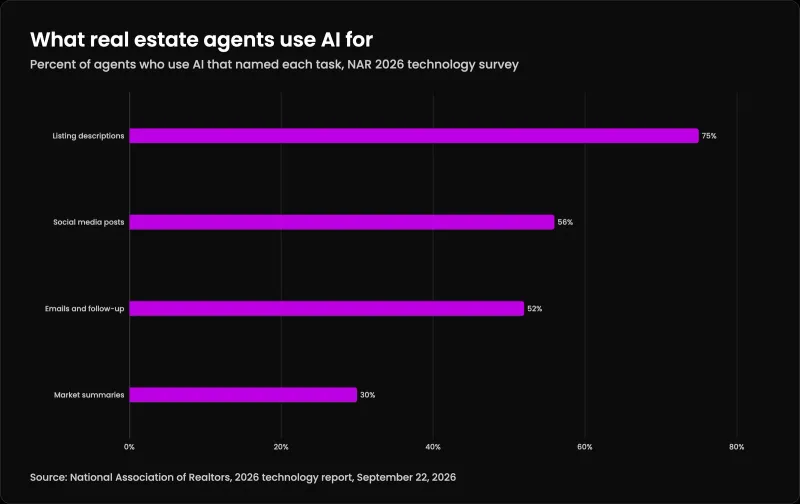
| Task | Agents who use AI |
|---|---|
| Listing descriptions | 75% |
| Social media posts | 56% |
| Emails and follow-up | 52% |
| Market summaries | 30% |

Each job below produces a draft for you to approve, not something that sends itself.
AI listing descriptions
Give the model the facts sheet, the room list and your walkthrough notes, and ask for three versions. You pick one, fix what it got wrong and check every number against the facts sheet. The first draft is the slow part; editing is fast.
The catch is accuracy. NIST's generative AI profile calls the failure mode confabulation: "the production of confidently stated but erroneous or false content." (NIST AI 600-1, July 2024) A model that adds a finished basement or a third bathroom sounds exactly as confident as one that gets it right.
Lead follow-up
Leads go quiet when nobody answers on Saturday night. AI for real estate is good at lead follow-up drafts: a reply to a portal inquiry that answers the actual question, a check-in after an open house, a note to a past client on their closing anniversary. Your real estate CRM holds the history, the AI writes the first version, and you approve and send. Our note on what an AI receptionist can and cannot do for a local business covers the inbound side.
Showing logistics
Confirming times with sellers, sending buyers the route and access notes, asking for feedback afterward. A model drafts the batch from your calendar, and you look it over before it goes.
Market summaries
A monthly note for a seller or a farm area, built from the comps you pulled. The AI writes it; you own the numbers and the opinion.
Is it legal for Realtors to use AI in Massachusetts?
Yes. Massachusetts treats AI for real estate work as a professional skill, not a forbidden one. The Board of Registration of Real Estate Brokers and Salespersons lists an approved continuing education course, RE118RC25, "AI Essentials for Real Estate Professionals." Its outline is blunt about the limits: "Always disclose AI use where required" and "Human oversight is essential; AI does not replace fiduciary duty." (Mass.gov, RE118RC25 course listing)
California's Department of Real Estate put it more sharply in March 2026: "failure to review AI output could subject a real estate licensee to disciplinary action for breaching fiduciary duties." (California Department of Real Estate, March 17, 2026) Another state, same logic: the license is yours, so the output is yours.
The FTC said it plainly when it announced its crackdown on deceptive AI claims: "there is no AI exemption from the laws on the books." (FTC, September 25, 2024) Realtors also answer to Article 12 of the NAR Code of Ethics, which requires "a true picture" in advertising, and Standard of Practice 12-10, which bars "misleading images." (NAR Code of Ethics, effective January 1, 2026)
So the legal question is not whether you may use AI for real estate. It is whether what it produced, once you send it, follows the rules you already work under.
What do fair housing advertising rules mean for AI listing copy?
This is the rule most likely to catch AI for real estate copy, because models write the way people talk about homes, and people talk about homes in ways the law does not allow in an ad.
Federal law makes it unlawful to publish any "notice, statement, or advertisement, with respect to the sale or rental of a dwelling" that indicates a preference, limitation or discrimination based on race, color, religion, sex, handicap, familial status or national origin. (42 U.S.C. 3604(c), via Cornell LII) HUD's regulation says that includes "words, phrases, photographs, illustrations, symbols or forms" that convey a home is or is not available to a particular group. (24 CFR 100.75, via Cornell LII)
Massachusetts goes further. Chapter 151B adds, among others, gender identity, sexual orientation, genetic information, ancestry, children, marital status and "public assistance recipiency" to the list for covered housing ads. (M.G.L. c.151B, s.4(7B)) And the board's own rules say a broker may not advertise "in any way that is false or misleading," or "in any manner that indicates directly or indirectly unlawful discrimination." (254 CMR 3.00(9), via Cornell LII)
One update: HUD's April 2024 guidance on fair housing advertising through digital platforms was withdrawn effective September 17, 2025. The withdrawal notice still says "any actions that do not comply with the text of the Fair Housing Act continue to be subject to enforcement." (Federal Register, April 6, 2026) The guidance went away. The statute did not.
A fair housing read for every AI for real estate draft
Describe the property, not the people who should live there. Before any AI listing description goes out, someone reads it for these:
- Who it is "perfect for." "Perfect for a young family," "ideal for empty nesters," "great bachelor pad." Swap it for what the home has: three bedrooms on one floor, a fenced yard, single-level living.
- Neighborhood character. Words about who lives nearby, or the area's religious or ethnic makeup. Stick to distances and facts: the library, the commuter rail stop, the conservation land.
- Ability language. "Must be able to climb stairs." Describe the stairs instead.
- Payment source. Anything that hints a voucher holder is unwelcome in a rental ad. In Massachusetts that is its own protected category.
A model can run this check as a first pass and flag phrases for a person, but it should never be the only reader. Our note on AI quality gates that stop bad output explains how to build the check so a flagged draft cannot go out by accident.
Does AI virtual staging have to be disclosed?
In California, yes, by statute. Its Department of Real Estate says the law now "requires a clear disclosure when images have been digitally modified in a way that changes the appearance of the property," and that "licensees must also make the original, unaltered image available to consumers." (California Department of Real Estate, March 17, 2026)

Massachusetts reaches a similar place by a different road. What applies here is the broker advertising rule against anything "false or misleading," and, for Realtors, the true picture standard and its ban on "misleading images." A virtually staged living room is fine. A virtually removed power line, a repainted water stain or a lawn that is not there is a misleading ad, whatever tool made it.
Photos are where AI for real estate is easiest to overdo. The practical AI virtual staging disclosure policy is short:
- Label every staged or altered photo on or beside the image, in plain words: "Virtually staged."
- Keep the original photo in the listing or one click away.
- Stage furniture and decor only. Never change walls, floors, fixtures, views, damage or anything that conveys with the house.
- Check your MLS rules, which can be stricter than the law.
Can AI call, text or record your clients?
This is where lead follow-up tools need the most care, because two different laws apply.
Massachusetts recording consent
Massachusetts is an all-party state. The wiretap statute covers secretly recording a conversation by anyone other than "a person given prior authority by all parties to such communication," with penalties up to a $10,000 fine and five years in state prison. (M.G.L. c.272, s.99) An AI note taker on a buyer consultation records the call, so everyone on it has to know. I wrote more about whether an AI note taker is legal in Massachusetts (opens in a new tab) on my own site.
AI voice calls need consent
The FCC ruled in February 2024 that the federal robocall law's limits on "artificial or prerecorded voice" calls cover AI voices, so "callers must obtain prior express consent from the called party" first. (FCC Declaratory Ruling FCC 24-17, February 8, 2024) An AI voice calling your old open house sign-in list is exactly that call. Emails and texts drafted by AI for real estate follow-up, then sent by you to people who asked to hear from you, are a much smaller question.
Reviews are advertising too
The FTC's fake reviews rule covers reviews that "misrepresent that they are by someone who does not exist, such as AI-generated fake reviews." (FTC, August 14, 2024; 16 CFR 465.2, via Cornell LII) Let AI draft the request to a past client, never the review. I covered whether it is legal to ask customers for Google reviews (opens in a new tab) separately.
What should a brokerage AI policy say?
A brokerage AI policy fits on one page. If it runs longer, nobody reads it. Here is what I would put on it:

- Approved tools. Name them. A free personal chat account is not on the list for anything with client information in it.
- What never goes in. Social Security numbers, bank statements, pre-approval letters, lockbox codes, alarm codes. If a draft needs a private detail, a person adds it after.
- AI drafts with approval. Every listing description, ad, mass email and market summary is approved by a named person before it goes out. Write down who approves what.
- Ad checks. Every ad gets the fair housing read above. Every altered photo gets a label and keeps its original.
- Calls and recording. Tell everyone before a call is recorded or transcribed. No AI voice calls without prior express consent.
- Vendor contracts. Massachusetts requires businesses that hold residents' personal information to take "reasonable steps to select and retain third-party service providers" that can protect it, and to require those safeguards "by contract." (201 CMR 17.03, via Cornell LII) An AI vendor that reads your client files is a service provider.
- A record. Which tool produced it, who approved it and when.
My partner Amelia wrote about building an AI policy for your team before you need one (opens in a new tab). Our least privilege playbook for AI agents covers why an assistant should see only the files a task needs, and the AI agent governance guide has the short version.
A hypothetical start: a small brokerage in Wayland might begin AI for real estate with listing descriptions only. For a month, the AI drafts each one from the facts sheet, the broker reads it for accuracy and fair housing, and both versions get saved. At the end of the month, the broker counts the edits. If the fixes are getting smaller, follow-up emails come next.
How do you judge AI for real estate tools?
Most pitches for AI for real estate lead with a feature tour. Skip it and ask every vendor the same questions:
- Will training, retention and access to your client data be written into the contract?
- Does every outgoing message wait for a person's approval, and can you set who approves what?
- Can you see a record of what the AI drafted, what changed and who approved it?
- Does it work with the real estate CRM you already use, or does it want to replace it?
- If it places calls or records them, how does it get and log consent?
- If you leave, do your templates, contacts and history leave with you?
Amelia's guide to evaluating AI tools without getting sold (opens in a new tab) goes deeper on the demo questions. And if the CRM itself is the open question, I broke down what a CRM costs a small business (opens in a new tab).
I am not going to print a price range for AI for real estate, because I could not find a neutral, reputable source for one. What drives the cost is the number of agents, which jobs you automate, how many systems it connects to (CRM, email, calendar, listing feeds) and whether it runs on shared or dedicated infrastructure. Kief Studio prices custom work around the use case, the size of the brokerage, its needs and the systems it already runs.
Frequently asked questions
What is the best AI to use for a real estate agent?
The best AI for real estate agents is the one that keeps client data under a contract, waits for your approval before anything goes out, keeps a record, and works with the CRM you already use. The model behind it matters less than those four. Judge tools on them first, then on writing quality with your own listings.
Is it legal for Realtors to use AI?
Yes. Massachusetts approves continuing education on AI for real estate work. The output still has to meet fair housing law, the broker advertising rule against misleading ads, the recording statute and the Realtor Code of Ethics. You remain responsible for what goes out.
Are real estate agents struggling in 2026?
Two numbers give context. In NAR's 2026 buyer and seller profile, first-time buyers rose from a record low 21% of purchases to 22%, and their median age held at a record 40. (NAR, November 5, 2026) The Bureau of Labor Statistics projects 2% job growth for brokers and sales agents from 2025 to 2035. (BLS Occupational Outlook Handbook, updated August 27, 2026)
How much would a real estate agent make on a $300,000 house?
It depends on the commission you negotiate and your split with your brokerage. Broker commissions "are not set by law and are fully negotiable." (NAR, Written Buyer Agreements 101) As arithmetic, each 1% of $300,000 is $3,000 before the brokerage split, fees and expenses.
Does AI virtual staging have to be disclosed?
California requires it by law. In Massachusetts, a staged photo that misleads a buyer breaks the broker advertising rule, and Realtors are bound by the true picture standard. Label every staged image, keep the original available and never alter the property itself.
Can AI write listing descriptions that break fair housing rules?
Yes. A model trained on how people describe homes can write "perfect for a young family" or describe who lives nearby. Federal and Massachusetts law both bar ads that signal a preference about who should live there, so a person reads every AI listing description before it is published.
Do I have to tell clients I use AI for real estate work?
Disclose where a rule requires it, such as a recorded call in Massachusetts or an altered photo, and wherever leaving it out would mislead someone. The state's AI course says the same: disclose where required, and keep a human in charge.
This article is general information, not legal advice. Kief Studio is not a law firm, and reading it does not create an attorney-client relationship. Laws and regulations change, so check the current text and talk with a licensed Massachusetts attorney or your broker's counsel about your situation.
Where we fit
Content operations automation runs the repeatable steps, so your team only handles the decisions that need a person. For an agent, that is the listing description, the follow-up and the monthly summary, with a quality gate and a person's approval on every one. That work sits in our automate line, through content operations automation and AI automation.
The work follows the steps above: write down the standard each output has to meet, automate the repeatable steps, put quality gates on every output and send failures to a person, then report what shipped and what was held back. Your agents drive the work.
We run it on LTFI (opens in a new tab), a private system Kief Studio hosts and runs where AI drafts the work and a person approves it. It works with any model provider, so the choice of AI stays yours, and nothing is installed on your side. We are in Shrewsbury, and this work is open to agents and brokerages across Massachusetts, including Sudbury, Wellesley and Wayland.
First conversation is free. No commitment.
Co-founder and CTO, Kief Studio