
Custom software development is designing, building, testing, and maintaining software for one organization's needs, instead of buying a product made for everyone. It covers customer portals, internal tools, ERPs, integrations, and data systems, and the code is usually owned by the client under a written agreement.

What a custom software development company does and how to choose one
A custom software development company designs, builds, tests, and maintains software made for one client's process, such as a customer portal, an internal tool, an ERP, or an integration. Choose one on evidence: live work you can use, a written scope after discovery, code ownership assigned to you in the contract, clear security practices, and a named team that hosts and patches the software after launch.
What is a custom software development company?
A custom software development company is a firm that designs, builds, tests, and usually maintains software made for one client's needs, instead of selling the same product to everyone. The result might be a customer portal, an internal operations tool, an ERP, a data pipeline, or the integration that makes your existing systems talk to each other.
The people inside it do the work the Bureau of Labor Statistics describes for software developers: they analyze users' needs and then design and develop software to meet those needs, plan how the pieces of a system will work together, and keep a program working through maintenance and testing (BLS Occupational Outlook Handbook, software developers). Quality assurance analysts and testers, a separate BLS occupation, find and report the defects before your customers do.
What does a custom software development company do?
It turns a business process into working software and keeps it running. A good firm spends as much care on the parts around the code (discovery, testing, security, deployment, and hosting) as on the code itself, because that is where most projects succeed or fail after launch.
- Discovery: sitting with the people who do the work and writing down how it really happens.
- Architecture: choosing the data model, the services, and how the system connects to what you already run.
- Design: the screens and flows, tested with real tasks before they are built.
- Build: the code, written in small releases you can try on a staging copy.
- Testing: automated tests, security checks, and accessibility checks before each release.
- Deployment and hosting: a written path to production, backups, and monitoring.
- Maintenance: patches, updates, and the changes you will want once people use it.
The services below are what a full-service firm covers. At Kief Studio they map to our custom web application development, ERP and business systems, API integration, data engineering, cloud infrastructure, and legacy modernization work.
When should you hire a custom software development company instead of buying software?
Hire a custom software development company when the way you work is part of what makes you better, and off-the-shelf tools force you to give that up or to patch it with spreadsheets. Buy when a product already fits most of your process and the rest can be bridged with an integration.
| Custom software | Off-the-shelf software | Low-code tools | |
|---|---|---|---|
| Fits your process | Built around it | You adapt to it | Partly, within the tool's limits |
| Who owns it | You, by written assignment | The vendor | You build on the vendor's platform |
| Up-front cost | Highest | Lowest | Low to moderate |
| Ongoing cost | Hosting, care, and changes | Subscriptions that rise with seats | Platform fees plus your time |
| Leaving later | Take the code and data | Depends on export options | Often a rebuild |
| Best for | Work that sets you apart | Common tasks done the common way | Simple internal workflows |
Cost over time matters more than cost on day one. The comparison of custom software cost versus SaaS on ameliasgagne.com works through the math, and briansgagne.com argues that build versus buy is often the wrong question. Our note on bespoke versus off-the-shelf software and the entry on vendor lock-in cover the risks on each side.
What is the custom software development process?
Most firms follow a version of the software development life cycle: plan, gather requirements, design, build, test, deploy, and maintain. What separates good firms is how often you see working software along the way. The U.S. Digital Services Playbook asks for agile and iterative practices and contracts that request frequent deliverables, not multi-month milestones (U.S. Digital Services Playbook).
| Phase | What happens | What you should receive |
|---|---|---|
| Discovery | Interviews, process mapping, data review | A written scope and a first-release plan |
| Design | Screens, flows, data model, architecture | Clickable designs and a short technical plan |
| Build | Code in small releases on a staging copy | Working software you can try every few weeks |
| Test | Automated tests, security and accessibility checks | Test results and a list of known issues |
| Deploy | Data migration, accounts, go-live | A live system, backups, and a rollback plan |
| Maintain | Patches, monitoring, changes | A written support agreement and change log |
Security has to live inside those steps. NIST notes that few software development life cycle models explicitly address software security in detail, and its Secure Software Development Framework, SP 800-218, gives a core set of practices that can be integrated into each one (NIST SP 800-218). Ask any custom software development company which of those practices it follows and how it shows you the evidence.
How do you choose a custom software development company?
Choose the firm whose answers you can verify. Live work you can click through, references who describe life after launch, a written scope before a total, code ownership in the contract, and a named person accountable for security tell you more than awards or a polished pitch.
| What to check | What to ask | Evidence to see |
|---|---|---|
| Relevant work | What have you built that is like this? | Live software you can use, not screenshots |
| Discovery | How will you learn our process? | A sample scope document from a past project |
| Delivery | How often will we see working software? | A release plan with dates |
| Quality | How do you test before release? | Automated tests running on every change |
| Security | Who is accountable for security, and how? | Answers to CISA's buyer questions |
| Ownership | Who owns the code and the accounts? | Assignment language in the contract |
| After launch | Who hosts, patches, and monitors it? | A written support agreement |
| Exit | What do we receive if we leave? | Code, data export, credentials, documentation |
CISA's Secure by Demand guide is written for exactly this moment: it lays out questions organizations buying software can use to understand a software manufacturer's approach to cybersecurity, and it suggests asking them before procurement (CISA, Secure by Demand Guide). The guide for vendors behind it names three principles: take ownership of customer security outcomes, embrace radical transparency and accountability, and build organizational structure and leadership to achieve these goals.
For a broader vendor checklist, the guide to evaluating a technology vendor on ameliasgagne.com is a good companion, and our guide to hiring a web developer covers contracts and red flags in detail.
How do you check a development company's security practices?
Ask how their process handles the most common web application risks, and ask to see it. The OWASP Top 10, a standard awareness document for developers and web application security, lists broken access control, security misconfiguration, and software supply chain failures as the top three risks in its 2025 edition (OWASP Top 10:2025).
Good answers sound specific: access checks on every request, hardened server baselines, pinned and scanned dependencies, logging that someone actually reads, and tests that run on every change. Supply chain risk is covered in our entry on software supply chain security, and the LTFI page on test automation shows how we write tests alongside the code. Before launch we offer security architecture review and authorized penetration testing.
What are the advantages of an onshore, US-based development company?
An onshore company is based in the same country as you; nearshore usually means a nearby country in a similar time zone; offshore means farther away. Capable teams work in all three. The practical advantages of a US-based custom software development company for a US business are overlapping working hours, contracts under US law, and familiarity with US and state rules on data.
The data point is concrete in Massachusetts. 201 CMR 17.00 establishes minimum standards to be met by persons who own or license personal information about a resident of the Commonwealth (Mass.gov, 201 CMR 17.00), so ask any firm you consider how its process handles that rule. Discovery also goes faster when the people who do the work can meet the people who build the software.
If you are an agency buying development to deliver under your own name, our white-label development service and the guide to outsourcing web development cover how that works with a US-based team.
How much does custom software development cost?
It depends on scope, because the cost is mostly skilled time: the number of users and roles, the business rules, the integrations, the data to migrate, the security and compliance needs, and the support after launch. A custom software development company should give you a written number for a defined first release only after discovery, with a list of what it excludes.
Wages show why that time is expensive. BLS reports May 2025 median annual wages of $135,980 for software developers and $104,300 for software quality assurance analysts and testers, against $50,980 for all workers (BLS Occupational Outlook Handbook, software developers). Those are wages, not prices, but every project buys a mix of that time. Our guides to what a custom website costs and custom web application cost in Central Massachusetts break down the drivers.
Who owns the software a custom software development company builds?
The firm does, unless the contract transfers it to you in writing. Copyright vests initially in the author, and a transfer of ownership is not valid unless it is in writing and signed by the owner of the rights conveyed (17 U.S.C. chapter 2). Computer programs are not among the nine categories of commissioned work that a signed agreement can make a work for hire (U.S. Copyright Office, Circular 30), so ask for an assignment.
The federal playbook sets the bar buyers should copy: maintain contractual rights to all custom software developed by third parties, and to all data developed by third parties (U.S. Digital Services Playbook). Our guide to who owns the website and the login covers the accounts side. This is general information, not legal advice.
How are custom software development companies using AI?
Many now use AI coding tools to draft code, tests, and documentation faster, and the good ones keep a person accountable for every change. A useful pattern is spec-driven development: you write down what to build and why, and the tool's output is checked against that written spec, which stays the source of truth (Qurtoo, spec-driven development).
Demand for the people who review that work is still rising. BLS projects employment of software developers to grow 10 percent from 2025 to 2035, against 6 percent for computer occupations and 3 percent for all occupations, with demand driven partly by software development for AI, the Internet of Things, and robotics (BLS Occupational Outlook Handbook, software developers). Software quality assurance analysts and testers are projected to grow 6 percent.
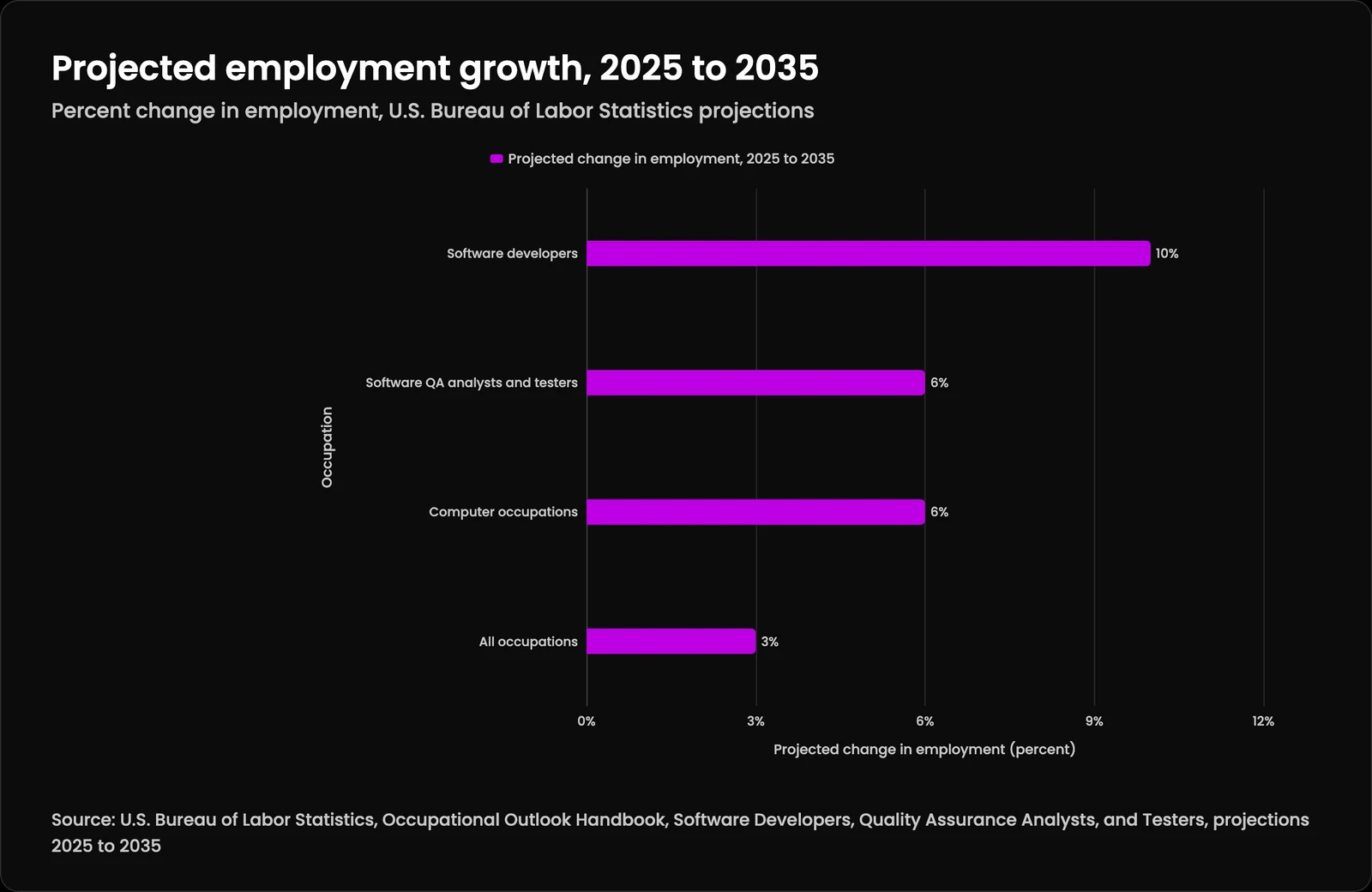
| Occupation | Projected change in employment, 2025 to 2035 |
|---|---|
| Software developers | 10% |
| Software QA analysts and testers | 6% |
| Computer occupations | 6% |
| All occupations | 3% |
What happens after custom software launches?
The software starts its longest phase: running. It needs security patches, dependency updates, backups, monitoring, and the changes your team asks for once they use it every day. Ask who does that, under what agreement, and how a change reaches production without breaking what works.
We host and run what we build on managed hosting on LTFI, on dedicated infrastructure, with website operations for the public pages around it. No shared hosting. Dedicated infrastructure. Our note on how to replace old business software without downtime covers what happens when an older system finally has to go.
How does Kief Studio work as a custom software development company?
We are a technology studio in Shrewsbury, Massachusetts, working with businesses across Worcester County and the rest of the state, and with agencies through white-label work. We write custom code in TypeScript, Python, and Rust, start every project with discovery, put the code, data, and accounts in your name, and host what we build so you never install or maintain anything. Founded 2022. Operating together since 2012. 13+ year client relationships. 121 million records indexed with sub-second search.
Also read
What a custom software development company does and how to choose one: questions people ask
What is custom software development?
What is a custom software development company?
A custom software development company is a firm that builds software to one client's specification and usually tests, hosts, and maintains it after launch. It brings discovery, design, development, quality assurance, security, and deployment skills together, so the client gets working software without hiring a whole team.How much does it cost to develop custom software?
It depends on scope: users and roles, business rules, integrations, data migration, security needs, and support after launch. The cost is mostly skilled time. A good firm gives you a written number for a defined first release after discovery, with a clear list of what is excluded.What are the 7 steps of SDLC?
A common list of the seven steps of the software development life cycle is planning, requirements, design, development, testing, deployment, and maintenance. Firms name and group them differently. What matters more is how often you see working software and where security checks happen in each step.What is an example of custom software?
A customer portal where clients upload documents, track job status, and approve quotes is a common example. Others are an internal scheduling tool that replaces spreadsheets, an ERP built around how a manufacturer actually runs, and an integration that keeps orders and accounting in sync.What is the difference between onshore and offshore?
Onshore means the development team is in your own country; offshore means it is in a distant country, often in a very different time zone; nearshore sits in between. Capable teams work in all three. The real differences are working-hour overlap, contract law, and data rules.How do you choose a software development company?
Look for live work you can use, references who describe life after launch, a written scope before a total, code ownership in the contract, clear answers to CISA's buyer security questions, and a named person who hosts and patches the software. Compare written answers, not sales calls.What does "off-the-shelf solution" mean?
An off-the-shelf solution is ready-made software sold to many customers, such as an accounting package or a scheduling app. You configure it rather than build it. It is quick to start and maintained by the vendor, but your process has to fit the product.Why is customized software developed?
Customized software is developed when a business process is unusual enough that ready-made products force workarounds, when several systems need to share data, or when owning the code and data matters more than a quick start. It is also built to replace legacy systems that nobody can safely change.Is custom software worth it?
It is worth it when the software supports work that sets you apart, when subscriptions and workarounds cost more each year than building would, or when you need to own your data. It is not worth it for common tasks a good product already handles well.What is a custom software developer?
A custom software developer writes software for a specific client or employer rather than for a mass-market product. BLS describes software developers as people who analyze users' needs and then design and develop software to meet those needs.How can I develop my own custom software?
Write down the process the software must handle, who uses it, and what data it stores, then prototype the simplest version with low-code or AI tools. Bring in a developer once it needs sign-in, permissions, customer data, or integrations, because security and upkeep become the hard part.Is custom software cheaper than SaaS?
Sometimes, over several years. SaaS costs less on day one, but subscriptions rise with seats and price changes, while custom software costs more up front and then mainly hosting and changes. The comparison of custom software cost versus SaaS on ameliasgagne.com walks through the math.
Keep reading
More in Build
- ERP Systems
Your business runs on a dozen disconnected tools. An ERP connects them.
- API Integration
Your tools already know how to talk to each other. They just need someone to make the introduction.
- Legacy Modernization
Upgrade outdated systems without losing your data or your mind.