
Define what the site must do, choose a partner that has built similar work, and get a written scope and contract before work starts. The contract should assign the code to you, keep accounts in your name, set security terms, and explain handover. Review progress on a staging site as the build moves.

How to outsource web development and keep control
To outsource web development is to hire an outside studio, freelancer, or partner to plan, build, and often host your website or web app instead of employing developers yourself. It works best when you keep ownership of the code, domain, and accounts in writing, agree security terms in the contract, and choose a partner whose working hours, language, and law match yours.
What does it mean to outsource web development?
It means another company or person does the build while you keep the business decisions. When you outsource web development, the partner may handle design, code, testing, hosting, and care after launch, or only one of those. You still decide what the site must do, approve the work, and own the result.
It is a common way to buy this skill. The U.S. Bureau of Labor Statistics counts 87,400 web developer jobs in 2025 and lists the largest employers: computer systems design and related services firms at 21 percent, self-employed workers at 18 percent, the information industry at 11 percent, educational services at 10 percent, and consulting services at 6 percent. A large share of the people who build websites already work for studios or for themselves rather than inside the businesses they serve.
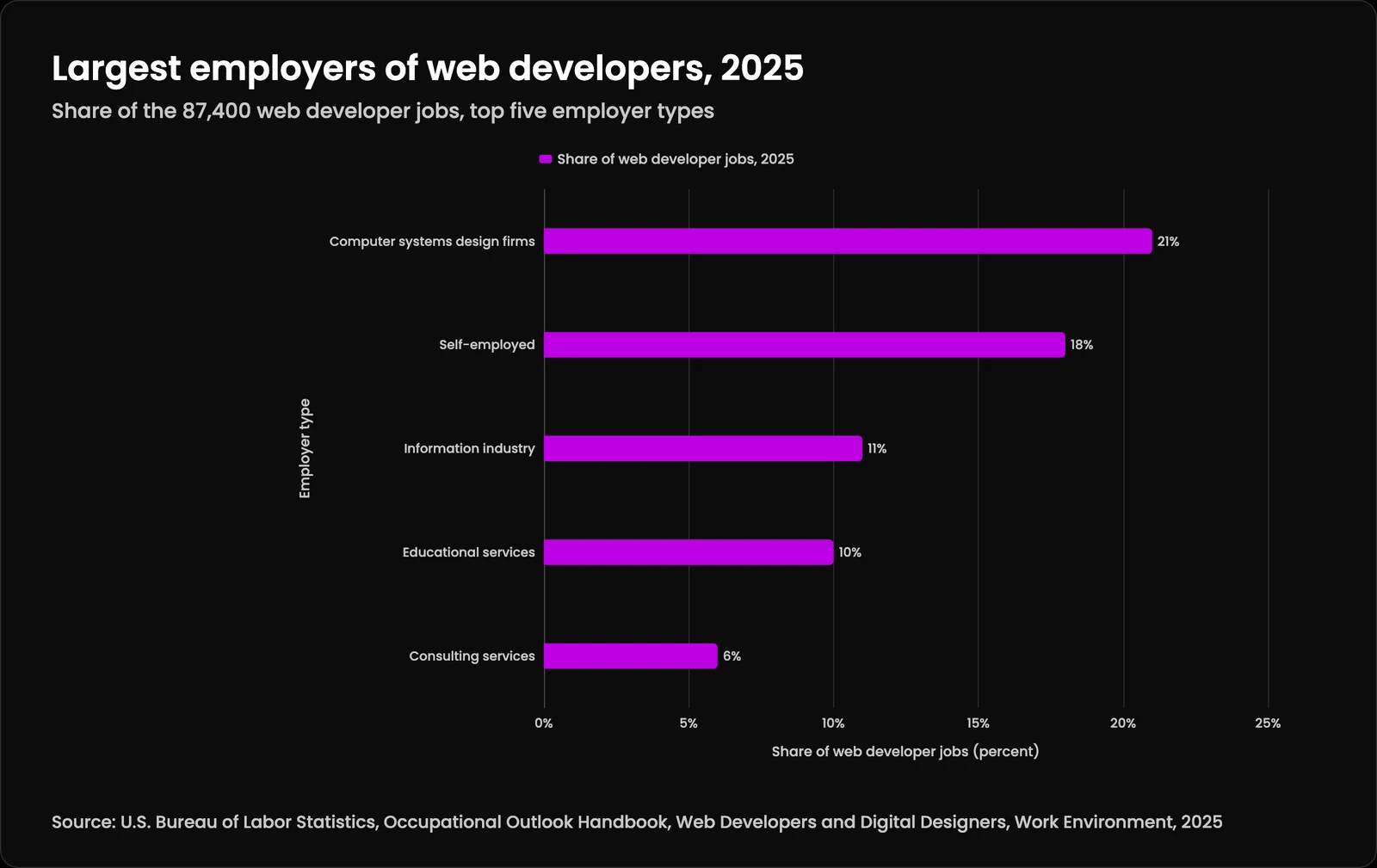
| Employer type | Share of web developer jobs, 2025 |
|---|---|
| Computer systems design firms | 21% |
| Self-employed | 18% |
| Information industry | 11% |
| Educational services | 10% |
| Consulting services | 6% |
Who can you outsource web development to?
Three kinds of partner cover most projects: a freelancer, a studio or agency, or a white-label partner working behind another agency. Each fits a different size of job and a different appetite for management. The right way to outsource web development depends on how much of the work you want to hand off and how much continuity you need after launch.
| Option | Fits best | Watch for |
|---|---|---|
| Freelancer | A defined, smaller build with a clear brief | Continuity if that one person becomes unavailable; who hosts and patches it |
| Studio or agency | Design, build, hosting, and care from one team | Whether the people who sell the work also build it |
| White-label partner | Agencies that sell builds under their own brand | NDA, non-solicitation, and who supports the end client |
| In-house hire | Steady, ongoing development work for years | Recruiting time, salary, tools, and coverage for leave |
Should you outsource web development or hire in-house?
Outsource web development when the work comes in projects and bursts; hire when you have a steady backlog for years. A single in-house developer is also a single point of failure, and one person rarely covers design, front end, back end, hosting, and security equally well.
Hiring has real costs before the first line of code. BLS reports a May 2025 median annual wage of $92,650 for web developers, and an employer also pays benefits, tools, and management time on top of the wage. BLS projects about 13,600 openings a year for web developers and digital designers through 2035, so good people are in steady demand. Notes on ameliasgagne.com about what to outsource and what to keep in-house offer a knowledge test for the decision, and a briansgagne.com piece argues that build vs buy is often the wrong question.
Why outsource web development to a US-based studio?
Mostly for overlap: working hours, language, and law. A US-based partner works the same business day as you, can join a call when a launch goes sideways, signs contracts under US law, and is reachable in the courts you already know. For regulated work, it is also simpler to show where your data lives and who touched it.
Onshore means the partner is in your own country; nearshore means a nearby country with similar hours; offshore means a distant one. Every model can produce good work. The questions that matter are the same everywhere: who writes the code, who can see your data, and whether the contract gives you the code and the keys. We work from Shrewsbury, Massachusetts, on Eastern Time, for clients across the US.
Who owns the code when you outsource web development?
The person who wrote it, until a signed document says otherwise. Under the US Copyright Act, a "work made for hire" made by a contractor covers only specific listed categories of commissioned work, and only with a signed written agreement. Website code is not clearly one of those categories, so the safer path is a written assignment.
That assignment must be in writing: 17 U.S.C. 204(a) says a transfer of copyright ownership is not valid unless it is in writing and signed by the owner of the rights. Ask for the code, designs, and content to be assigned to your company, and for the repository, domain, hosting, and every admin login to be in your company's name from day one. Our guide to who owns the website and login covers the accounts, and who owns the source code when you hire a developer on ameliasgagne.com covers the clause in detail.
What should a contract say when you outsource web development?
It should say who owns what, who protects what, and how you leave. A clear scope and a payment schedule are the start, not the whole contract.
| Clause | What to ask for | Why it matters |
|---|---|---|
| Scope and acceptance | Written features, targets, and how work is accepted | Prevents arguments about what done means |
| IP assignment | Code, design, and content assigned to your company in writing | 17 U.S.C. 204(a) requires a signed writing |
| Accounts | Repository, domain, hosting, and admin logins in your name | You can change partners without asking permission |
| Confidentiality (NDA) | Mutual NDA covering your data, plans, and clients | Protects what you share during discovery and build |
| Security | Named practices, patching, access control, breach notice | FTC guidance and 201 CMR 17.03 expect it in writing |
| Subcontracting | Who else may touch the code, and with your approval | You know every party in your supply chain |
| Exit and handover | Documentation, credentials, and transition help | Leaving should cost time, not the site |
Security belongs in writing too. The FTC's Start with Security guide tells businesses to make sure service providers, including companies hired to develop apps, implement reasonable security measures: put it in writing, then verify compliance. If the site handles personal information about Massachusetts residents, 201 CMR 17.03 requires you to take reasonable steps to select capable service providers and to require them by contract to protect that data. For the exit, see vendor contract exit terms; Qurtoo has a prompt playbook for pulling red flags out of vendor documents.
How do you keep outsourced work secure?
Treat the partner as part of your supply chain, because they are. NIST's Cybersecurity Framework 2.0, published February 26, 2024, describes a technology supply chain of suppliers, developers, and system integrators with multiple levels of outsourcing, and gives it its own category of outcomes, supply chain risk management. The OWASP Top 10:2025 lists software supply chain failures as the third biggest web application risk.
In practice that means a few habits. Give the partner its own accounts with the least access it needs, never shared passwords. Keep credentials in a password vault, not email. Ask which third-party libraries the build uses and how they are updated. Make sure someone is named to patch the site after launch, which is the job of managed website operations when we run a site.
How much does it cost to outsource web development?
The cost follows scope and hours, not the word outsourcing. A brochure site costs far less than a portal with logins and integrations, wherever it is built. Our guide to custom website development cost lays out the drivers, and if you are unsure which you need, start with web app vs website.
Compare quotes on what they include: content, revision rounds, testing, accessibility, hosting, security care, and the terms above. A quote that leaves out ownership, hosting, or handover usually moves that cost to a later invoice. When you weigh it against hiring, count recruiting time, benefits, tools, and the months before a new hire is productive.
How do agencies outsource web development under their own brand?
Through a white-label partner who builds the work and stays out of sight. The agency owns the client relationship, sets its own price, and delivers under its own name; the partner writes the code and, when the engagement includes it, hosts and maintains it unbranded. See our white-label development service and the white-label development guide.
Our partner program has two paths. A referral partner introduces a client and earns a disclosed referral fee; the introduction is not an endorsement. A white-label partner buys builds and hosting at a partner discount, sets its own price, and owns the client, while we deliver unbranded under a mutual NDA. We never use a partner's name publicly without written permission. For the margin math behind reselling, LTFI has a write-up on what agencies keep when they resell.
How do you outsource web development step by step?
Start with the outcome, then pick the partner, then write the contract. Rushing the order is how projects end up owned by someone else. Our guide to hiring a web developer and our guide to choosing a custom software development company go deeper on interviews.
- Write down what the site or app must do and who uses it.
- Decide which parts you hand off: design, build, hosting, care, or all of it.
- Shortlist partners who show work like yours and name the people who will build it.
- Ask each one for a written scope, a schedule, and the contract terms above.
- Register the domain, repository, and hosting in your company name before work starts.
- Agree how you will review progress, such as a weekly demo on a staging site.
- Plan the care after launch: who patches, who backs up, and who answers when it breaks.
Also read
How to outsource web development and keep control: questions people ask
How do you outsource web development?
What does an outsource web development company do?
It plans, designs, builds, and often hosts websites and web applications for other businesses, so they do not have to employ developers. A full-service studio also handles testing, launch, security updates, and changes after launch, under a contract that sets scope, ownership, and support.What is onshore outsourcing?
Onshore outsourcing means hiring a partner in your own country. For a US business that means a US-based studio or freelancer, working the same business hours, under the same law, and usually in the same language as your team.What is the difference between offshore and onshore outsourcing?
Onshore partners are in your own country; offshore partners are in a distant one, usually across several time zones. Nearshore sits between, in a nearby country with similar hours. The quality questions are the same for all three: who builds it, who sees your data, and what the contract gives you.What is nearshore outsourcing?
Nearshore outsourcing means hiring a partner in a nearby country with working hours close to yours. It sits between onshore, which is in your own country, and offshore, which is in a distant one with a larger time difference.What is a drawback of onshore outsourcing?
Labor usually costs more in high-wage countries, so onshore quotes can be higher for the same hours. Buyers weigh that against shared working hours, easier contracts and enforcement, and fewer handoffs. For many small projects the bigger cost difference comes from scope, not location.Is it better to outsource website development or build in-house?
Outsource when the work comes in projects or you need several skills at once; hire in-house when you have years of steady development work. Many businesses outsource the build and hosting, and keep a person inside who owns priorities and approvals.Do I need an NDA for website development?
It is wise when you share plans, client data, or anything not public. A mutual NDA protects both sides during discovery and the build. Agencies using a white-label partner usually pair it with a non-solicitation clause so the partner does not approach their clients.How much does it cost to outsource website development?
It depends on scope: page types, integrations, logins, content, and requirements such as accessibility and security. Location changes the hourly rate, but scope changes the hours. Compare quotes line by line, including hosting, care after launch, and what handover costs if you leave.What is white label web development?
White label web development is when a partner builds websites or apps that an agency sells and delivers under its own brand. The end client deals only with the agency. The partner writes the code and stays out of the client relationship.Why choose a US based web development company?
For shared working hours, contracts under US law, and simpler answers about where your data lives and who can reach it. A US-based studio can also join calls with your team or your clients on short notice during launches and fixes.What are the pros and cons of outsourcing web development?
Pros: access to a full team of skills, no recruiting, and capacity that scales with projects. Cons: less day-to-day control, dependence on a partner, and risk if ownership, security, and exit terms are not written down. Good contracts and named accounts handle most of the cons.How do you find a good web developer?
Look for work like yours that is live and fast, ask who will actually build your project, and request references from clients who stayed after launch. Ask how they handle ownership, security updates, and handover. A clear written scope is a good sign; a vague one is not.Who owns the source code when you outsource?
The developer owns it by default until a signed written agreement transfers it. US copyright law requires a transfer of ownership to be in writing and signed. Ask for the code, designs, and content to be assigned to your company, and keep the repository in your name.
Keep reading
More in Build
- ERP Systems
Your business runs on a dozen disconnected tools. An ERP connects them.
- API Integration
Your tools already know how to talk to each other. They just need someone to make the introduction.
- Legacy Modernization
Upgrade outdated systems without losing your data or your mind.