
It depends on scope more than page count. A few informational pages cost far less than a site with logins, payments, or integrations, because each feature adds design, code, and testing hours. Ask for a written scope with line items, and compare quotes item by item rather than by the total.

Custom website development cost: what drives the number
Custom website development cost is set mostly by labor: the hours a team spends planning, writing, designing, building, testing, and launching pages and features made for your business. Scope decides those hours, so the number of page types, integrations, logins, content, and accessibility and security requirements drive the quote. Hosting, updates, and security monitoring add a smaller ongoing cost after launch.
What drives custom website development cost?
Hours drive it, and scope drives the hours. A custom website is built for one business, so nearly every line on the quote is a person's time: discovery, writing, design, front-end and back-end code, testing, and launch. Software licenses and hosting are real, but on a custom build they are usually small next to the labor.
| Driver | What raises it | What keeps it lower |
|---|---|---|
| Page types (templates) | Many unique layouts: services, locations, case studies, products, each designed separately | A few well-designed templates reused across many pages |
| Content | The studio researches and writes every page from scratch | You supply approved text, photos, and facts |
| Integrations | Booking, CRM, payments, inventory, or an ERP that must stay in sync | Embeds or simple links to tools you already use |
| Logins and accounts | Customer portals, roles, saved data, password reset | No accounts; the site only informs |
| Design depth | Custom illustration, motion, and many rounds of revision | An agreed visual direction and one or two review rounds |
| Requirements | WCAG 2.2 AA, strict speed targets, regulated data | The same targets, met with a lighter build |
| Migration | Hundreds of old URLs, posts, and redirects to carry over | A new domain or a small old site |
That is why two businesses asking for "a five-page site" can get very different numbers. One needs a brochure with a contact form. The other needs online booking that writes to a calendar, a member login, and a product catalog synced from inventory. The page count matches, and the custom website development cost does not, because the second site carries three pieces of software inside it. When a site starts to need accounts, workflows, or data of its own, it is crossing into a web app instead of a website, and the budget should be planned that way.
Why do two quotes for the same website differ so much?
Because they rarely describe the same website. Most of the gap in custom website development cost between two quotes comes from what they leave out: who writes the content, how many revision rounds are included, whether accessibility is tested or assumed, who owns the domain and logins, and what happens after launch. A low number can mean a smaller scope, a template behind the scenes, or work that has been moved to later invoices.
- Is content writing included, and for how many pages?
- How many design revision rounds are included?
- Is accessibility tested against WCAG 2.2 AA, or only claimed?
- Are the domain, hosting, and every login in your company name?
- What does the first year after launch include, and what does it cost to leave?
The fair way to compare is line by line. Ask each studio to list the page templates, the integrations, the testing, the content plan, the hosting, and the ownership terms. If one quote is silent on a line, assume that work is either missing or billed later. Our guide to hiring a web developer has the questions to ask before you sign, and the custom website cost guide for Worcester small businesses on ameliasgagne.com walks through the four common paths, from a builder to a managed site.
Why is labor the biggest part of custom website development cost?
Because the work is skilled, and every feature takes hours of it. The U.S. Bureau of Labor Statistics Occupational Outlook Handbook puts the May 2025 median annual wage for web developers at $92,650 and for web and digital interface designers at $104,000. The median for all computer occupations was $109,470, and for all occupations $50,980. Those are wages paid to employees, not prices a studio charges.
A studio's rate has to cover more than wages: benefits, payroll taxes, hardware, software, insurance, project management, and the hours nobody bills, such as estimates and support calls. So a quote will always sit above the raw wage math. What the wage data does show is that every extra week of scope adds real cost, which is why trimming scope before the build is the most effective way to control custom website development cost.
BLS counts 220,100 web developer and digital designer jobs in 2025 and projects 5 percent growth from 2025 to 2035, faster than the 3 percent average for all occupations. Demand for the skill is steady, so the price of good work is unlikely to fall on its own.
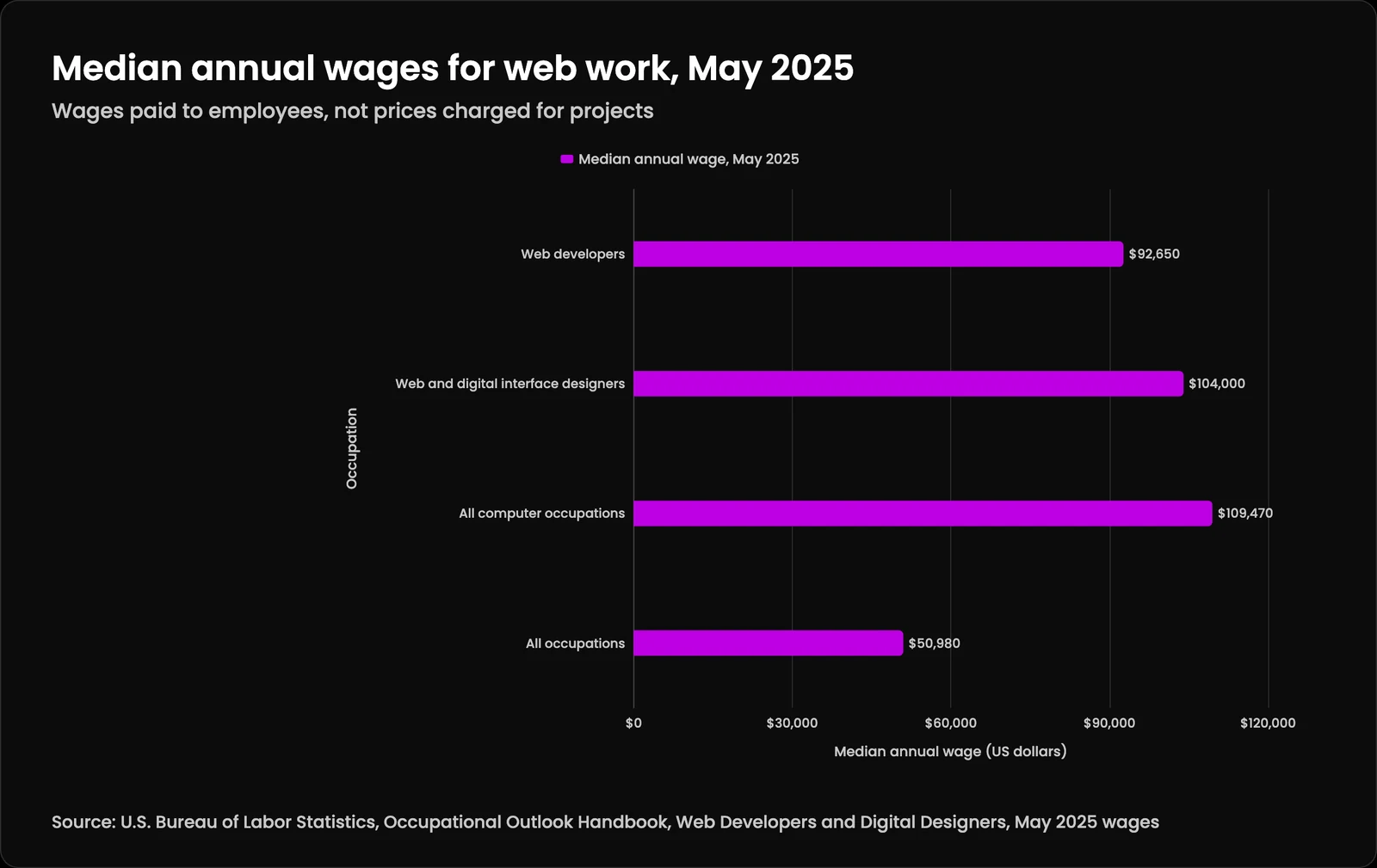
| Occupation | Median annual wage, May 2025 |
|---|---|
| Web developers | $92,650 |
| Web and digital interface designers | $104,000 |
| All computer occupations | $109,470 |
| All occupations | $50,980 |
Which features add the most to custom website development cost?
Anything that stores data, takes money, or talks to another system. A page of text is cheap to change. A feature that has rules, accounts, or a second system behind it needs design for every state it can be in, plus testing and security work.
- Logins and customer accounts: roles, password reset, saved data, and access control on every page.
- Payments and storefronts: catalog, cart, tax, shipping, and a payment processor.
- Integrations: booking, CRM, email, inventory, or an ERP, each with its own API and failure cases (see API integration).
- Search and filters across many items, such as products, listings, or documents.
- Multiple languages, which multiply content, testing, and structured data.
- AI features such as a chat assistant or document search, which add model usage costs; the token budget and cost estimator for LLM apps on Qurtoo shows how to estimate those before you build.
Online payments are the clearest case. The PCI Security Standards Council says PCI DSS applies to entities that store, process, or transmit cardholder data. A well-built store hands card entry to a payment processor so card numbers never touch your server, which keeps that scope small. For larger catalogs, see custom ecommerce development.
How do speed, accessibility, and security change custom website development cost?
They add hours up front and save money later. A site that is fast, accessible, and secure by design costs less to maintain than one patched after a complaint, a slow ranking, or an incident.
Speed is measured. Google Search Central's Core Web Vitals guidance asks site owners to load the main content within 2.5 seconds, respond to taps in under 200 milliseconds, and keep layout shift under 0.1. Google also says it uses the mobile version of a site's content for indexing and ranking (Google Search Central, mobile-first indexing), so the phone layout is the one that has to be complete. Our performance optimization guide explains how we meet those numbers.
Accessibility is a legal and a sales question. The Justice Department's ADA web guidance says an inaccessible website can exclude people just as much as steps at an entrance to a physical location. The guidance points to the Web Content Accessibility Guidelines as helpful technical guidance; the current edition is WCAG 2.2, a W3C Recommendation updated 12 December 2024, and we build to level AA. Building to it from the first template costs far less than retrofitting a finished site.
Security depends on what the site holds. If it collects personal information about Massachusetts residents, 201 CMR 17.03 expects you to oversee service providers and require them by contract to protect that data. The OWASP Top 10:2025 lists broken access control, security misconfiguration, and software supply chain failures as the top three web application risks, and each one is cheaper to design out than to fix later.
What does a custom website cost to run after launch?
Running costs are smaller than the custom website development cost of the build, and they never go to zero. A live site needs hosting, a domain, certificates, backups, software updates, security monitoring, and someone to change content as the business changes. Skipping them only moves the cost to the day something breaks.
| Ongoing item | What it covers | If it is skipped |
|---|---|---|
| Hosting | The server, bandwidth, and certificates the site runs on | Slow pages, outages, or a shared server's problems become yours |
| Domain and DNS | The name, renewal, and email records | An expired domain takes the site and email down |
| Updates and patches | Framework, library, and server updates | Known vulnerabilities stay open |
| Backups and restore tests | Copies you can actually restore | A bad update or attack has no undo |
| Monitoring | Uptime, speed, and security alerts | Customers find the problem first |
| Content changes | New services, staff, hours, posts | The site drifts out of date and loses trust |
Shared hosting looks cheap because the risk is shared too. LTFI's write-up on the real twelve-month cost of dedicated versus shared hosting counts the slowdowns and cleanups a low monthly plan leaves out, and our shared hosting vs managed hosting comparison explains the trade. For what each care level buys, see website maintenance cost by level. We run sites after launch through managed website operations, on dedicated infrastructure.
When is a custom website worth the cost over a template?
When the site has to do something a template cannot do well, or when you need to own every part of it. A template is a fine choice for a simple brochure site, and we say so when that is all a business needs. If you are a small business that wants a simple site to start, kiefstud.io is the free way into the same studio.
| Need | Template or builder | Custom build |
|---|---|---|
| A few pages that inform | Usually enough | More than you need |
| Booking, accounts, or a portal | Plugins with limits | Built around your process |
| Integrations with your systems | Whatever the platform supports | Any system with an API |
| Speed and accessibility targets | Depends on the theme | Designed in from the first template |
| Owning the code and leaving freely | Often limited by the platform | Code, data, and logins are yours |
Custom pays off, and the custom website development cost earns its keep, in four cases: the site must fit a process you already run, it must connect to systems you depend on, speed and accessibility are business requirements, or leaving a builder would be expensive. The last one is easy to miss. Our note on why website builders are easy to launch and expensive to leave covers what an exit can cost. A briansgagne.com piece on whether a free website is enough for a small business covers the other end of the range.
How do you plan a budget for custom website development cost?
Start from the outcome and the must-have features, then let the studio price the scope. Owners who arrive with a list of what the site must do get firmer quotes than owners who arrive with a page count, because a feature list is what custom website development cost is actually built from.
- Write down the three jobs the site must do, such as booking calls, selling products, or answering questions.
- List every system it must connect to, and who owns each account.
- Decide who writes the content and who supplies photos.
- Set the speed, accessibility, and security targets in the contract.
- Ask for line items, revision rounds, and the first year of hosting and care.
- Keep a reserve for the changes you discover once real customers use the site.
A short paid or included discovery phase turns that list into a written scope, which is the single biggest protection against change orders. Our requirements discovery guide explains what it produces. Get ownership in writing too: the domain, hosting account, code, and content should be in your company name, as our guide to who owns the website and login explains.
How does Kief Studio scope a custom website?
We map how the work happens today before choosing a screen or a stack, then write the scope in plain language: page templates, integrations, content, targets, and what runs after launch. That written scope is what our estimate of custom website development cost is based on. We write custom code in TypeScript, Python, and Rust, with frameworks such as React, React Router, and Astro chosen to fit the job, not one framework for every site.
Every site is built for phones first, carries structured data, and keeps the domain and logins in your name. We host it on dedicated infrastructure with managed hosting on LTFI, and the same studio keeps it patched. For marketing sites see web design; for portals and tools see custom web application development. If you are weighing a studio against a freelancer or an in-house hire, our guide to outsourcing web development covers that choice.
Also read
Custom website development cost: what drives the number: questions people ask
How much does a custom website cost?
What affects custom website development cost the most?
Labor hours, which follow scope. The biggest drivers are the number of unique page templates, integrations with other systems, customer logins, who writes the content, migration of an old site, and accessibility, speed, and security requirements written into the contract.How much does a web developer charge per hour?
Rates vary by region and by who you hire, and BLS does not publish rates. It publishes wages: the May 2025 median pay for web developers and digital designers was $47.85 an hour. A studio's rate sits above wages because it covers benefits, tools, insurance, and project management.How long does it take to build a custom website?
Most of the time goes to decisions, not code. Discovery, content, and review rounds often take longer than the build itself. A small site moves quickly when content is ready; a site with integrations, logins, or a large migration takes longer. A written scope gives you a realistic schedule.What does a website cost per month after launch?
The monthly cost covers hosting, the domain, backups, updates, security monitoring, and content changes. It is smaller than the build and should be written into the contract, including what is included each month and what it costs to take the site elsewhere.Is a custom website better than a template?
Not always. A template is fine for a simple site that only informs. A custom build is worth it when the site has to fit your process, connect to your systems, meet strict speed and accessibility targets, or stay fully in your ownership without platform limits.Is a custom website better than WordPress?
It depends on what the site needs to do. WordPress is a content management system with a large plugin ecosystem; a custom build is code written for your site. Custom suits sites with unusual features, integrations, or strict performance and security needs. Editing can still be simple with a CMS.How much does a custom ecommerce website cost?
More than a brochure site, because a store adds a catalog, cart, tax, shipping, a payment processor, and often inventory sync. PCI DSS applies to anyone who stores, processes, or transmits card data, so a good build hands card entry to the processor to keep that scope small.Do I own my website if a developer builds it?
Only if the contract says so. Ask for the code, content, and design to be assigned to your company in writing, and for the domain, hosting, and every login to be registered in your company name from day one.Does a website need to be ADA compliant?
The Justice Department's guidance says the ADA applies to businesses open to the public, including what they offer on the web, and points to WCAG as helpful technical guidance. We build to WCAG 2.2 level AA from the first template, which costs much less than fixing a finished site.Does a website need monthly maintenance?
Yes, if you want it to stay fast and safe. Software updates, backups, certificate renewals, and security monitoring are ongoing jobs. A site left alone for a year collects known vulnerabilities and broken pieces that cost more to fix than regular care.How much does it cost to build a website with AI?
AI tools can draft pages and code faster, which can lower build hours on simple sites. The rest of the work stays: scope, content you can stand behind, testing, accessibility, security, hosting, and someone accountable after launch. AI features inside the site also add ongoing model costs.
Keep reading
More in Build
- ERP Systems
Your business runs on a dozen disconnected tools. An ERP connects them.
- API Integration
Your tools already know how to talk to each other. They just need someone to make the introduction.
- Legacy Modernization
Upgrade outdated systems without losing your data or your mind.