
It depends on scope and on what you buy: a project, ongoing hours, or an employee. BLS reports a May 2025 median annual wage of $92,650 for web developers, but that is a wage, not a project price. For a project, pages, user roles, integrations, and data migration drive the number.

How to hire a web developer
To hire a web developer, define the job in writing, choose between a freelancer, a studio, or an employee, ask every candidate the same questions about ownership, testing, hosting, and exit terms, check live work and references, and sign a contract that assigns the code to you and keeps the domain and accounts in your name. Start with a small paid first step.
How do you hire a web developer?
To hire a web developer, write down the problem the site or app must solve, decide which kind of developer fits it, shortlist from referrals and work you can see live, ask the same hard questions of each, and sign a contract that puts the code and the accounts in your name. Then start with a small, paid first step before you commit to the whole build.
- Write the job: who uses it, what they need to do, what data it holds, and what done looks like.
- Pick the shape: a freelancer, a studio, or an employee (the table in the next section helps).
- Shortlist two or three from referrals, live sites, and working apps you can click through yourself.
- Ask every candidate the same questions, in writing, so the answers are comparable.
- Call references and ask what happened after launch, not just how launch went.
- Pay for a short discovery or a small first release before signing the full build.
- Sign a contract that covers scope, code ownership, accounts, changes, hosting, and the exit.
Most bad hires come from skipping the first step. If you cannot say in two sentences what the software has to do and for whom, every developer will quote a different project, and you will have no fair way to compare them. The list below is the order we would follow if we were on your side of the table.
Should you hire a freelancer, a studio, or an in-house developer?
Hire a freelancer for a defined, short job with one skill; a studio when the work spans design, code, security, and hosting and has to keep running; and an employee when software is the core of your business and there is a full-time job's worth of it every week. Many businesses start with a studio and hire in-house later.
| Freelancer | Studio | In-house employee | |
|---|---|---|---|
| Best for | A defined job with one skill | Design, code, security, and hosting together | Software that is your core business |
| Who covers vacations and sick days | Depends on their own backup arrangements | The rest of the studio | You, by hiring more people |
| Range of skills | One person's | Several people's | One person's, unless you build a team |
| Who hosts and maintains it | Often you, after handoff | Often the studio, under contract | Your employee, on your infrastructure |
| Your management time | High: you direct the work | Lower: the studio manages delivery | High: you manage, review, and retain |
| Employment rules | Contractor classification must hold up | A business-to-business contract | Payroll, benefits, and taxes |
| Code ownership | Needs a signed assignment | Needs a signed assignment | Usually yours as work made for hire |
Freelancing is common in this field. The Bureau of Labor Statistics says some web developers and digital designers work in the computer systems design industry, others are self-employed, and others work in publishing, management consulting, and advertising, out of 220,100 jobs in 2025 (BLS Occupational Outlook Handbook). Good people work in all three arrangements; the difference is who covers the gaps when one person is out.
If the real gap is technical leadership rather than hands on keyboards, the breakdown of fractional CTO cost versus a full-time CTO on briansgagne.com is a useful second read, and our note on building the team or finding the partner covers the same decision from the studio side.
Do you need a web designer or a web developer?
Before you hire a web developer, check which skill you need. You need a designer for how it looks and flows and a developer for how it works, and most real projects need both. BLS puts it simply: web developers create and maintain websites, and digital designers develop, create, and test website or interface layout, functions, and navigation for usability (BLS Occupational Outlook Handbook).
A marketing site that informs customers is a design-heavy job; see our web design service. A portal, booking system, or internal tool is a development-heavy job, which is custom web application development. If you are not sure which you have, our explainer on web apps versus websites sorts it out in a few minutes.
What questions should you ask before you hire a web developer?
Ask about the work after launch as much as the launch itself: who owns the code, where it is hosted, how changes are tested and deployed, and what happens if you part ways. A good developer answers these plainly and in writing. Vague answers to the ownership and exit questions are the clearest warning you will get.
| Question | Why it matters | A good answer |
|---|---|---|
| Can I click through something you built that is live today? | Screenshots hide speed, bugs, and accessibility | Yes, here are links, and here is what we did on each |
| Who owns the code, the domain, and the accounts? | Ownership is not automatic for contractors | You do, in the contract, with accounts in your name |
| How will I see progress? | Long silences hide problems | Small releases on a staging copy you can use |
| How do you test before something goes live? | Untested changes break working features | Automated tests plus a review before every deploy |
| How do you handle security and sign-in? | Access mistakes expose customer records | Access checks on every screen, current password rules, updates |
| Who hosts it and who patches it? | Unpatched sites are easy targets | A named person or studio, under a written agreement |
| What happens if we stop working together? | Lock-in is cheapest to prevent up front | You get the code, data, and documentation |
| What is not included in your estimate? | Surprises usually live here | A written list: content, hosting, integrations, changes |
When you hire a web developer, send the same list to every candidate. Comparing written answers side by side is fairer than comparing sales calls, and it shows you who listens to the question.
How much does it cost to hire a web developer?
It depends on the size of the job, the skills it needs, and what you are buying: a project, ongoing hours, or an employee. For a project, the number is driven by scope: pages, user roles, business rules, integrations, and data to move. For an employee, it is salary plus benefits, payroll taxes, equipment, and the time it takes to hire and manage them.
Wage data gives a fair anchor. BLS reports a May 2025 median annual wage of $92,650 for web developers, with the lowest 10 percent earning less than $48,100 and the highest 10 percent more than $162,290 (BLS Occupational Outlook Handbook). Those are wages, not prices for anyone's services, but the spread tells you that experience varies a great deal under the same job title.
For the project side, our guides to what a custom website costs and custom web application cost in Central Massachusetts walk through the drivers. For the employee side, our note on what your next hire really costs adds up the parts people forget.
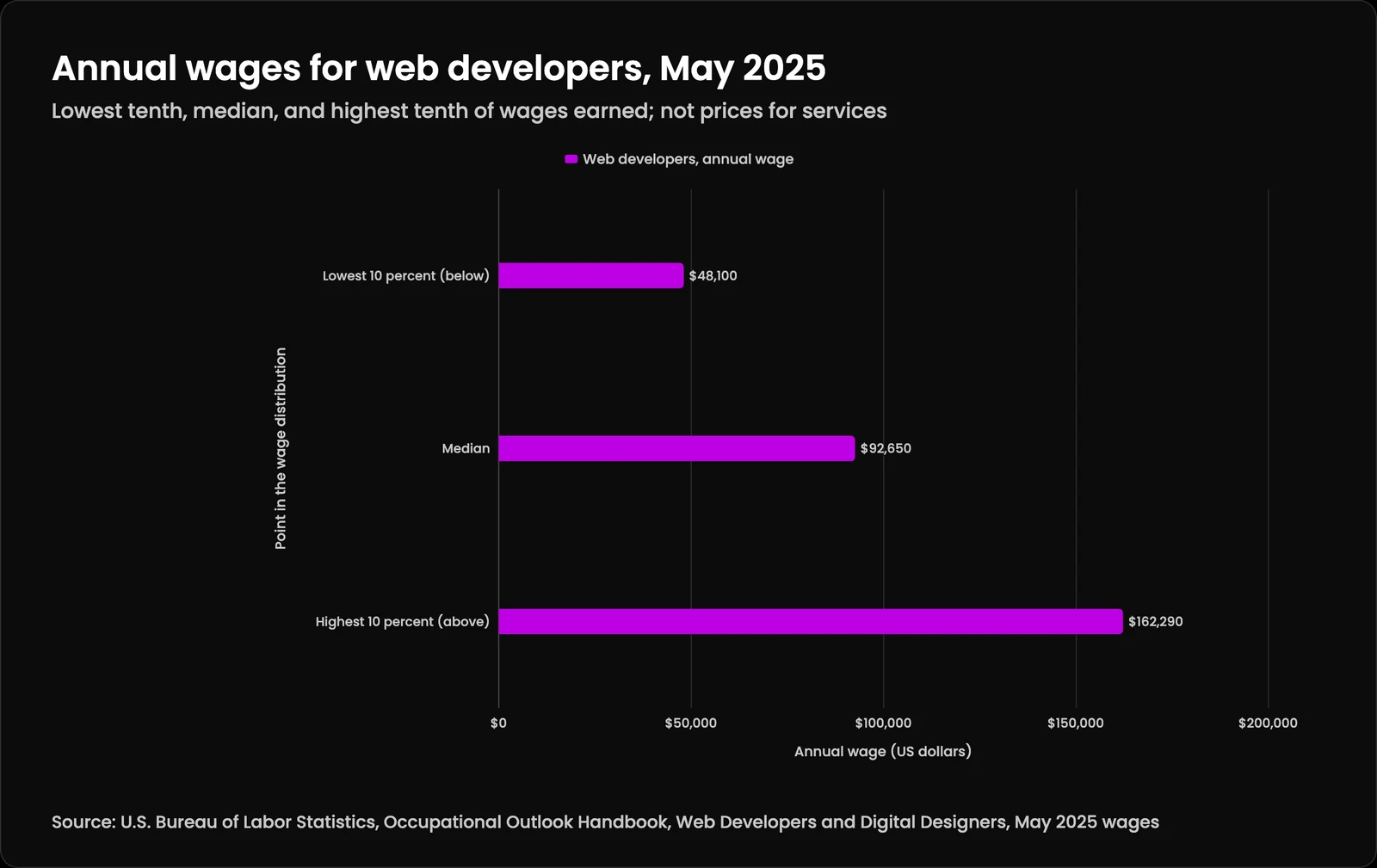
| Point in the wage distribution | Web developers, annual wage |
|---|---|
| Lowest 10 percent (below) | $48,100 |
| Median | $92,650 |
| Highest 10 percent (above) | $162,290 |
Is a freelance web developer a contractor or an employee?
It depends on the facts of the relationship, not the title on the invoice. The IRS says that to decide, you weigh evidence of control and independence in three groups: behavioral control, financial control, and the type of relationship (IRS, independent contractor or employee).
Massachusetts sets a stricter test. Under MGL c. 149, section 148B, workers are presumed to be employees, and a business that treats someone as an independent contractor has to show the work is done without its direction and control, is outside the usual course of its business, and is done by someone with their own independent business doing that kind of work (Mass.gov, independent contractors). If your Massachusetts business is about to hire a web developer to work alongside your staff, on your schedule, get advice before calling that person a contractor.
A business-to-business contract with a studio avoids most of that question, because the studio employs its own people. This is general information, not legal advice; your accountant or lawyer should look at your situation.
What should a web development contract include?
When you hire a web developer, the contract should say what gets built first, who owns the result, how changes are priced and approved, how the work is accepted, who hosts and maintains it, and how you leave with everything you paid for. If any of those is missing, you are relying on goodwill.
- Scope and first release: the problem, the users, and what the first version includes and excludes.
- Ownership: a signed assignment of the code and designs to you, plus a list of any third-party or open-source parts and their licenses.
- Accounts: domain, hosting, code repository, analytics, and app store accounts in your business's name.
- Change process: how new requests are estimated, approved in writing, and scheduled.
- Acceptance: how you test a release and what counts as done.
- Hosting and maintenance: who patches, backs up, and monitors it, and the response times you can expect.
- Exit: what you receive when the work ends, such as code, data exports, credentials, and documentation, and how fast.
- Confidentiality: how your data and business information are handled, and by whom.
The U.S. government's own playbook for buying software is a useful model. Its checklist asks that contracts request frequent deliverables, not multi-month milestones, that software and data generated by third parties remain under the buyer's control, and that the buyer maintains contractual rights to all custom software developed by third parties (U.S. Digital Services Playbook).
Who owns the code when you hire a web developer?
The person or company that writes it owns it, unless an employment relationship or a signed agreement says otherwise. Copyright vests initially in the author, and a transfer of ownership is not valid unless it is in writing and signed by the owner of the rights conveyed (17 U.S.C. chapter 2).
Many people assume work made for hire covers a contractor's code. The Copyright Office's circular lists only nine categories of commissioned work that a signed agreement can make a work for hire, and computer programs are not named among them (U.S. Copyright Office, Circular 30). So when you hire a web developer who is not your employee, the safer path is a written assignment of the code to you.
Ownership also covers the logins. Our guide to who owns the website and the login covers domains and accounts, and the plain guide to who owns the source code when you hire a developer on ameliasgagne.com goes deeper on the copyright side.
What are the red flags when you hire a web developer?
The biggest red flags are about control: a developer who registers your domain in their own name, will not put code ownership in writing, or cannot explain how you would leave. Close behind are a quote with no written scope and a portfolio with nothing live to click.
- Your domain, hosting, or code repository would sit in their account, not yours.
- They will not put code ownership or an exit plan in the contract.
- The estimate has a total but no written list of what is included and excluded.
- Nothing in the portfolio is live, or the live sites are slow and break on a phone.
- They promise first-page Google rankings by a date. Nobody controls that.
- There is no answer to who patches the site after launch.
- All the work would run through one person with no backup and no documentation.
Lock-in rarely looks dangerous at the start. The LTFI guide to vendor lock-in and how to avoid it lists the questions to ask before signing, and our note on how website builders made it easy to launch and expensive to leave shows what it costs later.
Can AI replace the need to hire a web developer?
For a simple page or a prototype, sometimes. For anything that signs people in, stores customer records, or takes payments, not yet, because someone still has to decide what to build, check the code, and answer for it in production. BLS notes that improving tools and AI may let workers in other jobs do basic web development tasks, which may soften growth for web developers (BLS Occupational Outlook Handbook).
Vibe coding, describing what you want to an AI model and accepting its code without reading it closely, is the risky end of that spectrum (Qurtoo, vibe coding definition). If you hire a web developer who uses AI tools, ask how they review and test what the tool writes. That answer tells you more than whether they use AI at all.
What happens when you hire Kief Studio?
If you hire a web developer through us, you get a studio, not a single contractor. We work from Shrewsbury, Massachusetts, with businesses across Worcester County and the rest of the state. We start with discovery, write custom code in TypeScript, Python, and Rust, and put the code, data, and accounts in your name. Founded 2022. Operating together since 2012.
After launch we host and run what we build on managed hosting on LTFI, on dedicated infrastructure, so you never install or maintain anything. Agencies that need the build under their own brand can use our white-label development. If you are comparing outside teams, our guides to what a custom software development company does and outsourcing web development cover the rest of the checklist.
Also read
How to hire a web developer: questions people ask
How much does it cost to hire a web developer?
What do freelance web developers charge?
Freelance rates vary widely with experience, skills, and location, and no government survey publishes freelance rates. Ask each freelancer for a written estimate against the same written scope, including what is excluded, so you compare like with like instead of comparing hourly rates for different amounts of work.Is it worth hiring a web designer?
Yes, when the site has to win customers. A professional designs for phones first, writes for search, builds to accessibility guidelines, and sets accounts up in your name. A template you build yourself is fine for a placeholder, but it often has to be rebuilt once the business depends on it.Can I pay someone to create a website for me?
Yes. You can hire a freelancer or a studio to plan, write, design, build, and host it. Make sure the contract puts the domain, the hosting account, and the content in your name, and says who updates and secures the site after launch.How do I find a good web developer?
Start with referrals from businesses like yours, then look at live sites and apps they built, not screenshots. Send two or three candidates the same written questions about ownership, testing, hosting, and exit terms, and call references about what happened after launch.What questions should I ask a web developer?
Ask who owns the code and accounts, how you will see progress, how they test and deploy changes, how they handle security and sign-in, who hosts and patches the site, what the estimate excludes, and what you receive if you part ways. Ask in writing so answers are comparable.What is the difference between an agency and a freelancer?
A freelancer is one person who sells their own skills. An agency or studio is a business with several people, so it can cover design, code, security, and hosting together and keep working when one person is out. Freelancers often suit small, defined jobs; studios suit ongoing systems.Should I hire a web designer or do it myself?
Do it yourself if you need a simple placeholder and have time to learn a builder. Hire a web designer when the site must bring in customers, rank in search, meet accessibility guidelines, or connect to other systems, because those take skills a builder does not supply.How do you choose a website developer?
Choose on evidence: live work you can test, clear written answers about ownership and hosting, a small paid first step, and references who describe life after launch. Price matters, but an estimate without a written scope is not a real number, so compare scopes before totals.Is web dev replaced by AI?
No. AI tools make developers faster and let non-developers build simple pages, but someone still has to decide what to build, review the code, and answer for it in production. BLS projects employment of web developers and digital designers to grow 5 percent from 2025 to 2035.How many developers do I need?
For most small business websites and first releases of a web app, one accountable lead with design, testing, and hosting support is enough. You need more people when several parts must be built at once or the software runs your core business around the clock.What is a statement of work for software development?
A statement of work is the document that says what will be built, what is excluded, the deliverables and their order, how work is accepted, and how changes are handled. It sits under the main contract and is the first thing to read when a project starts to drift.Is fixed price or time and materials better for web development?
Fixed price suits a small, well-defined scope where both sides know what done means. Time and materials suits work that will change as you learn, with a cap and regular releases so spending stays visible. Many projects use a fixed first release, then time and materials for what follows.
Keep reading
More in Build
- ERP Systems
Your business runs on a dozen disconnected tools. An ERP connects them.
- API Integration
Your tools already know how to talk to each other. They just need someone to make the introduction.
- Legacy Modernization
Upgrade outdated systems without losing your data or your mind.