
An MSP keeps your technology running: devices, accounts, networks, backups and the help desk. An MSSP watches that technology for attacks, investigates alerts and supports the response. The MSP asks whether it works; the MSSP asks whether it is being misused. In most MSP vs MSSP decisions, businesses end up with one of each, with contracts that say who acts on an alert.

MSP vs MSSP: what each one does, and which you need
MSP vs MSSP comes down to the job each one is hired to do. A managed service provider (MSP) keeps your technology running: devices, accounts, networks, backups and the help desk. A managed security service provider (MSSP) watches that technology for signs of attack, investigates alerts and leads the response. Many businesses use both, and the contracts should say exactly where one stops and the other starts.
MSP vs MSSP: what is the difference?
The short version of MSP vs MSSP: an MSP's job is to keep your technology working, and an MSSP's job is to notice when someone is misusing it. An MSP measures success in uptime, tickets closed and patches applied. An MSSP measures success in how quickly a real threat is spotted, confirmed and handed to the person who can act on it.
| MSP (managed service provider) | MSSP (managed security service provider) | |
|---|---|---|
| Main job | Keep devices, accounts, networks and software running | Watch for attacks, investigate alerts, lead or support the response |
| Typical work | Help desk, patching, backups, user setup, network changes, vendor coordination | Log collection and review, alert triage, threat hunting, incident support, security reporting |
| Where the work happens | A network operations center (NOC) or service desk | A security operations center (SOC) |
| What a good month looks like | Few outages, tickets resolved on time, patches current | Real threats caught early, false alarms tuned out, clear incident notes |
| Common tools | Remote monitoring and management (RMM), ticketing (PSA), backup software | Security information and event management (SIEM), endpoint detection and response (EDR), log storage |
| Contract measures | Response and resolution times for tickets and outages | Time to detect, time to escalate, what the provider may contain on its own |
| When they call you | Something is broken or needs approval | Something looks like an attack and needs a decision |
The two overlap more than the acronyms suggest. Many MSPs do some security work, such as patching, antivirus and firewall settings, because running systems well is part of keeping them safe. Many MSSPs depend on someone else to fix what they find. The cleanest way to read MSP vs MSSP is by the question each one answers: "is it working?" for the MSP, and "is it being attacked?" for the MSSP.
What does an MSP do?
On the MSP side of MSP vs MSSP, the provider runs the day-to-day technology of a business under a standing agreement. CISA's joint advisory on managed service providers describes MSPs as "entities that deliver, operate, or manage ICT services and functions for their customers via a contractual arrangement." ICT means information and communications technology: the computers, accounts, networks and software your staff touch every day.
In practice an MSP answers the help desk, sets up and removes users, keeps operating systems and applications patched, manages backups, looks after the office network and Wi-Fi, and deals with vendors such as your internet provider or software publisher. A good MSP also plans ahead: aging hardware, license renewals and project impact.
Because an MSP holds administrator access to almost everything, it is part of your security whether or not it sells security. That is why the same CISA advisory tells customers to require multifactor authentication on every MSP account used to reach their environment, and why HHS lists a Managed Services Provider as an example of a HIPAA business associate when it supports systems that hold patient data.
What is an MSSP in cyber security?
On the other side of MSP vs MSSP, an MSSP is a company that runs some or all of your security monitoring and response as a service. In the terms of the NIST Cybersecurity Framework 2.0, published February 26, 2024, an MSSP mostly covers two of the six functions: DETECT, where "possible cybersecurity attacks and compromises are found and analyzed," and RESPOND, where "actions regarding a detected cybersecurity incident are taken."
The core of most MSSP work is a security information and event management (SIEM) platform, which NIST defines as an application that gathers security data from information system components. Analysts review the alerts that platform raises, decide which ones are real, and escalate those to you or to your MSP with a recommended next step. Many also manage firewalls and run vulnerability scans.
One naming trap: in healthcare, MSSP usually means something else entirely. The Medicare Shared Savings Program is run by CMS for groups of doctors and hospitals, and it shares the acronym. If a search for MSSP returns accountable care organizations, that is the reason.
MSP vs MSSP: do you need one, the other, or both?
Many small businesses start with an MSP and add security monitoring when their data, customers or insurer require it. The decision turns on three things: what data you hold, who is watching your systems outside office hours, and who can make a containment decision when something looks wrong at 2am on a Saturday.
| Your situation | Usually enough | Worth adding |
|---|---|---|
| Small office, no customer data beyond email and invoices | An MSP | Security basics written into the MSP contract |
| You hold card data, patient records or Social Security numbers | An MSP plus security monitoring | An MSSP or a co-managed SOC with written response steps |
| You have an internal IT person who works business hours | Your IT person | After-hours monitoring from an MSSP, or an MSP for overflow |
| You run your own applications, sites or customer portals | A provider who knows how those systems were built | Monitoring and hardening on the applications themselves |
| Your insurer or a customer sent a security questionnaire | Whatever you have today | Written evidence of monitoring, logging and response |
If you hold customer financial data, patient records or Massachusetts residents' personal information, several rules already expect someone to watch for misuse. The FTC Safeguards Rule requires covered financial institutions to "monitor and log the activity of authorized users," and the Massachusetts 201 CMR 17.00 compliance checklist asks if you have "monitoring in place to alert you to the occurrence of unauthorized use of or access to PI." Neither rule names a provider type; both expect the monitoring to actually happen.
Why is the MSSP side of MSP vs MSSP harder to staff?
Security monitoring needs people who read alerts all day, and those people are scarce. The Bureau of Labor Statistics Occupational Outlook Handbook projects employment of information security analysts to grow 21% from 2025 to 2035, with about 14,100 openings a year. Over the same decade it projects computer support specialists to change by -3% and network and computer systems administrators by -4%.
| Occupation | Projected change in employment | Median annual wage, 2025 |
|---|---|---|
| Information security analysts | 21% | $129,180 |
| Network and computer systems administrators | -4% | $99,130 |
| Computer support specialists | -3% | $62,890 |
The wage data points the same way. BLS reports a 2025 median wage of $129,180 for information security analysts, against $99,130 for network and computer systems administrators and $62,890 for computer support specialists. Those are wages for employees, not prices for any service. They explain why few small businesses hire a security analyst of their own, and why the security half of MSP vs MSSP is so often bought as a service.
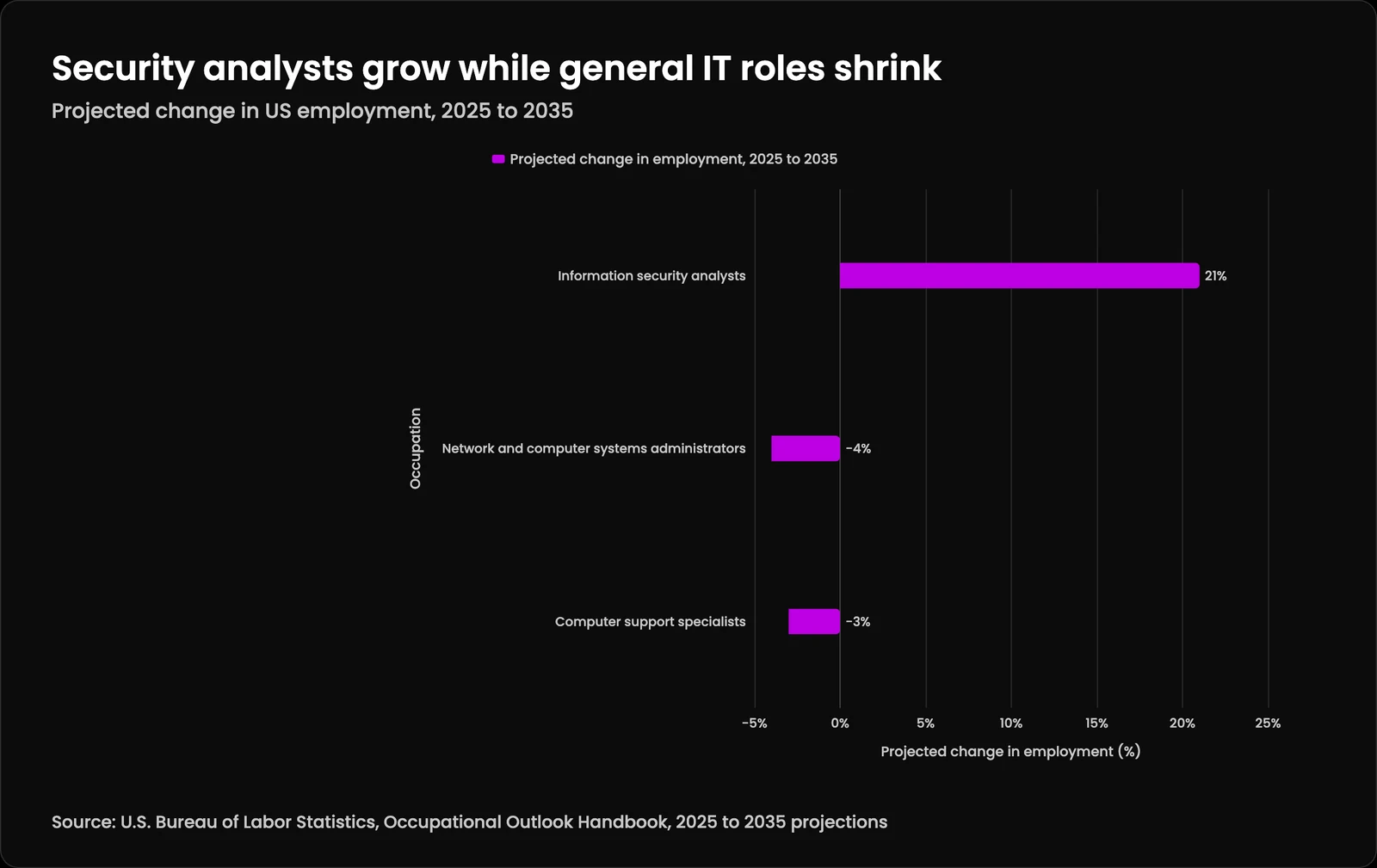
| Occupation | Projected change in employment, 2025 to 2035 |
|---|---|
| Information security analysts | 21% |
| Network and computer systems administrators | -4% |
| Computer support specialists | -3% |
What should the contracts say when you use both?
When you settle MSP vs MSSP by hiring both, the gap between their contracts is where incidents stall. The MSSP sees an alert and recommends isolating a server. The MSP owns the server. If neither contract says who acts, how fast, and on whose approval, the alert waits. NIST CSF 2.0 asks for exactly this under GV.SC-02: cybersecurity roles and responsibilities for suppliers "are established, communicated, and coordinated internally and externally."
- Who may contain a threat on their own (disable an account, isolate a device) and who must ask first.
- How each provider reaches the other and you, at every hour the contract covers, with named people.
- Response time and resolution time, written separately. A fast reply is a different promise from a fix.
- Multifactor authentication on every provider account, as CISA's MSP advisory recommends.
- Which logs are kept, where, for how long, and who can read them during an investigation.
- What happens to your accounts, logs and admin access when either contract ends.
- For health data, a business associate agreement with each provider that touches patient information.
Write these into both agreements, and make them match:
Can an MSP also be an MSSP?
Yes. Some providers do both, which takes the MSP vs MSSP choice off the table, and for a small business one accountable company can be simpler than two. The question to ask is how the security side is kept honest. If the same team that configures your systems also reviews the alerts about them, nobody outside that team checks the work.
Ask a combined provider three things. Who reviews security alerts, and are they separate from the technicians who make changes? Where are the logs stored, and can the technicians edit them? What do you receive each month that shows what was detected and what was done? Clear answers to those questions matter more than the label on the contract.
Where do MDR and a SOC fit in MSP vs MSSP?
A security operations center (SOC) is the team and tooling that does security monitoring, wherever it sits. An MSSP runs a SOC for many customers. Managed detection and response (MDR) is a narrower service that focuses on finding and stopping active threats, usually on endpoints and cloud accounts, with the provider allowed to take containment steps itself.
We compare those models in more depth in MDR vs MSSP, explain what a managed SOC includes, and cover the hybrid model in MSSP vs a co-managed SOC. If you already have an IT team and want to keep it, co-managed IT explains how the split of work is usually drawn.
How does Kief Studio fit between an MSP and an MSSP?
Kief Studio builds and hosts the applications, websites and servers a business runs on, and we run them on LTFI, the system we built for that work. Our managed technology services keep those systems running and patched, and managed security monitoring watches and hardens what we host. We do not run a laptop help desk. Many clients keep their existing IT provider for that, and we work beside them with the split written down.
After-hours response is in the agreement or it is not offered: 3am is a retainer, not a default. We are based in Shrewsbury, Massachusetts and work with businesses across Worcester County and beyond. For the wider picture of both service types, start at our MSP and MSSP services hub. If you run an MSP or MSSP yourself, LTFI for MSPs and agencies and our partner program explain the referral and white-label paths.
What should you check before you sign with either one?
Whichever side of MSP vs MSSP you hire, get the scope, the response path and the exit in writing before you sign. Scope is the list of systems and tasks covered. The response path is who acts on an alert or an outage, in what order, at what hours. The exit is how you get your accounts, logs and admin access back when the relationship ends.
Amelia S. Gagne's guide to evaluating a managed service provider walks through those three tests in detail. Brian S. Gagne's checklist for switching IT providers covers what to take back first, and our guide to choosing an MSP lists the questions to ask in the first meeting. For response times, see SLA response times.
Also read
MSP vs MSSP: what each one does, and which you need: questions people ask
What is the difference between an MSP and an MSSP?
What does MSP vs MSSP mean?
MSP vs MSSP compares two kinds of outside provider. MSP stands for managed service provider, a company that runs your day-to-day IT under a standing agreement. MSSP stands for managed security service provider, a company that runs security monitoring and response. The comparison helps you decide which jobs to hand to whom.Is MSSP the same as MSP?
No. An MSSP is a specialist in security monitoring and response, while an MSP covers general IT operations. Some companies offer both services, but they are different jobs with different staff, tools and contract measures. Ask any provider which of the two jobs they are actually taking on, and in writing.What is MSP in cybersecurity?
In cybersecurity, an MSP is the managed service provider that holds administrator access to your systems. That access makes it part of your security even if it sells no security service. CISA recommends that customers require multifactor authentication on every MSP account that reaches their environment.What is the difference between MSSP and SOC?
A SOC, or security operations center, is the team and tooling that monitors for attacks. An MSSP is a company that sells security services, usually delivered from its own SOC shared across many customers. You can have a SOC in-house, buy one from an MSSP, or split the work in a co-managed SOC.What's the difference between MSSP and MDR?
An MSSP usually covers a broad set of security services, such as monitoring, firewall management and reporting, and often escalates alerts for someone else to act on. MDR, managed detection and response, focuses on finding and stopping active threats, and the provider is usually allowed to contain them itself.Do I need an MSSP or MSP?
The MSP vs MSSP choice starts with what you need done. If systems break and nobody fixes them, you need an MSP. If nobody watches for attacks, especially outside office hours, you need security monitoring from an MSSP or similar. If you hold customer financial, health or personal data, plan for both, with matching contracts.How much does an MSSP cost?
MSSP cost depends on what is monitored and how. The main drivers are the number of devices, users and log sources, how long logs are kept, the hours covered, whether the provider may contain threats itself, and any compliance reporting. Ask for those items itemized so you can compare quotes fairly.How does a MSP make money?
Most MSPs earn recurring revenue from a monthly agreement, usually priced per user, per device or as a flat tier of services. Many also resell software licenses and hardware, and bill projects such as migrations separately. Knowing the model helps you read a proposal and spot work that falls outside the monthly fee.Is MSP outdated?
No. Businesses still need someone to run their devices, accounts and networks, which is why MSP vs MSSP is a pairing question more than a replacement. What has changed is that security monitoring, cloud applications and compliance now sit beside that work, so many businesses pair an MSP with security services or choose a provider that clearly covers both jobs in writing.Can an MSP be an MSSP in cyber security?
Yes, some providers run both IT operations and security monitoring. The risk is that the same team configures your systems and reviews the alerts about them. Ask who reviews security alerts, whether they are separate from the technicians, and whether technicians can edit the logs.What is an MSSP partner?
An MSSP partner is usually an MSP or agency that works with a security provider to offer monitoring to its own clients, either by referring them or by reselling the service under its own brand. Kief Studio offers referral and white-label paths for partners.What does MSSP stand for in healthcare?
In healthcare, MSSP usually means the Medicare Shared Savings Program, a CMS program for accountable care organizations made up of doctors, hospitals and other providers. It is unrelated to managed security. A health practice can, of course, use a managed security service provider too.
Keep reading
More in Support
- Managed Services
You run your business. We keep the technology running.
- Quarterly Business Review
Strategic check-ins, not status calls.
- Strategic Advisory
Technology decisions that make business sense, not just technical sense.