
MDR focuses on finding active threats and containing them, and the provider is usually allowed to act within agreed limits. An MSSP covers a broader set of security services, such as log monitoring, firewall management and reporting, and usually escalates alerts for your team or IT provider to act on. In short, MDR vs MSSP is depth versus breadth.

MDR vs MSSP: what each one does, and which one you need
MDR vs MSSP is a choice between depth and breadth. Managed detection and response (MDR) focuses on finding active threats and stopping them, and the provider is usually allowed to contain an attack itself. A managed security service provider (MSSP) covers a wider set of security services, such as log monitoring, firewall management and compliance reporting, and often escalates alerts for your team to act on.
MDR vs MSSP: what is the difference?
The core difference in MDR vs MSSP is what happens after an alert. An MSSP watches your logs and security tools, decides which alerts look real, and tells you or your IT provider what to do. An MDR provider investigates the alert itself and, within limits you agree in advance, takes the first containment step: isolating a server, disabling an account or blocking a connection.
| MDR (managed detection and response) | MSSP (managed security service provider) | |
|---|---|---|
| Main job | Find active threats and stop them | Run a range of security services and monitoring |
| After a real alert | Investigates and usually takes the first containment step | Usually escalates with a recommendation for someone else to act |
| Typical data | Endpoint, server, identity and cloud activity | Logs from firewalls, servers, applications and security tools |
| Typical tools | EDR software plus the provider's own analysis platform | A SIEM, firewall and VPN management, vulnerability scanners |
| Other services | Threat hunting, incident support | Device management, compliance reporting, log retention |
| What you still need | Someone to fix the root cause and run IT | Someone to act on escalations at every hour covered |
| Contract question that matters most | Exactly which containment steps they may take alone | Who acts on an escalation, and how fast |
The second difference is scope. An MSSP often runs several security functions at once, from firewall rules to vulnerability scans to monthly compliance reports. MDR is narrower and deeper: it concentrates on detection and response, often using endpoint detection and response (EDR) software on your servers and computers plus signals from cloud and identity accounts.
What is MDR in cyber security?
Managed detection and response is an outsourced service that hunts for, investigates and contains attacks on your behalf. It maps to the DETECT and RESPOND functions of the NIST Cybersecurity Framework 2.0, where RESPOND "supports the ability to contain the effects of cybersecurity incidents." The defining feature is that the provider does more than raise an alarm.
An MDR service usually installs or connects to EDR software, watches for suspicious behavior such as a new administrator account or unusual file encryption, and has analysts confirm what they see. When a threat is confirmed, the provider follows a playbook you approved: isolate the machine, end the session, reset the credential, then hand you a written account of what happened and what still needs fixing.
What MDR does not usually do is run your IT. It will not reset a forgotten password, set up a new hire or patch an application. Those stay with your IT team or MSP, which is why the MDR vs MSSP question is often really a question about who fixes things after the provider stops the immediate threat.
What does an MSSP do that MDR does not?
On the MSSP side of MDR vs MSSP, the provider covers more of the security program, with less hands-on response. A typical MSSP collects logs into a security information and event management (SIEM) platform, manages firewalls and remote access, runs vulnerability scans, keeps logs for the period your regulators or insurer expect, and produces reports you can hand to an auditor.
That breadth is useful when the problem is coverage and evidence. Several rules ask you to watch for unauthorized access: the FTC Safeguards Rule requires covered financial institutions to "monitor and log the activity of authorized users," and the 201 CMR 17.00 compliance checklist asks about monitoring for unauthorized use of personal information. An MSSP can supply the monitoring and the records that show it ran. What it often cannot do, unless the contract says so, is act at 2am without calling someone first.
MDR vs MSSP vs SIEM: where does a SIEM fit?
A SIEM is a tool, while MDR and an MSSP are services. NIST defines a SIEM as an application that gathers security data from information system components and presents it as actionable information through a single interface. It does the work that NIST CSF 2.0 describes under DE.AE-03: "Information is correlated from multiple sources."
| SIEM | MSSP | MDR | |
|---|---|---|---|
| What it is | Software that gathers and correlates security data | A provider that runs security services | A provider that detects and contains active threats |
| Who watches it | Your team, unless you buy a service | The provider's analysts | The provider's analysts |
| Who acts on a threat | Your team | Usually your team or MSP, after escalation | Usually the provider, within agreed limits |
| Best fit | Teams with security staff | Businesses that need broad coverage and reporting | Businesses that need fast containment |
A SIEM with nobody reading it produces stored alerts, not detection. That is why the MDR vs MSSP vs SIEM comparison is lopsided: an MSSP usually operates a SIEM for you, an MDR provider may use one or its own platform, and buying a SIEM alone means your own staff must watch it. CISA and its international partners published their best practices for event logging and threat detection on August 21, 2024, and the theme is the same: logs only help when they are collected centrally, kept safely and actually reviewed.
MSP vs MSSP vs MDR: who does what?
An MSP keeps your technology running, an MSSP runs security services and monitoring, and MDR finds and stops active attacks. The three often work together, so MDR vs MSSP is rarely an either-or choice. A common setup for a small business is an MSP for day-to-day IT, MDR on servers and computers, and an MSSP or co-managed security operations center (SOC) where compliance reporting or log retention is required.
| MSP | MSSP | MDR | |
|---|---|---|---|
| Question it answers | Is it working? | Is our security program covered? | Is someone attacking us right now? |
| Typical work | Help desk, patching, backups, accounts | Monitoring, firewalls, scans, reports | Threat detection, investigation, containment |
| Usual measure | Ticket response and resolution times | Coverage, escalation time, reports delivered | Time to detect and time to contain |
We cover the first pair in detail in MSP vs MSSP. When your own staff want to stay in the loop, the hybrid is a co-managed SOC, and what a managed SOC includes explains the fully outsourced version.
MDR vs MSSP: which one does your business need?
Choose by the gap you need to close. If nobody can act on a threat outside office hours, MDR closes that gap because the provider is allowed to contain. If you need broad coverage, retained logs and reports for an insurer, auditor or customer questionnaire, an MSSP closes that one. Many businesses end up needing a piece of each, so in any MDR vs MSSP decision, read each contract for what the provider will actually do.
| If this is your gap | Lean toward | Why |
|---|---|---|
| Nobody can contain an attack at night or on weekends | MDR | The provider may isolate and disable within agreed limits |
| You need logs kept and reports for an auditor or insurer | MSSP | Log retention and reporting are core MSSP services |
| You have one or two IT people and want them to stay in charge | Co-managed SOC | Your team keeps context, the provider adds hours |
| Your applications and servers are custom built | A provider who knows the build | Detection rules have to match how the system really works |
| You hold regulated data and have no security staff | MDR plus an MSSP, or one provider covering both | You need both containment and documented coverage |
Amelia S. Gagne makes a related point in her guide to the cyber insurance renewal application: insurers now ask what share of your machines have endpoint detection, and they want evidence rather than a yes. Whichever service you pick should produce that evidence every month.
Why does response speed matter so much?
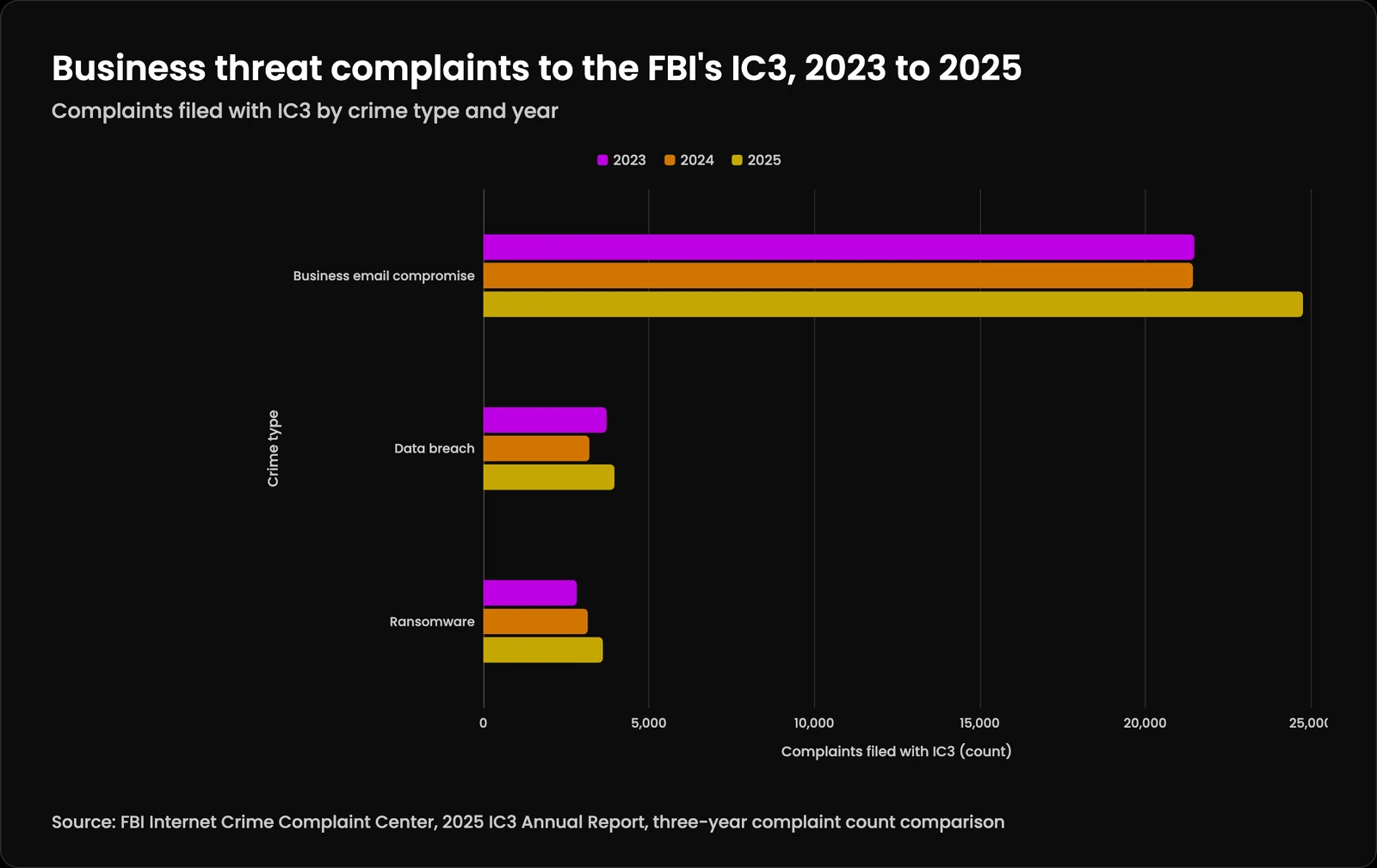
An attack that runs for hours before anyone acts has more time to spread. The FBI's 2025 Internet Crime Report shows business email compromise complaints rising from 21,489 in 2023 to 24,768 in 2025, ransomware complaints from 2,825 to 3,611, and data breach complaints from 3,727 to 3,963. Business email compromise alone carried $3,046,598,558 in reported losses in 2025.
| Crime type | 2023 | 2024 | 2025 |
|---|---|---|---|
| Business email compromise | 21,489 | 21,442 | 24,768 |
| Data breach | 3,727 | 3,204 | 3,963 |
| Ransomware | 2,825 | 3,156 | 3,611 |
The FBI also notes that its ransomware loss figures do not normally include lost business, time, wages, files or equipment, so the real cost is higher than the reported number. Those figures are complaints filed with IC3, not every incident that happened, but the direction is clear. For a business weighing MDR vs MSSP, the useful question is how long a confirmed attack can run before someone with authority stops it.
| Crime type | 2023 | 2024 | 2025 |
|---|---|---|---|
| Business email compromise | 21,489 | 21,442 | 24,768 |
| Data breach | 3,727 | 3,204 | 3,963 |
| Ransomware | 2,825 | 3,156 | 3,611 |
What should you ask an MDR or MSSP provider before you sign?
Whichever side of MDR vs MSSP you choose, ask about authority, coverage and evidence before features. NIST SP 800-61 Revision 3, published April 2025, frames incident response as part of everyday risk management under CSF 2.0, and CSF 2.0 asks that relevant suppliers be included in incident planning, response and recovery (GV.SC-08). Covered financial institutions also need a written incident response plan under 16 CFR 314.4(h). Your provider's contract should fit inside that plan.
- Which containment actions may you take without calling us, and which need approval?
- What hours do analysts watch, and who answers at 2am on a holiday?
- Which systems send you data: servers, cloud accounts, email, firewalls, applications?
- How long do you keep logs, where are they stored, and can we export them?
- What do we receive each month as evidence of what you saw and did?
- How do you hand off to our IT provider, and is that written into both contracts?
- Do all of your staff use multifactor authentication to reach our systems, as CISA recommends for providers?
- What happens to our data, logs and access when the contract ends?
Where does Kief Studio fit in MDR vs MSSP?
Kief Studio sits on the systems we build and host. Our threat detection and response service collects the signals from your applications and servers, correlates them so one attack shows up as one alert, and writes the response path for each alert: who acts, what they check, what they do. Managed security monitoring adds patching and hardening on what we host, as part of managed hosting on LTFI.
After-hours response is written into the agreement or it is not offered: 3am is a retainer, not a default. We work alongside your existing IT provider, and from Shrewsbury, Massachusetts we cover Worcester County and the rest of the state. For a local view of the service, read our note on small business MDR in Central Massachusetts, and for the full map of provider types, see the MSP and MSSP hub.
If you are weighing AI in the security workflow, LTFI's guide to the AI SOC sets out what agents may investigate alone and what still needs a person, which is the same authority question MDR contracts turn on. Brian S. Gagne's Massachusetts data breach statistics show how often small incidents still trigger state notice.
Also read
MDR vs MSSP: what each one does, and which one you need: questions people ask
What is the difference between MDR and MSSP?
What is the difference in MDR vs MSSP vs SIEM?
In MDR vs MSSP vs SIEM, the SIEM is software that collects and correlates security data, while MDR and an MSSP are services run by people. An MSSP often operates a SIEM for you. An MDR provider may use one too. A SIEM alone still needs someone to watch it.What is the difference between MSP vs MSSP vs MDR?
An MSP runs your day-to-day IT: help desk, patching, backups and accounts. An MSSP runs security services such as monitoring, firewalls and compliance reports. MDR finds and stops active attacks. Many small businesses use an MSP plus MDR, and add MSSP services when reporting or log retention is required.Is MDR the same as a SOC?
No. A SOC, or security operations center, is the team and tooling that monitors for attacks. MDR is a service, and an MDR provider runs its own SOC to deliver it. You can also have an in-house SOC, a managed SOC from a provider, or a co-managed SOC shared with your staff.How is MDR different from EDR?
EDR, endpoint detection and response, is software installed on servers and computers that records activity and flags suspicious behavior. MDR is a service where a provider's analysts watch that data, investigate alerts and take containment steps. EDR is the tool; MDR is the people and process that use it.Does MDR include SIEM?
Sometimes. Some MDR services include a SIEM or log platform, and others rely on EDR data and their own analysis tools. If you need logs kept for an auditor or insurer, ask the provider which sources they collect, how long they keep them, and if you can export them.What's the difference between XDR and MDR?
XDR, extended detection and response, is a product that combines signals from endpoints, email, identity and cloud into one detection platform. MDR is a managed service. An MDR provider might run XDR software for you, the same way it might run EDR. One is the technology; the other is who operates it.Why do we need MDR?
You need MDR when nobody on your side can confirm and contain an attack quickly, especially at night or on weekends. The FBI's IC3 recorded 3,611 ransomware complaints in 2025, up from 2,825 in 2023. MDR shortens the time a confirmed attack runs before someone stops it.How much does an MDR cost?
MDR cost depends on the number of servers, computers and cloud accounts covered, which data sources are included, the hours watched, how much the provider may contain on its own, and how long data is kept. Ask for each item listed separately, so any MDR vs MSSP comparison runs on the same terms.What is an example of MDR?
A common example: at 1am, a provider's analysts see a server account start encrypting files. Within the limits you agreed, they isolate the server from the network, disable the account, and call your named contact. In the morning you receive a written timeline and a list of what still needs fixing.What does MDR mean in cybersecurity?
In cybersecurity, MDR stands for managed detection and response: an outsourced service in which a provider's analysts monitor your systems, investigate suspicious activity and take agreed containment steps. In medicine and payments MDR means other things, such as multidrug resistance or a merchant discount rate.What does MSSP stand for?
MSSP stands for managed security service provider, a company that runs some or all of a business's security services, such as monitoring, firewall management, vulnerability scanning and compliance reporting. In healthcare the same letters usually mean the Medicare Shared Savings Program, which is unrelated.
Keep reading
More in Protect
- Agentic Security
AI-driven penetration testing that thinks like an operator.
- Penetration Testing
Authorized attacks that find vulnerabilities before real attackers do.
- Vulnerability Management
Finding vulnerabilities is step one. Fixing them is the whole point.