
It means renting a security operations center instead of building one. A provider's analysts and tools monitor your systems, investigate alerts and support the response during the hours your contract covers. You supply access, contacts and decision rights; the provider supplies people, platform and playbooks.

What is a managed SOC? SOC as a service, explained
SOC as a service is a security operations center you rent instead of build: a provider's analysts and tools watch your systems during the hours you agree, investigate alerts and support the response when an attack is confirmed. A managed SOC is the same idea under another name. You keep ownership of your systems and of the big decisions, and the provider supplies the people, the monitoring platform and the playbooks.
What is SOC as a service?
In plain terms, it means hiring an outside team to run the security operations center (SOC) work for you: collecting security data, watching it, deciding which alerts are real, and helping contain attacks. The provider owns the tooling and the staff; you pay for the outcome of having someone watching.
| Component | What it does | NIST CSF 2.0 function |
|---|---|---|
| Log collection and a managed SIEM | Gathers security data from servers, applications, cloud accounts and network devices | DETECT |
| Monitoring and alert triage | Analysts review alerts, discard false alarms and confirm real ones | DETECT |
| Threat hunting | Analysts search for signs of attack that did not raise an alert | DETECT |
| Endpoint detection and response | Records activity on servers and computers and supports isolation | DETECT and RESPOND |
| Incident response support | Contains, investigates and documents confirmed incidents with your team | RESPOND |
| Reporting and a client portal | Shows what was seen, what was done and what is still open | GOVERN |
A clear public example comes from the U.S. Department of Justice, which offers a SOC service to other federal agencies through CISA's services catalog. The listing says DOJ's Security Operations Center as a Service "delivers 24x7x365 threat monitoring, detection and incident response," and names the parts: cyber threat intelligence, network and system monitoring, incident response, cyber hunt, logging-as-a-service, endpoint detection and response (EDR), managed security information and event management (SIEM), a client portal, forensics and onboarding. Commercial managed SOC offerings are built from the same pieces, in different amounts.
Is a managed SOC the same as SOC as a service?
Yes, in practice the two names describe the same thing: a security operations center run by a provider. Some vendors use managed SOC for a service tailored to one customer and SOC as a service for a standard subscription, but there is no official line between them. Read the contract, not the label.
What does vary is how much of the work stays with you. In a fully managed SOC the provider takes the whole monitoring function. In a co-managed SOC your own IT or security people stay in the workflow and the provider adds hours and tooling around them. We compare those two models in MSSP vs a co-managed SOC. Either way, ask who holds the decision to isolate a system at 2am, because that is where the models really differ.
What does a SOC actually do all day?
A SOC turns raw activity into a short list of things a person must act on. The NIST Cybersecurity Framework 2.0 describes the work in its DETECT function as a chain of outcomes, and a good provider can show you how it covers each one:
- Watch: networks, people's account activity and the computing environment "are monitored to find potentially adverse events" (DE.CM-01, DE.CM-03, DE.CM-09).
- Correlate: "Information is correlated from multiple sources" (DE.AE-03), usually in a SIEM, which NIST defines as an application that gathers security data and presents it as actionable information.
- Size it: "The estimated impact and scope of adverse events are understood" (DE.AE-04).
- Tell the right people: information on adverse events "is provided to authorized staff and tools" (DE.AE-06).
- Call it: "Incidents are declared when adverse events meet the defined incident criteria" (DE.AE-08).
- Act: under RESPOND, contain the effects of the incident, then analyze, mitigate, report and communicate.
- Tune: remove noisy rules and add new ones after each real incident, so the same attack is caught sooner next time.
In-house SOC vs SOC as a service: what does each take?
An in-house SOC needs people on every hour you want covered, and that is the expensive part. A week has 168 hours and one full-time schedule covers about 40, so a single seat watched all week needs four or more analysts before vacation, sick days and training. Those analysts are scarce: the Bureau of Labor Statistics projects about 14,100 openings a year for information security analysts from 2025 to 2035, and reports a 2025 median wage of $129,180.
| In-house SOC | Managed SOC | Co-managed SOC | |
|---|---|---|---|
| Who watches | Your employees | The provider's analysts | Your staff by day, the provider around them |
| What you build | Team, tooling, playbooks, coverage rota | Log sources, contacts and decision rights | Shared queue, handoff rules, shared tools |
| Knowledge of your systems | Highest | Learned during onboarding | Kept by your staff |
| Main risk | Hiring and keeping analysts | A provider that alerts but cannot act | Gaps at shift changes and holidays |
| Best fit | Large organizations with security budgets | Businesses with no security staff | Teams with one or two capable people |
For comparison, BLS reports 2025 median wages of $99,130 for network and computer systems administrators and $62,890 for computer support specialists. These are wages for employees, not prices for any service. They explain why a managed SOC appeals to businesses that have an IT person or an MSP but no security staff: the provider spreads the analyst bench across many customers.
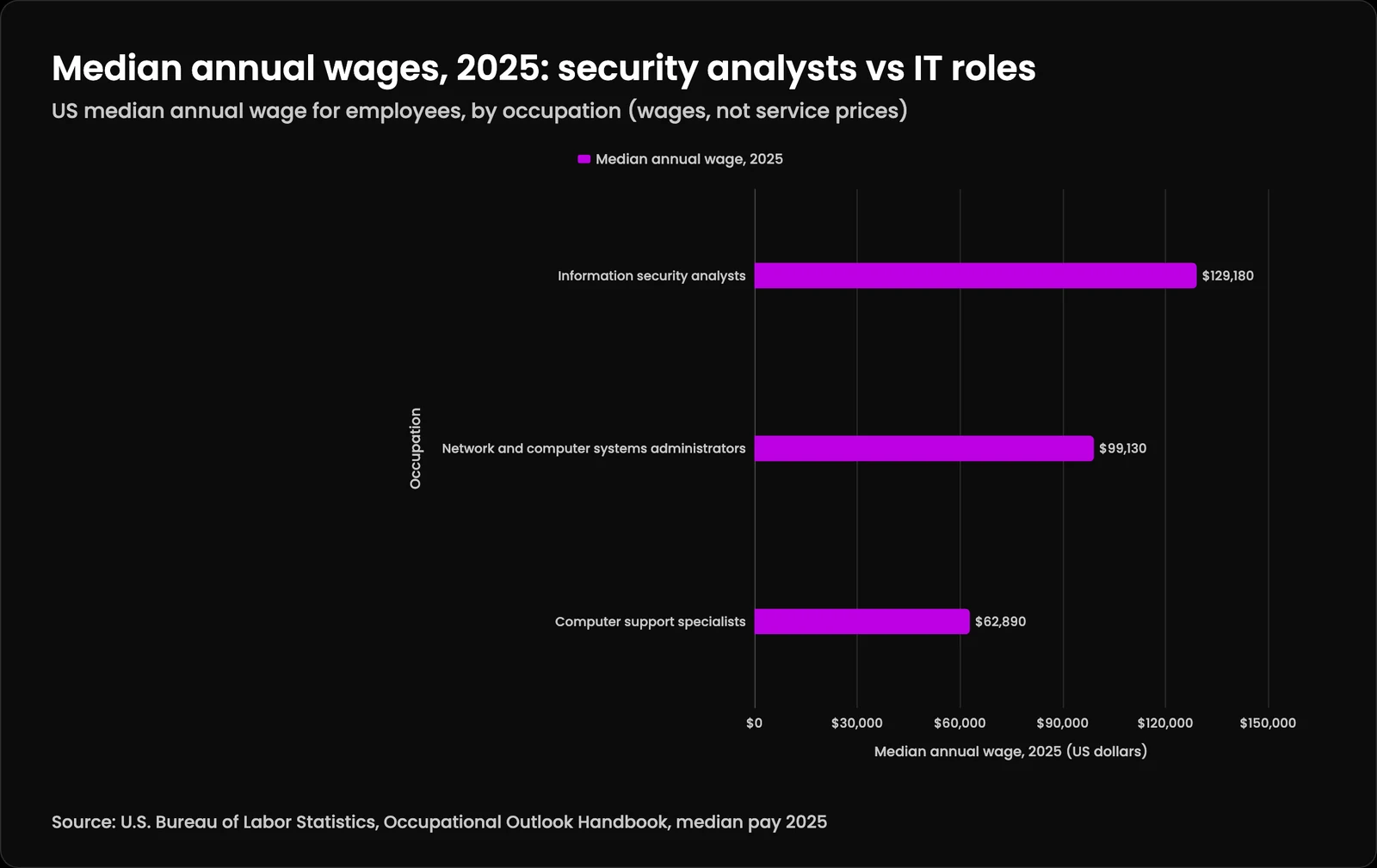
| Occupation | Median annual wage, 2025 |
|---|---|
| Information security analysts | $129,180 |
| Network and computer systems administrators | $99,130 |
| Computer support specialists | $62,890 |
How does SOC as a service compare with an MSSP and MDR?
The labels overlap. A managed security service provider (MSSP) usually delivers its monitoring from its own SOC, so buying from an MSSP often means buying managed SOC work plus extras such as firewall management and compliance reports. Managed detection and response (MDR) is a narrower service focused on finding and containing active threats, and it is also delivered from a SOC.
The questions that separate them are scope and authority: which systems are watched, and whether the provider may contain an attack on its own. Our MDR vs MSSP comparison covers that choice in detail, and MSP vs MSSP explains where your everyday IT provider fits next to all of them.
Is a SOC the same as SOC 2?
No. The letters collide but the meanings do not. A security operations center is a team that monitors for attacks. SOC 1, SOC 2 and SOC 3 are reports from the AICPA, whose System and Organization Controls are "a suite of service offerings CPAs may provide." A SOC 2 report examines controls at a service organization relevant to security, availability, processing integrity, confidentiality or privacy.
A SOC as a service provider may hold a SOC 2 report about its own controls, which is worth asking for, but buying monitoring does not give your business a SOC 2 report. If a customer has asked you for SOC 2, Brian S. Gagne's guide Do I need SOC 2 as a small business? explains what they likely want and how to answer, and our page on compliance vs security covers why passing an audit and being watched are different things.
What does a managed SOC need from you?
A provider can only watch what it can see and act within the rights you give it. Before go-live, expect to supply an inventory of systems and accounts, access to the logs from each one, named contacts for every hour covered, maintenance windows, and a written list of who may approve containment. NIST SP 800-61 Revision 3, published April 2025, ties incident response to everyday risk management, and this preparation is that idea in practice.
Logging is the part most often underestimated. CISA and its international partners published best practices for event logging and threat detection on August 21, 2024, written for organizations with limited resources. If your servers or applications do not keep useful logs, the first weeks of the service are spent fixing that, so plan for it. For Massachusetts businesses, the 201 CMR 17.00 compliance checklist also asks if you have monitoring that alerts you to unauthorized use of personal information.
What should you ask a SOC as a service provider?
Ask what the provider will do, not only what it will see. These questions cover the basics; our note Stop overpaying for managed SOC has a longer buyer checklist for mid-market teams.
- Which hours are watched by a person, and who answers on weekends and holidays?
- Which containment steps may you take without calling us?
- Which of our systems will send you data, and which will not?
- How long are logs kept, where, and can we export them if we leave?
- How do you show us each month what you saw and what you did?
- Do your staff use multifactor authentication on every account that reaches our systems, as CISA recommends for providers?
- How do we monitor your access to us? NIST CSF 2.0 asks that external service provider activities be monitored too (DE.CM-06).
How does Kief Studio approach SOC work?
Our security monitoring centers on the applications, websites and servers we build and host. Managed security monitoring watches, patches and hardens what runs on LTFI, and threat detection and response correlates the signals so one attack shows up as one alert, with a written response path for each: who acts, what they check, what they do. After-hours response is in the agreement or not offered, because 3am is a retainer, not a default.
We use AI to read and summarize, and people to decide. LTFI's guide to the AI SOC sets out what agents may investigate on their own and what still needs a person to approve, and qurtoo's guide to incident response prompts for triage shows the same rule applied to log review. If an incident does involve Massachusetts residents' data, Amelia S. Gagne's explainer on Massachusetts data breach notification requirements covers who must be told. For the full map of provider types, start at the MSP and MSSP hub.
Also read
What is a managed SOC? SOC as a service, explained: questions people ask
What does SOC as a service mean?
What does managed SOC mean?
A managed SOC is a security operations center run for you by an outside provider. It watches your security data, triages alerts and helps contain confirmed attacks. The two names are used almost interchangeably; check the contract for hours covered and what the provider may do on its own.Is a managed SOC the same as SOC as a service?
Yes, for practical purposes. Both mean a provider runs security monitoring and response for you. Some vendors use one name for a tailored service and the other for a standard subscription, but there is no official distinction. Compare the scope, hours and containment rights in the contract instead.What are managed SOC services?
Managed SOC services usually include log collection into a managed SIEM, alert monitoring and triage, threat hunting, endpoint detection and response, incident response support, and monthly reporting. Which of those you receive, and for which systems, depends on the contract, so ask for the list in writing.What is a SOC service?
A SOC service is any security operations work bought from a provider: monitoring, alert triage, threat hunting, incident response or log management. It can cover all of your systems or a few, and it can replace your own security staff or work beside them in a co-managed arrangement.What does SOC stand for?
In security operations, SOC stands for security operations center: the team, processes and tools that watch an organization's systems for attacks and lead the response. In audit and compliance, SOC stands for System and Organization Controls, the AICPA's family of CPA reports such as SOC 2.What is the difference between SOC as a service vs MSSP?
The first is the monitoring and response function itself, bought from a provider. An MSSP is a type of company, and most MSSPs deliver monitoring from their own SOC while also selling firewall management, scanning and compliance reports. Buying from an MSSP often includes that function plus those extras.What is the difference between an MDR and a SOC?
A SOC is the team and tooling that monitors for attacks, whether in-house or rented. MDR, managed detection and response, is a service focused on finding and containing active threats, delivered from the provider's SOC. MDR providers are usually allowed to take containment steps within limits you agree.How much does a managed SOC cost?
Managed SOC cost depends on how many systems and log sources are watched, how much log data is kept and for how long, the hours staffed by a person, whether the provider may contain threats itself, and the reporting you need. Ask for each driver itemized so proposals can be compared.What does SOC and SIEM mean?
SOC is a security operations center, the people and processes that watch for attacks. SIEM is security information and event management, the software that gathers security data from many systems and correlates it into alerts. A SOC usually works from a SIEM, and a managed SOC often includes a managed one.How do I build a SOC?
Building a SOC means hiring analysts for every hour you want covered, choosing and running a SIEM and endpoint tools, writing detection rules and response playbooks, and keeping logs from every important system. Most small businesses find a managed or co-managed SOC more practical than staffing all of that themselves.What is co-managed SOC?
A co-managed SOC keeps your own IT or security staff in the monitoring workflow while a provider adds coverage, usually overnight, at weekends and during busy periods. Your team keeps knowledge of what is normal; the provider adds hours and tools. Handoff rules between the two have to be written down.What is SOC 1 and SOC 2 and SOC 3?
SOC 1, SOC 2 and SOC 3 are reports in the AICPA's System and Organization Controls suite, issued by CPA firms about a service organization's controls. They are unrelated to a security operations center. SOC 2, the one customers ask for most, covers controls relevant to security, availability, processing integrity, confidentiality or privacy.Is SOC 2 hard to get?
It takes real work. A SOC 2 report is an examination by a CPA firm of how your controls are designed and, for a Type 2 report, how they operated over a period. Effort depends on how much is already documented and running. A managed SOC does not produce one for you.
Keep reading
More in Protect
- Agentic Security
AI-driven penetration testing that thinks like an operator.
- Penetration Testing
Authorized attacks that find vulnerabilities before real attackers do.
- Vulnerability Management
Finding vulnerabilities is step one. Fixing them is the whole point.