


Amelia GagneCo-founder and CEO, Kief Studio
- Published
- 13 min read

TL;DR: Custom AI solutions are AI systems built around your own documents, tools and approval rules, not a general chat subscription. Buy a subscription for drafting and general questions. Build when the AI has to read your private records, write into your systems, or act with sign-off. The build that lasts includes permissions, quality checks, logs and someone running it.
Custom AI solutions sit between two things most owners already know: the chat assistant on everyone's laptop, and the software their business actually runs on. The question I hear from owners in Boston, Woburn and along Route 128 is rarely "should we use AI?" It is "which parts of our work need something built, and which parts are fine with a subscription?"
Here is the practical version: what a custom build consists of, when buying is the better call, why so many builds stall, what it should include, and who keeps it running after launch.
What are custom AI solutions?
A custom AI solution is a model connected to your data, your tools and your rules, with a defined job and a defined place where a person signs off. The model itself is usually rented from a provider. What makes it custom is everything around the model.

Most custom AI solutions for a small or mid-sized business take one of three shapes.
1. Retrieval over your own documents
The most common build answers questions from your own files: contracts, procedures, past proposals, product specs, tickets. The technique is called retrieval augmented generation. The 2020 research paper that named it describes models "which combine pre-trained parametric and non-parametric memory for language generation," meaning the model's built-in knowledge plus a searchable index of documents it can quote. (Lewis et al., NeurIPS 2020, via arXiv (opens in a new tab))
The hard part is not the search. It is who may see what. The OWASP project on large language model security warns that "inadequate or misaligned access controls can lead to unauthorized access to embeddings containing sensitive information," and recommends "permission-aware vector and embedding stores." (OWASP Top 10 for LLM Applications, LLM08, 2025 (opens in a new tab)) If the front desk cannot open the payroll folder, the AI answering the front desk should not be able to either. Our note on an AI knowledge base for staff questions walks through that setup.
2. AI integration with the tools you already pay for
The second shape is AI integration: the model reads from one system and writes into another. An intake email becomes a structured record in the CRM. A supplier invoice becomes a draft entry in accounting. A support ticket gets a suggested answer and a category before anyone opens it.
This is ordinary API integration work with a model in the middle. The same rules apply: authorized connections only, retries when a vendor's service is down, and an alert when a sync fails instead of silently dropping records.
3. An agent that asks before it acts
The third shape is an agent: software that takes steps on its own, such as looking up an order, drafting a reply and queuing a refund. OWASP names the risk "excessive agency," caused by "excessive functionality," "excessive permissions" or "excessive autonomy," and its advice is to "utilise human-in-the-loop control to require a human to approve high-impact actions before they are taken." (OWASP, LLM06, 2025 (opens in a new tab))
In practice, the agent prepares and a person approves anything that spends money, sends to a customer or changes a record that matters. I wrote more about governing the sequence of an agent's actions (opens in a new tab), and our note on least privilege for AI agents covers the permissions side.
Should you build custom AI solutions or buy a subscription?
Start with what is already happening. In the U.S. Census Bureau's Business Trends and Outlook Survey for October 19 to November 1, 2026, 24.2% of businesses said they used AI in a business function in the prior two weeks, and 26.8% said employees used generative AI to help with work tasks. (U.S. Census Bureau, BTOS, published November 5, 2026 (opens in a new tab)) In roughly a quarter of businesses, staff already use generative AI tools. The build vs buy AI question is about whether custom AI solutions should come next.

A subscription is the right answer when the work is general: drafting, summarizing a public article, brainstorming, rewriting an email. Nothing about your business needs to change for it to help, and the vendor handles the model, the updates and the interface.
When are custom AI solutions worth building?
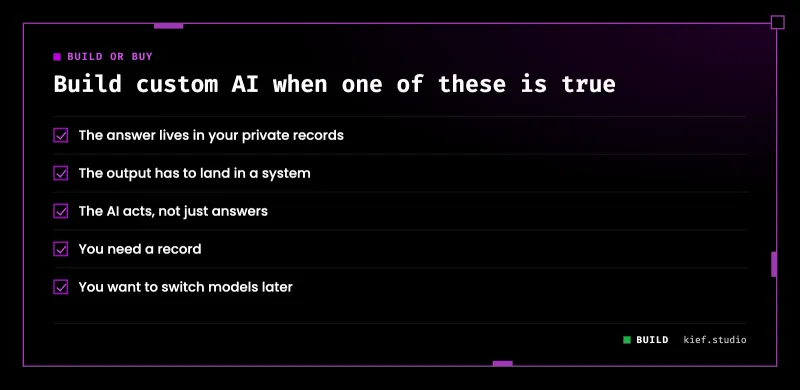
Custom AI solutions earn their cost when at least one of these is true:
- The answer lives in your private records. The AI needs your documents, your history or your customer data, with your access rules intact.
- The output has to land in a system. A draft in a chat window still needs a person to copy it somewhere. If the point is a record in your CRM, ERP or ticketing tool, that is an integration.
- The AI acts, not just answers. Anything that sends, buys, books or changes data needs approvals and a log.
- You need a record. Regulated or contract-bound work needs to show what the AI saw, what it produced and who approved it.
- You want to switch models later. Owning the workflow around the model keeps you free to change providers when prices or quality move.
That last point is the core of our knowledge base answer on whether to own or rent AI: rent the commodity, own the workflow, the data and the record of what the AI did. I made the longer case in own versus rent AI (opens in a new tab). If you are weighing custom software against packaged tools more broadly, our note on bespoke versus off-the-shelf software uses the same test.
Why do so many custom AI projects stall before production?
Adoption is wide. AI that acts on its own is still rare. Stanford's 2026 AI Index reports that generative AI "is now used in at least one business function at 70% of organizations," while "AI agent deployment was in the single digits across nearly all business functions." (Stanford HAI, AI Index 2026, Economy chapter (opens in a new tab))
A widely cited 2025 report from MIT's Project NANDA put it more sharply: "only 5 percent of custom enterprise AI tools reach production." Read that figure with its method in view. The report rests on 52 structured interviews with enterprise leaders, an analysis of more than 300 public AI initiatives and announcements, and a survey of 153 business professionals. (The Register, August 18, 2025 (opens in a new tab)) That is a small sample for a large claim. It is a signal about how hard the last mile is, not a census of failure.
The reason it gives is useful anyway. The report traces the gap to the inability of AI systems to retain data, adapt and learn over time. (The Register (opens in a new tab)) In my reading, that describes a build that was finished as a demo and never given an owner: no one feeding corrections back, no one updating the documents it reads, no one watching what it does on a bad day. The difference between an AI agent at 3am and in the demo (opens in a new tab) is mostly operations.
What does a custom AI build include?
The National Institute of Standards and Technology published its AI Risk Management Framework on January 26, 2023 and a Generative AI Profile, NIST AI 600-1, on July 26, 2024. Both are voluntary. (NIST AI RMF (opens in a new tab)) They are a good checklist for what a serious build covers, whatever its size. Here is how that translates for a business:
- One workflow, measured before anything is built. Pick the job, define what good output looks like, and record how long it takes today. Without a baseline you cannot tell whether the AI helped.
- Data and permissions. List the sources the AI may read and who is allowed to see each one. This is where retrieval augmented generation projects succeed or leak.
- Model choice, kept swappable. Most businesses do not need to train a model. A private AI model setup usually means a commercial or open model running under your contract and your access rules, on terms that keep your data out of model training. Write the workflow so the model can change.
- Quality checks on every output. NIST AI 600-1 lists confabulation, "the production of confidently stated but erroneous or false content," as a generative AI risk, and suggests teams "review and verify sources and citations in GAI system outputs." (NIST AI 600-1, July 2024 (opens in a new tab)) Our note on AI quality gates shows what those checks look like.
- A human path. Anything the model is unsure about goes to a person, with the source attached.
- Logs. What came in, what the AI produced, what a person approved or changed.
- Hosting and an owner. Where it runs, who patches it, and who gets the alert when it breaks.
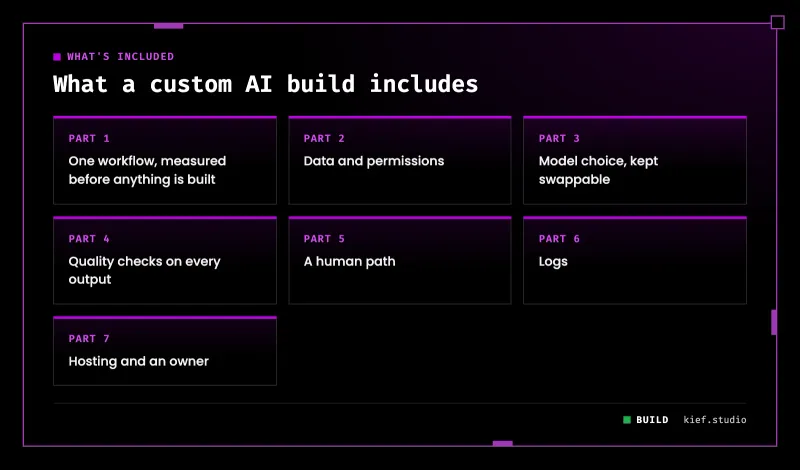
In custom AI solutions, only one of those seven items is about the model. The rest is the system around it, which is why custom generative AI services look more like software development than like buying a tool.
Who runs custom AI solutions after launch?
This is the question I would ask any AI development company before signing, and the one most proposals answer last. Models change, providers retire versions, documents go stale and staff find new ways to use the tool. NIST's profile suggests teams "re-assess model risks after fine-tuning or retrieval-augmented generation implementation and for any third-party GAI models deployed for applications and/or use cases that were not evaluated in initial testing." (NIST AI 600-1, MG-3.1-003 (opens in a new tab))

In plain terms, someone has to:
- keep the document index current and respect access changes when people join or leave;
- retest when the model provider ships a new version;
- read the log of what went to a person and why, and tighten the checks;
- report what the system handled and what it handed back.
If the answer to "who does that?" is "your office manager, in spare time," custom AI solutions drift. Plan for it either way: inside your team, with the builder on a support agreement, or with a studio that hosts and runs it.
What drives the cost of custom AI solutions?
I have not found a reputable, neutral source for typical prices of custom AI solutions at small and mid-sized businesses, so I will not quote a range. What moves the cost is predictable:
- How many systems it touches. Reading one shared drive is simpler than writing into a CRM, an ERP and a billing tool.
- How messy and sensitive the data is. Scanned PDFs, mixed permissions and regulated records take more work than a clean wiki.
- How much it is allowed to do. Answering questions costs less to build safely than taking actions with approvals.
- Model usage. API providers bill by use, so volume matters. Brian Gagne, Kief Studio's CTO and co-founder, worked through what bring-your-own-key AI usage costs a small team (opens in a new tab).
- Who runs it afterward. Hosting, monitoring and model updates are ongoing, not one-time.
Tax treatment can differ between a subscription and software built for you; I covered Massachusetts sales tax on SaaS versus custom software (opens in a new tab) separately. Kief Studio prices custom work around the use case, the size of the business, what it needs and the stack it already runs.
Custom AI solutions in Boston, Woburn, Burlington and Waltham
Massachusetts has public support for AI work. Governor Healey launched the Massachusetts AI Hub in December 2024, using resources authorized in the Mass Leads Act. (Massachusetts AI Hub at MassTech, May 2025 (opens in a new tab)) The businesses buying custom AI solutions here are mostly not AI companies, though. They are operators with records, regulations and customers.
Woburn describes itself as "centrally located at the intersection of Rt. 128 and 93," with "a thriving life sciences sector, state of the art office parks, and a diverse mix of small businesses," and counts 3,791 businesses and 44,578 working employees. (City of Woburn, Economic Development (opens in a new tab)) For a distributor or lab supplier there, the first custom AI solutions are often AI integration: orders, specs and inventory moving between systems without retyping.
Burlington credits the 1954 completion of Route 128 as "the catalyst for rapid industrial expansion" and names life scientists, manufacturers, tech innovators and medical professionals among its businesses. (Town of Burlington, Economic Development (opens in a new tab)) Waltham reports that much of its commercial activity, in technology, biotech, pharmaceuticals, consulting and manufacturing, "is concentrated along Interstate 95 (Route 128)." (City of Waltham, FY2024 Annual Comprehensive Financial Report (opens in a new tab)) Firms like these tend to hold years of protocols, specs and proposals, which is where custom AI solutions built on retrieval with source citations pay off.
Census's latest state estimate put AI use at 20.4% of Massachusetts businesses, against 24.2% nationally. The state number moves several points from one survey cycle to the next (it was 25.7% the cycle before), so one reading does not put Massachusetts ahead of or behind the country. (U.S. Census Bureau, BTOS state estimates (opens in a new tab)) Either way, most businesses here have room for custom AI solutions that start with one well-chosen workflow.
Kief Studio is in Shrewsbury, MA, and works with businesses in Boston, Woburn, Burlington and Waltham from there. We do not have an office in any of those towns.
Frequently asked questions
What does an AI consultant actually do?
A useful one picks the workflow worth automating, checks your data and permissions, recommends buy or build, and defines how success is measured. If they also build and run custom AI solutions, ask who operates the system after launch and what reports you get.
What are the uses of artificial intelligence in business?
Common generative AI use cases are drafting and summarizing, answering staff questions from internal documents, sorting and routing email or tickets, pulling fields from invoices and forms, and preparing replies or actions for a person to approve.
What companies provide AI services?
Four kinds: model providers that rent access to models, cloud platforms that host them, software vendors that add AI to their products, and studios or developers that build custom AI solutions around your own data and tools. Many businesses use more than one.
Are there AI companies in Boston that build custom AI solutions for small businesses?
Yes, from startups to established studios. Judge them on what they build around the model: permissions, quality checks, logs, a human approval path, and who runs it after launch.
Should a small business build custom AI or buy a subscription?
Buy a subscription for general drafting and research. Build when the AI must read private records with access rules, write into your systems, take actions that need approval, or keep a record you can show a customer or regulator.
How long does a custom AI build take?
It depends on how many systems it touches, how clean the data is and how much the AI may do on its own. Custom AI solutions that answer questions from one document set are far quicker than an agent that writes into several systems. Start with one.
Is a private AI model the same as training our own model?
Usually not. Most private setups run an existing model under your contract and access rules, with your documents searched at question time rather than trained in. Training your own model is rarely needed for a small or mid-sized business.
Where we fit
Kief Studio builds custom AI solutions as production systems, not demos. Our AI automation work picks the workflow, defines what good output looks like and measures how it runs today, then builds the automation with retries, error handling and quality gates on every output, and keeps a human path for anything the model is unsure about. For answers from your own files, our knowledge systems return the source document with every answer and respect the access rules you set; one engagement indexed 121 million records with sub-second search. Where AI needs to reach the tools you already pay for, API integration builds on authorized APIs only, with retries and an alert when a sync fails.
We run it for you on LTFI (opens in a new tab), the private system Kief Studio hosts and operates, which works with any model provider, so nothing is installed on your side and you can change models later. If the right answer is a custom portal or internal tool around the AI, that is our custom web application work, and the code and data are yours. What we do not build: demo-only chatbots, or projects meant to replace staff. More on our custom software development.
First conversation is free. No commitment.
Co-founder and CEO, Kief Studio