


Brian GagneCo-founder and CTO, Kief Studio
- Published
- 12 min read

TL;DR: A co-managed SOC keeps your in-house IT person in charge of the systems they know and adds an outside security operations team for 24/7 security monitoring, alert triage and escalation. It works when a written shared responsibility matrix says who owns each alert, each tool, the logs, and the call to contain an incident.
Picture a 70-person manufacturer in Marlborough with one IT person. Call that person Sam. Sam knows every server, every vendor login, and which machine on the shop floor still runs the old software. Sam also sleeps, takes vacations, and gets the flu.
The owner asks a fair question: do we hire a security team, hand everything to an outside provider, or is there something in between? A co-managed SOC is the something in between. Here is how it works, who owns what, and what to write down before you sign anything.
What is a co-managed SOC?
A SOC is a security operations center: the people, tools and process that watch your systems for signs of an attack and act on what they find. A co-managed SOC splits that job between your own staff and an outside team. Your IT person keeps the context and the keys. The outside team brings the hours, the analysts and the tooling to watch around the clock.
NIST describes this mix directly in its 2025 incident response guidance. An organization's incident handlers might be "on staff," "on contract (e.g., outsourcing a security operations center [SOC] to a managed security services provider [MSSP]...)," or available when needed, and "many organizations may use more than one of these approaches." (NIST SP 800-61 Rev. 3, April 2025 (opens in a new tab))
The same document names the thing most co-managed arrangements get wrong. When a provider takes on part of incident response, NIST calls it "a shared responsibility model in which the organization transfers some of its responsibilities to a provider," and says those responsibilities "should be clearly defined in a contract," including "authority to act on behalf of the organization." (NIST SP 800-61r3, section 2.2 (opens in a new tab))
Hold onto that phrase, authority to act. Most of this post is about it.
How is a co-managed SOC different from an MSSP or co-managed IT?
Three models get lumped together in search results and sales calls. They solve different problems.

A fully outsourced MSSP
A managed security service provider runs the whole monitoring function. Alerts land with them, they triage, and they escalate. It fits a company with nobody in-house who knows the systems. The trade is context: the provider sees your alerts but not your business, and the contract often limits them to alerting and recommending. Our short note on MSSP vs a co-managed SOC covers where each one fails, and if you are shopping for the fully outsourced kind, the managed SOC buyer checklist walks through vendor selection.
The co-managed SOC model
In a co-managed SOC, your person stays in the workflow. The outside team covers nights, weekends, vacations and the surge when something real is happening. Your IT person tells them what normal looks like. They tell your IT person when something is not normal. People sometimes search for this as a co-managed MSSP; the label matters less than the split of duties.
Co-managed IT is a different job
Co-managed IT usually means splitting the help desk, patching and projects between an internal person and an outside provider. My business partner (and wife) Amelia wrote about co-managed IT without splitting accountability (opens in a new tab). A co-managed SOC is the security operations version of the same idea, and the accountability problem is sharper, because the gap between two teams is where an alert gets dropped.
One more neighbor: managed detection and response, or MDR, usually watches endpoints such as laptops and servers. If that is the piece you need, our post on small business MDR covers it.
Why add a co-managed SOC instead of hiring a security team?
Start with the math on hiring. The 2025 annual median wage for information security analysts was $128,630 in the Worcester, MA metro area and $136,550 statewide. (O*NET, BLS 2025 wage data (opens in a new tab)) The national median was $129,180 in May 2025, and BLS notes these analysts "sometimes have to be on call outside of normal business hours in case of an emergency." (BLS Occupational Outlook Handbook (opens in a new tab))
- Massachusetts
- $136,550
- United States
- $129,180
- Worcester, MA metro
- $128,630
One in-house security analyst costs about $130,000 a year in pay alone (O*NET OnLine, BLS 2025 wage data for information security analysts)
Now the clock. A week has 168 hours. One full-time person covers about 40 of them. Covering every hour with your own people takes more than four analysts before anyone takes a day off. That is the gap a co-managed SOC fills: you keep the one person who knows your stack and rent the other 128 hours.
NIST's small business guide to the Cybersecurity Framework says the same thing in plain words: "Prioritize engaging a service provider to monitor computers and networks for suspicious activity if you don't have the resources to do it internally." (NIST SP 1300, CSF 2.0 Small Business Quick-Start Guide, February 2024 (opens in a new tab)) MyRHC keeps a plain reference to the NIST Cybersecurity Framework 2.0 (opens in a new tab) if you want the whole map.
Then look at who actually catches breaches. In IBM's Cost of a Data Breach Report 2026, internal IT or security teams identified 38% of breaches, and managed security service providers "identified almost as many." Attackers disclosed 17% themselves, and those attacker-disclosed breaches were the costliest of any discovery route. (IBM, Cost of a Data Breach Report 2026 (opens in a new tab); Help Net Security, July 30, 2026 (opens in a new tab))
Put those two facts side by side. The two groups a co-managed SOC combines, your own team and an outside security provider, are the two that found the most breaches in IBM's study. The costliest outcome is the one where nobody on either side was watching and the attacker told you.
Who owns what in a co-managed SOC?
This is the shared responsibility matrix, and it is the most important page in a co-managed SOC agreement. For every line, write down who does it, how fast, and who signs off. Here are the four lines that cause the most trouble.

Alerts: triage, escalation and handoffs
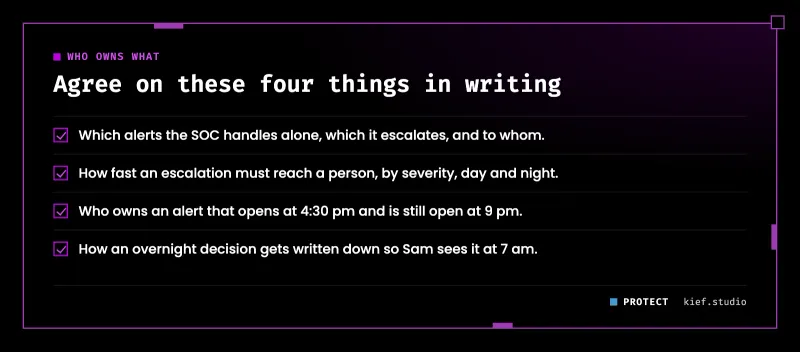
Alert triage and escalation is the daily heart of a co-managed SOC. The outside team watches the queue, throws out the noise, and escalates what matters. Your matrix should say:
- Which alerts the SOC handles alone, which it escalates, and to whom.
- How fast an escalation must reach a person, by severity, day and night.
- Who owns an alert that opens at 4:30 pm and is still open at 9 pm.
- How an overnight decision gets written down so Sam sees it at 7 am.
Response time and resolution time are different promises. Amelia covers the difference in MSP SLA: response time is not resolution time (opens in a new tab), and our note on SLAs and response times explains how to write them.
Tools and admin access
Who owns the security tools in a co-managed SOC? Decide it before the first install. If the provider brings its own SIEM or endpoint agent and you leave, what happens to the data and the agents on your machines? If you own the licenses, the provider needs written, limited admin access.
NIST is direct about the risk: "Service providers often have privileged access to organizational systems and may also have access to sensitive organizational data," so the risk of the provider being compromised "should be considered and addressed." (NIST SP 800-61r3 (opens in a new tab)) Give the SOC its own named accounts with multifactor login, never a shared admin password, and review them every quarter.
Logs and SIEM log retention
Logs are the evidence. A joint guide from Australia's ACSC, CISA, the FBI, the NSA and partner agencies says a logging policy "should take into consideration any shared responsibilities between service providers and the organisation," and that "default log retention periods are often insufficient." It adds that "it can take up to 18 months to discover a cyber security incident and some malware can dwell on the network from 70 to 200 days before causing overt harm." (CISA and partners, Best Practices for Event Logging and Threat Detection, August 2024 (opens in a new tab); full guide PDF (opens in a new tab))
So SIEM log retention is a contract line in a co-managed SOC, not a default setting. Write down where the logs live, who can delete them, how long they are kept, and how you get a full copy if the relationship ends. The same guide warns that SIEMs "are attractive targets for malicious actors," so ask how the provider protects the SIEM itself. For the hands-on side, the HxHippy log auditing reference (opens in a new tab) shows what the raw material looks like.
The incident call
At 2 am the SOC sees a laptop talking to a server it should never touch. Can they isolate it, or do they have to wake someone up first?
NIST puts high-impact decisions with leadership, which "may have decision-making authority on high-impact response actions, such as shutting down or rebuilding critical services." (NIST SP 800-61r3 (opens in a new tab)) The co-managed SOC answer is a short pre-approved list: actions the SOC may take on its own (isolate one laptop, disable one account), actions that need Sam, and actions that need the owner. The NIST small business guide asks the same thing: understand "who has authority and responsibility for implementing various aspects of the plan." (NIST SP 1300 (opens in a new tab))
How do you build the incident response runbook for a co-managed SOC?
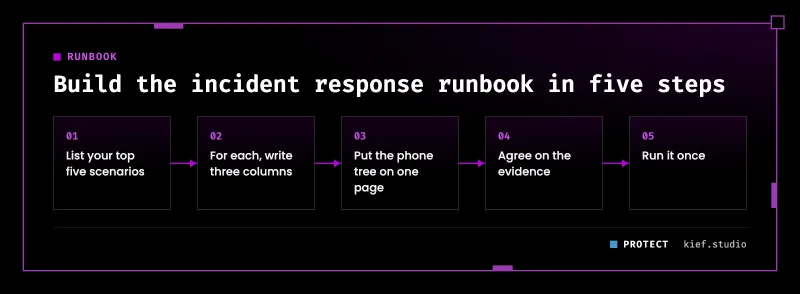
In a co-managed SOC, an incident response runbook turns the matrix into steps a tired person can follow at 2 am. NIST notes that playbooks "provide actionable steps or tasks for people to perform during various scenarios or situations." (NIST SP 800-61r3 (opens in a new tab)) Here is a starting order that works for most small teams:
- List your top five scenarios. A stolen password, ransomware on one laptop, a suspicious login to email, a vendor breach, a lost device.
- For each, write three columns. What the SOC does alone, what your IT person does, what the owner decides.
- Put the phone tree on one page. The SP 1300 template lists a business leader, a technical contact, legal, the bank, insurance and the state police.
- Agree on the evidence. Which logs get preserved, by whom, before anything is wiped or rebuilt.
- Run it once. A one-hour tabletop with Sam, the SOC and the owner. Fix whatever confused people.
Our note on incident response covers the phases, and what happens in the first 24 hours after a breach shows why the first decisions matter so much.
What does a co-managed SOC look like for a Metrowest business?
Take companies shaped like the Marlborough example: a few dozen to a few hundred people, one or two IT staff, and customer data. Here is how a co-managed SOC might play out along the 495 belt, as hypothetical examples:
- A medical device supplier in Marlborough keeps its IT lead for the plant network and the ERP. The co-managed SOC watches email, identity and endpoints overnight, and isolates a laptop on its own if ransomware behavior shows up.
- A professional services firm in Westborough has one IT person who also runs the help desk. The SOC handles triage. Anything touching client files escalates to the IT person and the managing partner.
- A biotech startup in Hopkinton owns its cloud tools and licenses. The SOC gets read access to the logs plus a short list of approved containment actions.
The hiring math shifts a little with the county line. BLS counts Worcester County as the Worcester, MA metro and Middlesex County as part of the Boston-Cambridge-Newton metro. (BLS OEWS area definitions (opens in a new tab)) Westborough is in Worcester County; Marlborough is in Middlesex. (Census Reporter, Westborough (opens in a new tab); Census Reporter, Marlborough (opens in a new tab)) The 2025 median for an information security analyst in the Boston metro was $136,550, against $128,630 in Worcester. (O*NET, BLS 2025 wage data (opens in a new tab))
Massachusetts adds its own reason to write things down. If you own or license personal information about Massachusetts residents and store or send it electronically, 201 CMR 17.04 lists "reasonable monitoring of systems, for unauthorized use of or access to personal information" as part of the required security system. (201 CMR 17.04, via Cornell LII (opens in a new tab)) 201 CMR 17.03 also calls for "documenting responsive actions taken in connection with any incident involving a breach of security." (201 CMR 17.03, via Cornell LII (opens in a new tab)) A co-managed SOC with a written matrix and a runbook gives you both the monitoring and the record. Monitoring alone is not the whole program, as our note on why compliance is not security explains.
Frequently asked questions
What is a co-managed SOC?
A co-managed SOC is a security operations center shared between your in-house IT staff and an outside security team. Your people keep context and control of the systems; the outside team adds 24/7 security monitoring, analysts and tooling, under a written split of duties.
What is a managed SOC provider?
A managed SOC provider is an outside company that runs security monitoring as a service: it collects your logs and alerts, triages them, and escalates or responds under a contract. NIST lists outsourcing a SOC to a managed security services provider as one way to staff incident response.
What is the difference between an MSSP and a co-managed SOC?
An MSSP usually takes over the monitoring function and escalates to you. A co-managed SOC keeps your staff in the workflow and adds coverage around them. The practical difference is who holds the authority to act during an incident, and how fast that person can be reached.
Who owns the security tools and logs in a co-managed SOC?
Whoever the contract says. Decide before onboarding who holds the licenses, who has admin access, where logs are stored, how long they are kept, and how you get a full copy if you leave. If it is not written, assume you will have to negotiate it during an exit.
Does a co-managed SOC replace my IT person?
No. A co-managed SOC depends on your IT person. They know what normal looks like, own the systems, and make the calls the SOC is not authorized to make. The SOC covers the hours and the specialist analysis one person cannot.
What is the Massachusetts WISP law?
Massachusetts regulation 201 CMR 17.00 requires anyone who owns or licenses personal information about state residents to keep a written information security program, or WISP, with specific safeguards. Amelia's guide to Massachusetts WISP requirements (opens in a new tab) walks through what it needs.
Is a co-managed SOC 24/7?
It can be, but only if the contract says which hours the outside team watches and what it may do on its own at night. A co-managed SOC sold as 24/7 security monitoring with no written escalation path or containment authority only tells you about the problem in the morning.
How much does a co-managed SOC cost?
There is no reputable neutral price survey for this, so we will not quote a range. Cost follows the number of systems and log sources watched, how long logs are kept, which hours are covered, and how much response authority the SOC carries. Kief Studio prices custom work around your use case, size, needs and existing stack.
This article is general information, not legal advice. Kief Studio is not a law firm. Regulations change, so check the current text and talk with a licensed Massachusetts attorney about your situation.
Where we fit
Kief Studio is not a help desk, and we will not sell you a slogan about round-the-clock coverage. What we do fits the co-managed model this post describes. Our managed security monitoring is ongoing watch, patching and hardening of the systems we build and host, and many clients keep their existing IT person or provider for laptops and help desk while we work alongside them. It is described on how we watch what we host on LTFI (opens in a new tab).
For threat detection and response, we inventory what you run, decide which signals matter, correlate them so one attack shows up as one alert, and write the response path for each alert: who acts, what they check, what they do. Then we practice it. 3am is a retainer, not a default, so after-hours response goes into the agreement in writing or not at all. The rest of our security services cover testing and design.
We are in Shrewsbury and work with companies across Marlborough, Westborough, Hopkinton and the 495 belt. If you have one good IT person and want them to stop being the only one watching, that is the conversation to have.
First conversation is free. No commitment.
Co-founder and CTO, Kief Studio
Related articles

Protect
Stop Overpaying for Managed SOC: A Mid-Market Buyer Checklist for 2026
Compare managed SOC quotes on what they cover: response authority, real 24/7, hidden fees and exit terms. A mid-market checklist from CISA and NIST guidance.
Brian Gagne

Protect
The Technical Demands Grew. Your Team Didn't. When an Agency Needs a Technical Partner
Performance, AI and security work grew faster than agency teams. Why a technical partner can carry the hard layer, and a three-line audit to find your gaps.
Amelia Gagne

Protect
Holistic Cyber Safety: How Kief Studio Builds Security Into the Work
Holistic cyber safety for a small business: NIST CSF 2.0, CISA goals, Massachusetts 201 CMR 17, AI tools, and a four week plan your team can run.
Brian Gagne