

Amelia GagneCo-founder and CEO, Kief Studio
- Published
- Updated
- 12 min read
TL;DR: An AI receptionist can answer every call, sort what callers need, book routine appointments and take clean messages after hours. An AI receptionist should not handle emergencies, clinical or billing judgment, upset callers or anything that moves money. In Massachusetts, say up front that calls are recorded and that the caller is talking to an AI receptionist.
An AI receptionist for a small business is now a realistic option, not a novelty. The software answers in a natural-sounding voice, works out what the caller wants, and writes into your calendar. The useful question for an owner is narrower than whether an AI receptionist works: which calls should it take, which should it hand to a person, and what rules apply here in Massachusetts?
The phone is often the first conversation someone has with your business. I would get the handoffs, the disclosures and the data right before an AI receptionist takes the first call, not after the first complaint.
What can an AI receptionist do for a small business?
An AI receptionist chains three pieces: speech recognition turns words into text, a language model decides what the caller wants and what to say, and a synthetic voice replies. Connected to your calendar, an AI receptionist can do real front desk work:
- Answer every call. No busy signal at lunch, no full voicemail box. Every caller gets a next step.
- Triage. Sort new appointments, existing customers, billing, vendors and urgent problems, and route each to the right person.
- Book routine appointments. Offer open times and confirm, inside rules you set: which services, how far out, which staff.
- Take complete messages. Name, callback number, reason and urgency, the same way every time.
- Cover after hours. Capture the 9 p.m. inquiry so it is waiting at 8 a.m., instead of becoming a hang-up.
- Answer common questions. Hours, directions, accepted insurance, what a service includes, from documents you approve.
In a study of more than 5,000 customer support agents, AI assistance raised issues resolved per hour by 15% on average. (Brynjolfsson, Li and Raymond, Quarterly Journal of Economics, 2025) That study is about AI helping people, which is the right frame for the phone too: an AI receptionist clears routine calls so your front desk has time for the ones that need a person.
What should an AI receptionist hand to a person?
Some calls cost far more to get wrong than a few minutes of staff time. Build the handoff for these first.
- Emergencies. A caller to a heating company who mentions a gas smell does not need an appointment. Massachusetts and federal pipeline safety guidance both say the same thing: leave the building and call 911 from a safe place. (Massachusetts Department of Public Utilities; U.S. Pipeline and Hazardous Materials Safety Administration) The AI receptionist should say that immediately and alert your on-call person, not try to book a visit.
- Clinical or technical judgment. Whether a swollen jaw can wait until Thursday is a question for a dentist, not a phone script.
- Money and disputes. Refunds, billing disagreements, payment plans and price exceptions.
- Upset or distressed callers. Someone who is angry, frightened or grieving should reach a person quickly.
- Anything the system is unsure about. If it cannot tell what the caller needs after one clarifying question, it should hand off rather than guess.
The security standards point the same way. OWASP's 2025 list of risks for AI applications recommends that systems "require a human to approve high-impact actions before they are taken." (OWASP, LLM06 Excessive Agency, 2025)
The worst outcome is a caller who cannot get out of the AI receptionist. The Consumer Financial Protection Bureau studied chatbots in consumer finance and described "doom loops" that "are often caused when a customer's issue falls outside the chatbot's limited capabilities." (CFPB, Chatbots in Consumer Finance, June 2023) The fix: "press 0 or say 'person'" works at any point and actually reaches someone or takes a priority message.
Do you have to tell callers they are talking to an AI?
This section points to primary sources. It is not legal advice; talk to your attorney before launch.
Start with recording, since an AI receptionist transcribes every call by design. Massachusetts law makes it a crime to "secretly hear, secretly record" a phone call without prior authority from all parties, punishable by up to five years in state prison, a fine up to $10,000, or both, plus civil damages. (M.G.L. c. 272, s. 99) That is why Massachusetts is often called an all-party consent state.
The Supreme Judicial Court focuses on the word secretly. In 2021 it held that "it is the act of hearing or recording itself that must be concealed" for the law to apply, and found no violation because the person on the call knew throughout that he was being recorded. (Curtatone v. Barstool Sports, SJC, 2021; WBUR) The lesson: say it in the first sentence, before the caller says anything that matters. Brian covered the same law for AI note takers in meetings.
Disclosing the AI receptionist is a separate question. The Massachusetts Attorney General's 2024 advisory says existing consumer protection, anti-discrimination and data privacy laws "still apply to emerging technologies, including AI systems," and names deepfakes, voice cloning and chatbots "used to engage in fraud." (WBUR, April 2024) In August 2024 the FCC also proposed rules that would require callers to disclose AI-generated calls. It was a proposal; check its status before relying on it. (FCC 24-84, August 2024)
Either way, tell people. A greeting like "Thanks for calling. I'm the office's automated assistant, and this call is recorded. Say 'person' at any time to reach our team" takes a few seconds, and nobody feels tricked later.
Does the FCC's AI voice ruling apply to an AI receptionist?
It applies to the calls your AI receptionist makes. On February 8, 2024, the FCC confirmed that the Telephone Consumer Protection Act's limits on "artificial or prerecorded voice" calls cover AI-generated voices, so those calls "require the prior express consent of the called party" unless an emergency purpose or exemption applies. (FCC Declaratory Ruling 24-17; PBS NewsHour)
An AI receptionist that only answers is not placing calls. My reading is that the ruling matters once you turn on automatic callbacks, voice reminders or follow-up calls, because each is an outbound call in an artificial voice.
Before you switch those on, confirm with your attorney which outbound calls the system will place, how you record each person's consent, and how someone opts out and stays out.
Can every caller use an AI receptionist?
Not unless you design for it. More than 1 in 4 U.S. adults have some type of disability, and 6.2% have a hearing disability, according to the CDC. (CDC, Disability Impacts All of Us) Your callers include relay users, people with speech differences and people with strong accents.
Under the ADA rules for businesses open to the public, which include the professional office of a health care provider, an automated-attendant or interactive voice response system "must provide effective real-time communication" with people using text telephones and FCC-approved relay services. (28 CFR 36.303) The Justice Department's guidance adds that staff "must treat relay calls just like other calls." (ADA.gov, Effective Communication)
Relay calls are where an AI receptionist can fail. A communications assistant opens with "Hello. This is the relay service," and replies come with pauses while text is typed. The FCC's consumer guide asks people not to hang up on these calls. (FCC, Telecommunications Relay Service) A system that treats silence as a dropped call will hang up anyway, so test with a real relay call before launch.
Speech recognition also works better for some voices than others. A Stanford-led study of five major systems found an average word error rate of 0.35 for Black speakers against 0.19 for white speakers. (Koenecke et al., PNAS, 2020) A 2024 study of a widely used speech-to-text model, tested in 2023, found roughly 1% of transcriptions contained whole phrases never said, more often for speakers with aphasia, whose speech has longer pauses. (Koenecke et al., FAccT 2024) Models have improved since, but the design lesson holds:
- Read back every name, number, date and time, and let the caller correct it.
- Give a person on request, at any point, with no penalty for asking.
- Offer another way in: text, a web form or email, listed on your site and in the greeting.
- Have a person check the parts of a transcript that become a record.
I wrote about how AI customer communication can stay human, and the same habits apply on the phone.
What happens to the recordings and transcripts?
An AI receptionist collects audio, transcripts, phone numbers and whatever callers volunteer about their health, homes and money. Know where each goes and how long it stays.
Massachusetts already sets a bar for vendors. 201 CMR 17.00 requires businesses to select service providers "capable of maintaining appropriate security measures" and to require those measures by contract. (201 CMR 17.03, via Cornell LII)
A dental office has a second layer. Under HIPAA, a vendor that "creates, receives, maintains, or transmits protected health information" on a practice's behalf is generally a business associate and needs a business associate agreement. (45 CFR 160.103) See our HIPAA notes and MyRHC's reference on HIPAA business associate requirements. Brian wrote about AI scribe patient consent in Massachusetts, which covers the same agreement for clinical notes.
Then there is model training. The FTC warned in February 2024 that it "may be unfair or deceptive" for a company to start "using that data for AI training" and tell customers only through a quiet change to its terms of service. (FTC, February 2024) Read the terms before you sign and when they change.
Questions to put to any AI receptionist provider, in writing:
- Where are recordings and transcripts stored, and in which country?
- How long are they kept, and can you set a shorter period?
- Are they used to train any model, yours or anyone else's?
- Who on the provider's side can listen to calls, and is that access logged?
- Will you sign our contract terms, or a business associate agreement if we need one?
- If we leave, how do we export our data, and how do you confirm deletion?
Voice recordings are also raw material for voice cloning, so protect them like credentials. My explainer on vishing and voice phishing shows why. Our knowledge base note on voice systems explains why we prefer voice processing that runs on hardware you control, where audio never leaves your network.
How do you measure whether an AI receptionist is working?
NIST's voluntary AI Risk Management Framework puts it plainly: "AI systems should be tested before their deployment and regularly while in operation." (NIST AI RMF 1.0, January 2023) For an AI receptionist, measure before launch, then weekly.
Count these for two weeks before launch, as a baseline:
- Calls answered versus calls missed or sent to voicemail, by hour of day.
- After-hours inquiries and how many became appointments or jobs.
- Time to a person for calls that need one.
After launch, check whether it answers well, not just whether it answers:
- Handoff rate, and how many handoffs were correct. Too few can mean the system is guessing.
- Booking accuracy. Pull 20 bookings a week and check them against the recording: right service, right person, right time.
- Message accuracy. Does the callback number work? Is the reason right?
- Hang-ups in the middle of a call, and where in the script they happen.
- Monthly test calls: one through relay, one with background noise, one with an emergency phrase.
Providers update their models, and a change you never asked for can alter how your AI receptionist handles an edge case. Kief Studio calls these recurring checks quality gates.
What does this look like for a Central Massachusetts business?
Census data for 2023 counts 351 offices of dentists in Worcester County, and 93% of them had fewer than 20 employees. The county also had 328 plumbing, heating and air conditioning contractors, 88% of them with fewer than 20 employees. (U.S. Census Bureau, County Business Patterns 2023) In an office that size, if the person who answers the phone is with a patient or on a roof, the call goes to voicemail.
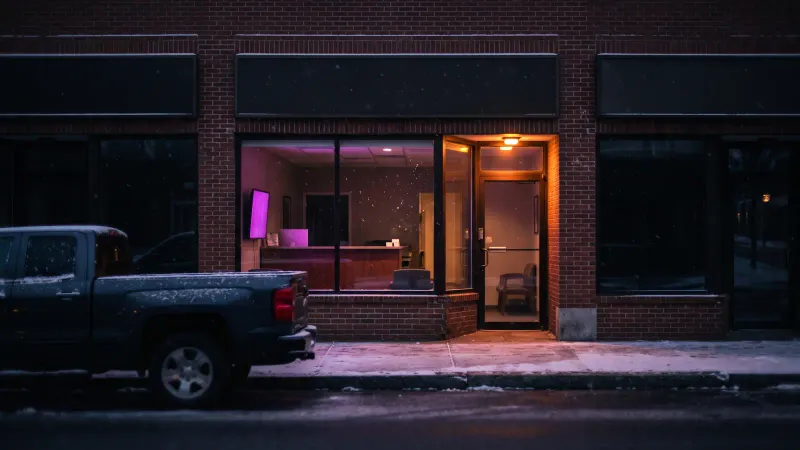
A dental office in Shrewsbury might let the AI receptionist book cleanings for existing patients, confirm insurance names from an approved list, and take new patient inquiries after hours. Pain, swelling, bleeding or a broken tooth goes straight to the on-call line. The vendor signs a business associate agreement first.
An HVAC company in Leicester might let its AI receptionist book fall maintenance and take messages on a January night. A caller who mentions a gas smell or a carbon monoxide alarm hears the safety instruction at once, and the on-call technician is paged. Reminder calls stay off until the company has a consent process its attorney has reviewed.
In both cases the goal of the AI receptionist is fewer missed calls and staff time spent where judgment is needed. See how we work in Worcester and Shrewsbury.
Frequently asked questions
What is an AI receptionist?
Software that answers your phone in a synthetic voice, works out what callers need, and books, answers or takes messages, handing anything sensitive to a person.
Is it legal to record calls with an AI receptionist in Massachusetts?
Massachusetts prohibits secretly recording a call without prior authority from all parties. Announce the recording at the start of every call, and confirm your setup with your attorney.
Do I have to tell callers they are speaking with an AI receptionist?
The Massachusetts Attorney General says existing consumer protection laws apply to AI, and the FCC has proposed AI call disclosure rules. Telling callers in the greeting is the simple choice.
Can an AI receptionist make reminder or follow-up calls?
Under the FCC's 2024 ruling, calls using an AI-generated voice need the called party's prior express consent unless an exemption applies. Record consent before turning outbound calls on.
What calls should never go to an AI receptionist alone?
Emergencies, clinical or technical judgment, billing disputes, upset callers and anything the system is unsure about. Each needs a fast path to a person.
Can a dental office use an AI receptionist under HIPAA?
A vendor that handles patient information for a practice is generally a HIPAA business associate, so the practice needs a business associate agreement before patient calls go through it.
This article is general information, not legal advice. Kief Studio is not a law firm, and reading it does not create an attorney-client relationship. Laws and regulations change, so check the current text and talk with a licensed Massachusetts attorney about your situation.
Where we fit
Kief Studio is in Shrewsbury, and we build AI automation for businesses in Worcester, Shrewsbury and across Central Massachusetts. Our AI automation work is for teams with repetitive work that follows rules most of the time. We pick the workflow, define what good output looks like, and measure how it runs today.
Then we build the automation with retries, error handling and quality gates on every output, keep a human path for anything the model is unsure about, and run it for you on LTFI, reporting what it handled and what it sent to a person. We do not build demo-only chatbots or projects meant to replace staff. We build systems that remove bottlenecks, and your people drive the work. See how we approach automation.
First conversation is free. No commitment.
Co-founder and CEO, Kief Studio