
White label SEO is search optimization work that one company performs and another company sells under its own brand. The reselling agency keeps the client, the price, and the reports, and the partner does the audits, fixes, content, and tracking behind the scenes without contacting the client.

What are white label SEO services, and how do agencies resell them?
White label SEO services are search optimization work done by one company and sold by another under its own brand. An agency keeps the client, the price, and the reports, while the partner does the technical fixes, content, local listings, and now answer engine and generative engine work. The agency stays responsible for the results, so the partner's methods have to hold up to Google's spam policies and the FTC's rules.
What are white label SEO services?
White label SEO services are search engine optimization done by a specialist partner and delivered by your agency under your name. The client signs with you, pays you, and reads reports on your letterhead. The partner audits the site, fixes what stops search engines from reading it, writes or improves pages, works on the Google Business Profile, and tracks the results, without ever speaking to the client unless you bring them in.
Agencies use the arrangement when clients ask for search work the agency does not do in-house, or cannot do at the depth the client needs. A design studio adds SEO to every new site. A marketing agency keeps a client who wanted search and paid media under one roof. An IT provider answers a client who asks why the website never shows up. In each case the agency sells and manages, and the partner delivers.
The term is borrowed from manufacturing, where a white label product is made by one company and sold under another's brand. Our note on how white label SEO changed after AI Overviews covers what that shift means for agencies already reselling search work.
How do agencies resell white label SEO services?
Agencies resell them by putting the partner's work inside their own process: the agency sells, scopes, and reports, and the partner does the work between those steps. A clean setup runs like this.
- Sell and scope. The agency agrees the goals, the pages, and the locations with the client, then briefs the partner with access details and brand rules.
- Audit. The partner checks crawler access, indexing, page speed, structured data, and the Google Business Profile, and reports what is broken in plain language the agency can reuse.
- Fix and write. The partner fixes the technical problems and writes or rewrites the pages the client's buyers search for, with every claim sourced. The agency approves anything the client will see.
- Report. Each month the partner records rankings, the sources AI answers cite, and what changed, in a template that carries the agency's brand.
- Keep the accounts straight. Search Console, analytics, and the Business Profile stay under accounts the client owns, with agency and partner access added as users, never as owners.
| Task | Your agency | The white label partner |
|---|---|---|
| Client relationship and contract | Owns it | Stays out unless invited |
| Price and packaging | Sets them | Supplies a partner cost |
| Technical audit and fixes | Approves | Does the work |
| Pages and content | Approves for voice and accuracy | Researches, writes, and sources |
| Google Business Profile | Holds client access and approves changes | Cleans up listings and posts updates |
| AI answer tracking | Shares the findings with the client | Runs the monthly citation check |
| Monthly report | Sends it under the agency's brand | Prepares the data and the summary |
What should white label SEO services include in 2026?
They should cover four kinds of work: technical health, pages worth citing, local presence, and visibility in AI answers, all reported in a way you can check. A package that stops at keyword reports and a monthly blog post is selling an older version of the job.
Technical health means the site can be crawled, indexed, and loaded quickly on a phone. Pages worth citing means each real question a buyer asks gets its own page, with the answer first and sources linked. Local presence means a complete Google Business Profile and site pages that agree with it. AI visibility means the crawlers behind ChatGPT search and Google's AI features can reach the site, and someone checks every month which sources the AI answers cite.
Every one of those has to be done honestly. Google says nobody can promise a top position in its results, and it warns against SEOs who "talk about link popularity schemes" (Google Search Central, Do you need an SEO?). A partner whose package rests on promised positions or bought links is selling risk with your name on it.
Why do white label SEO services need AEO and GEO now?
Because more searches now end in an AI-written answer, and a client will ask why a competitor is named in it and they are not. Answer engine optimization (AEO) shapes pages so an assistant can quote them. Generative engine optimization (GEO) gets a business cited when ChatGPT search, Perplexity, or Google's AI Mode writes a longer answer. Our guide to generative engine optimization explains the research behind it.
The good news for agencies is that the work builds on SEO. Google says there are "no additional requirements to appear in AI Overviews or AI Mode, nor other special optimizations necessary" beyond a page being indexed and eligible for a snippet (Google Search Central, AI features and your website). The extra pieces are crawler access and measurement. OpenAI says sites that opt out of OAI-SearchBot are not shown in ChatGPT search answers (OpenAI, overview of OpenAI crawlers), so a partner should check robots.txt and the firewall for every client.
Reports have to change too. A Pew Research Center study of 900 U.S. adults found that people who saw an AI summary on Google clicked a traditional result in 8% of visits, against 15% when no summary appeared, and ended their session after 26% of searches with a summary versus 16% without one. A client whose clicks dip may still be gaining citations, so the report should show both. For the platform steps, read how to show up in Google AI Overviews and how to rank in ChatGPT.
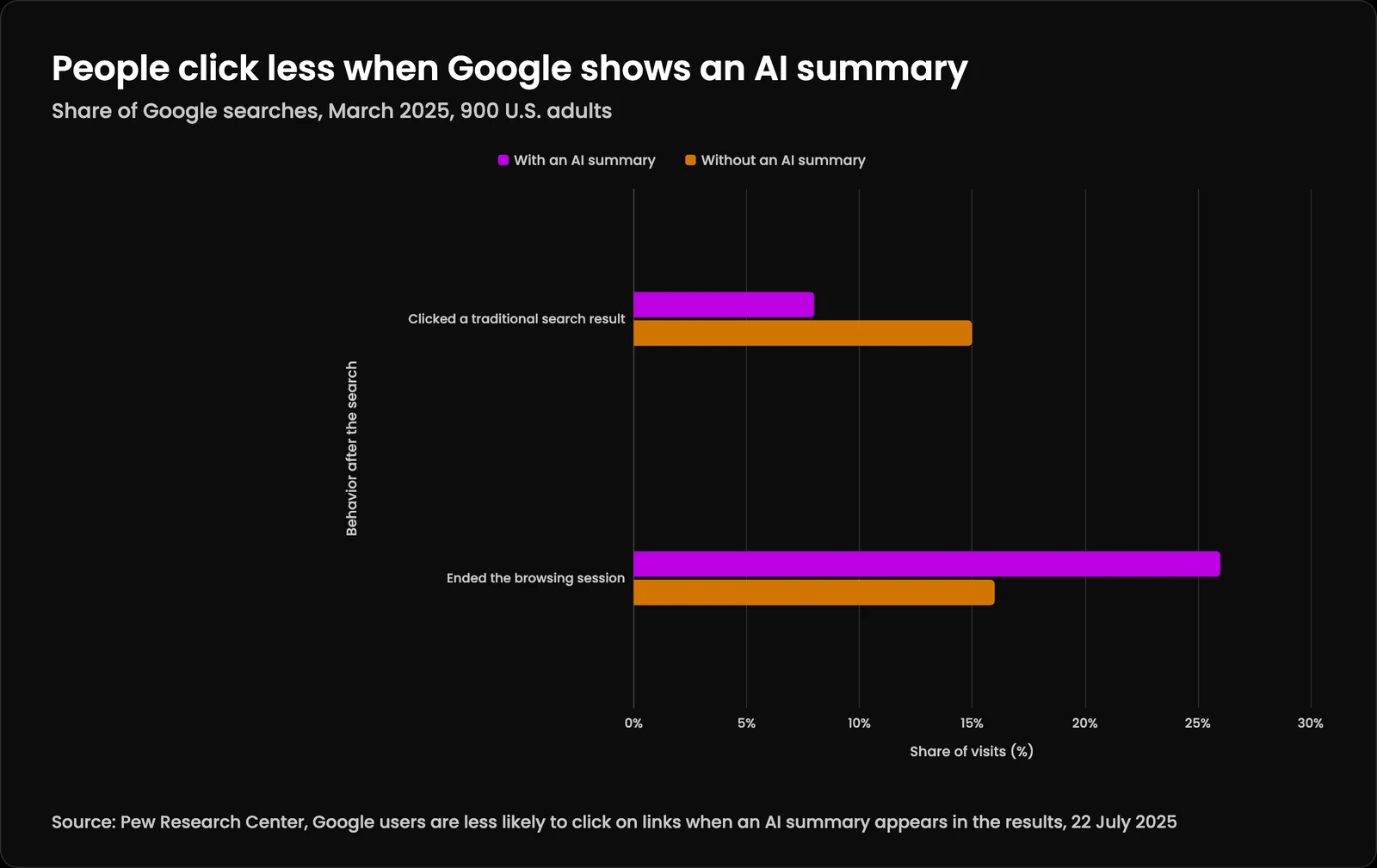
| What the person did next | With an AI summary | Without an AI summary |
|---|---|---|
| Clicked a traditional search result | 8% | 15% |
| Ended the browsing session | 26% | 16% |
What should an agency check before reselling white label SEO services?
Check the methods before the margins, because Google holds you to them. Its guidance says "Ultimately, you are responsible for the actions of any companies you hire" (Google Search Central). Google suggests asking an SEO for examples of past work, whether it follows Google Search Essentials, what results it expects and in what timeframe, how it measures success, and whether it will share every change it makes to the site.
| Ask the partner | A good answer | A red flag |
|---|---|---|
| How do you build links? | Earned mentions, partnerships, and content worth linking to | Bought links or a private link network |
| What results do you promise? | A baseline, a plan, and a monthly record | A promised position by a date |
| Who writes the content? | Named writers with a review and fact-check step | Bulk AI pages with no editor |
| How do you handle reviews? | Asking real customers, nothing paid or invented | Review packages or incentives for five-star reviews |
| Whose accounts hold the data? | The client's, with access added for you and the partner | The partner's own accounts |
| Do you track AI answers? | A fixed question list checked monthly across engines | No mention of AI search at all |
| Will you share every change? | A change log the agency can read | A black box |
Then test the answers against the table below. Amelia Gagne's AEO audit a small business can run in a week is a quick way to check whether a partner's AI visibility claims match what the engines actually show.
What are the risks of white label SEO services?
The main risk is that the partner's shortcuts become your client's penalty. Google's spam policies list "buying or selling links for ranking purposes" as link spam and define scaled content abuse as "when many pages are generated for the primary purpose of manipulating search rankings and not helping users." They state that sites which violate the policies "may rank lower in results or not appear in results at all."
Reviews carry legal risk as well. The Federal Trade Commission's final rule banning fake reviews and testimonials, announced on 14 August 2024, prohibits creating, selling, or buying fake reviews, including AI-generated ones, and buying reviews tied to a particular sentiment. A partner that offers review packages is offering your client legal risk.
AI-written content brings a quieter risk: a source that does not exist. Qurtoo's entry on hallucinated citations explains how a model can invent a paper or a page that looks real. Every figure in work you resell should link to a source a person has opened. Our AI quality gates exist for exactly this.
Is it legal to resell white label SEO services?
Yes. Reselling work a partner produced under your own brand is a common, lawful arrangement. The law cares about what you tell people. The FTC says that under the FTC Act "Advertising must be truthful and non-deceptive" and that "Advertisers must have evidence to back up their claims" (FTC, Advertising FAQs: a guide for small business). Describe your results and your process accurately, and do not claim credentials or staff you do not have.
Referral arrangements have their own rule. If you earn a fee for sending a client to a provider, the FTC's guidance says a connection consumers would not expect "should be disclosed clearly and conspicuously" (FTC, Endorsement Guides: What People Are Asking). Our partner program discloses referral fees to the referred client for that reason.
How much do white label SEO services cost?
It depends on the scope, and anyone quoting a flat number before seeing the site is guessing. The real cost drivers are the size and condition of the site, how many pages need writing or rewriting, how many locations and Business Profiles are involved, whether AI answer tracking is included, how competitive the searches are, and how much reporting the agency wants prepared. Your price to the client is yours to set on top of the partner cost.
Price the ongoing part as a defined package, not open hours. Brian Gagne's piece your retainer is a product, so treat it like one shows how to package monthly work so extras become paid changes. The LTFI note on what agencies keep when they resell versus embed explains why a markup on cost is not the same as a margin.
Is white label SEO better than in-house SEO?
Neither is better in general. White label suits an agency whose clients want search work now, at a depth the team cannot staff. In-house suits an agency where search is the core of what it sells and the volume justifies a full-time specialist, plus the tools and training around that person.
An agency can also do both: an in-house strategist owns the client conversation and the plan, and a partner handles technical fixes, page production, and tracking. That split keeps the expertise the client sees inside your agency, and moves the volume work to people who do it every day.
How does Kief Studio deliver white label SEO services?
We deliver our SEO, AEO, and GEO service behind agencies on the same terms as our white label web development: a mutual NDA, no contact with your clients unless you ask, and nothing in our portfolio. Because we also build and host websites, a problem found in search can be fixed in the site itself instead of waiting on another developer. Client accounts stay in the client's name, as our guide to who owns the website and the login explains.
IT providers and security firms can read about partner programs for MSPs and MSSPs, and agencies that want the background on answer engines can start with answer engine optimization for a small business.
Also read
What are white label SEO services, and how do agencies resell them?: questions people ask
What is a white label SEO?
What are white label SEO services?
White label SEO services are technical audits and fixes, page writing, Google Business Profile work, link earning, AI answer tracking, and monthly reporting delivered by a partner under your agency's brand. Good ones follow Google's spam policies, keep data in the client's accounts, and share every change they make.What is a white label SEO agency?
A white label SEO agency does search work for other agencies rather than for businesses directly. Its clients are the agencies that resell the work. It stays invisible to the end client and supplies reports and deliverables the reseller can send under its own name.How much does white label SEO cost?
It depends on the site's size and condition, how many pages need writing, how many locations are involved, how competitive the searches are, and whether AI answer tracking is included. Be wary of flat packages quoted before anyone has looked at the site. You set your own price to the client.Is white labelling illegal?
No. Selling work a partner produced under your own brand is lawful and common. What you must do is advertise honestly: the FTC says advertising must be truthful and non-deceptive. Do not invent credentials, results, or staff, and disclose any referral fees to the client.What is a white label reseller?
A white label reseller is a business that buys a product or service from a provider and sells it under its own brand. In SEO, that is usually a marketing, design, or IT agency that sells search work to its clients while a partner performs it.How much to charge for white labeling?
Start from the partner cost, then add the time your agency spends on account management, approvals, and reporting, plus the margin you need. Remember that a markup on cost is not the same as a margin on price. Package the monthly work with clear inclusions so extra requests become paid changes.What is white-label local SEO?
White-label local SEO is local search work, such as Google Business Profile cleanup, location pages, and review requests from real customers, done by a partner under your agency's brand. It matters most for clients that serve nearby towns, where the map results often bring more calls than the links below them.Can ChatGPT do SEO?
ChatGPT can help draft, outline, and check SEO work quickly. It cannot verify facts on its own, see a client's Search Console, or know the business, and it can invent sources. Any white label partner using AI should have a person fact-check and approve every page before it ships.Is SEO dead or evolving in 2026?
Evolving. Google says its AI Overviews and AI Mode have no requirements beyond a page being indexed and eligible for a snippet, so classic SEO still feeds AI answers. What changed is measurement: reports now need to show citations in AI answers alongside rankings and clicks.Does local SEO still work?
Yes. People still search for services near them, and Google's map results and AI answers both draw on accurate business information. A complete Google Business Profile, site pages that match it, and real customer reviews remain the core of local search work.Is white label SEO better than in-house SEO?
It depends on volume and focus. White label suits agencies that need search depth now without hiring. In-house suits agencies where search is the main product and the volume supports a full-time specialist. An agency can also combine an in-house strategist with a partner for production work.
Keep reading
More in Automate
- The LTFI Methodology
How the studio builds with AI. The product is at ltfi.ai.
- Multi-Agent Orchestration
Specialized AI agents coordinated as one system that does the work and hands the decisions to a person.
- Knowledge Systems
Search that understands meaning, not just keywords. Answers grounded in your actual data.