
Generative engine optimization (GEO) is the work of making a site easy for AI engines such as ChatGPT search, Perplexity, Google AI Overviews, and Copilot to find, understand, and cite when they write an answer. It builds on SEO: open crawler access, indexed pages, clear entities, and sourced passages that make sense on their own.

What is generative engine optimization (GEO)?
Generative engine optimization (GEO) is the work of making a website easy for AI systems such as ChatGPT search, Perplexity, Google AI Overviews, and Copilot in Bing to find, understand, and cite when they write an answer. The term comes from a 2023 research paper accepted to KDD 2024. It builds on SEO: open crawler access, indexed pages, clearly named entities, and sourced passages that stand on their own.
What is generative engine optimization?
Generative engine optimization is the practice of shaping a website so that generative engines, the AI systems that write an answer instead of listing links, can reach it, understand it, and cite it. A generative engine runs one or more searches, reads the pages it finds, and writes a single response with a few sources attached. GEO is about being one of those sources, and about that answer describing your business correctly.
Bing now uses the term in its own documentation. The Bing Webmaster Guidelines say that generative engine optimization "focuses on content eligibility for grounding and reference in AI responses," and they add that, just as SEO cannot promise rankings, GEO cannot promise a citation. Grounding means the engine bases its answer on documents it retrieved. Qurtoo's glossary entry on grounding explains the idea in plain terms.
The engines people search on today include ChatGPT search, Perplexity, Google AI Overviews and AI Mode, and Copilot in Bing. Each one publishes how its crawler works and what it needs, and those documents are the most reliable guide there is. The rest of this page sticks to what the research found and what the platforms themselves have written down.
Where did the term generative engine optimization come from?
The name comes from a paper by Pranjal Aggarwal, Vishvak Murahari, Tanmay Rajpurohit, Ashwin Kalyan, Karthik Narasimhan, and Ameet Deshpande, GEO: Generative Engine Optimization, first posted to arXiv on 16 November 2023 and accepted to KDD 2024, the Association for Computing Machinery's conference on knowledge discovery and data mining. The authors describe generative engine optimization as a black-box framework for improving how visible a source is inside the answers generative engines write.
To test it they built GEO-bench, a set of 10,000 queries across many subject areas, split into training, validation, and test sets. Their research engine fetched the top five Google results for each query and had gpt-3.5-turbo write the answer, and they repeated key tests on Perplexity.ai. They then rewrote one source page at a time with a single tactic and measured how much of the final answer that page earned, as described in the full text of the GEO paper.
The main measure was position-adjusted word count: how many words of the answer are attributed to a source, weighted so that a citation near the top of the answer counts more than one near the bottom. A second measure, subjective impression, used a language model to judge how influential the citation looked.
Which GEO tactics did the research find worked?
Adding quotations, adding statistics, and citing sources did best. On GEO-bench, a page with no changes scored 19.3 on position-adjusted word count. Quotation addition raised that to 27.2, statistics addition to 25.2, and citing sources to 24.6, according to Table 1 of the GEO paper. The paper's abstract sums up the effect as a visibility gain of up to 40% in generative engine responses.
| Tactic | What the rewrite did | Score |
|---|---|---|
| No optimization | The original page, unchanged | 19.3 |
| Keyword stuffing | Repeated the query's keywords through the text | 17.7 |
| Unique words | Swapped in less common vocabulary | 20.5 |
| Authoritative | Rewrote the text in a more confident, expert tone | 21.3 |
| Easy to understand | Simplified the language | 22.0 |
| Technical terms | Added subject-specific terminology | 22.7 |
| Cite sources | Added citations to credible sources | 24.6 |
| Fluency optimization | Improved how smoothly the text reads | 24.7 |
| Statistics addition | Replaced vague claims with figures | 25.2 |
| Quotation addition | Added quotations from relevant sources | 27.2 |
Keyword stuffing, the oldest trick in search, scored 17.7, lower than doing nothing at all. The paper reports that on Perplexity.ai keyword stuffing performed 10% worse than the baseline. That lines up with Google's spam policies, which define keyword stuffing as filling a page with keywords or numbers in an attempt to manipulate rankings.
Two more findings matter for smaller sites. Lower-ranked pages gained the most: the paper reports a 115.1% visibility increase from citing sources for the site ranked fifth in the search results, while the top-ranked site's visibility fell 30.3% on average. Results also varied by subject, so no single tactic wins everywhere. Read these numbers as evidence about direction, measured on one research engine, and not as a forecast for any one site.
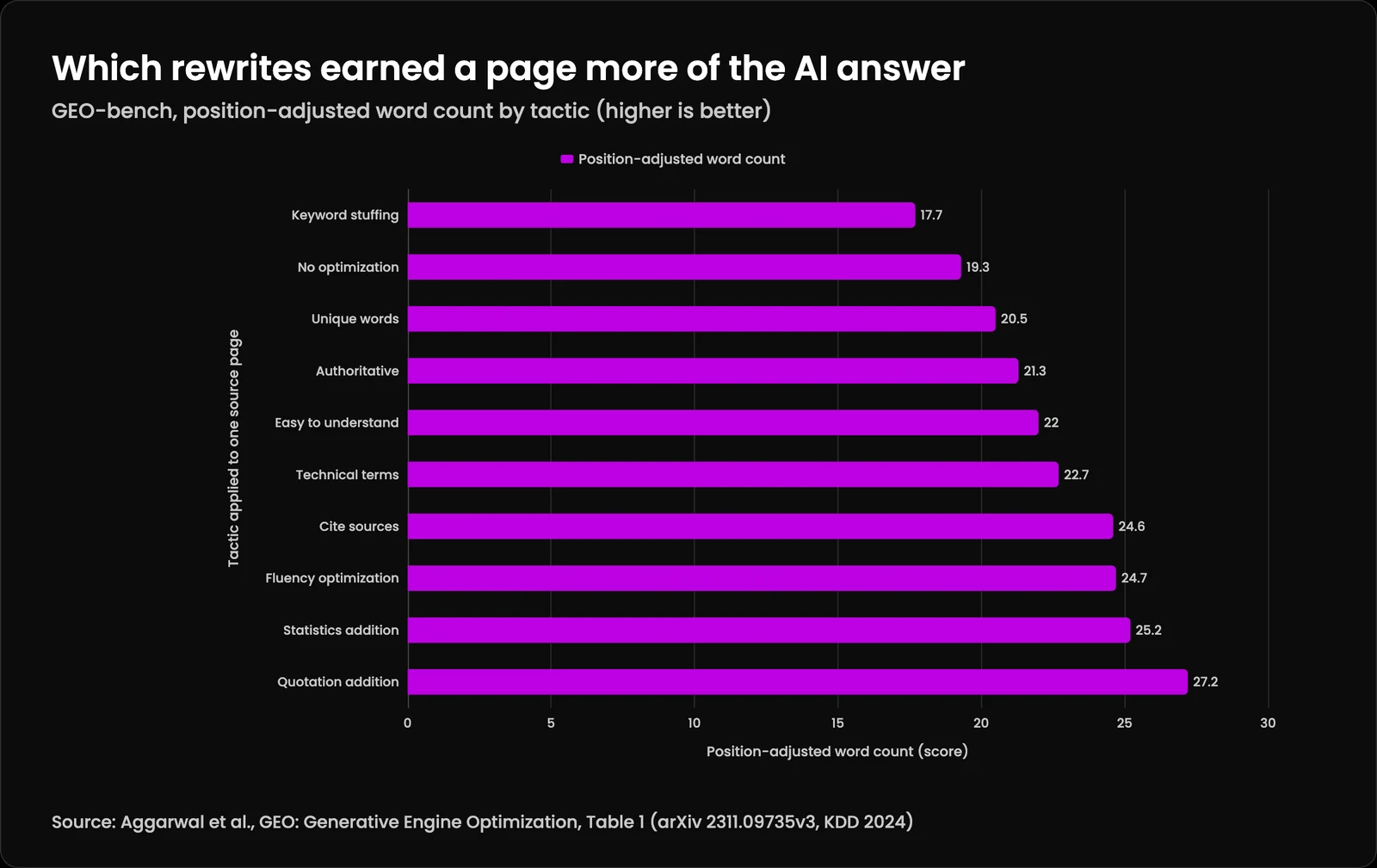
| Tactic | Position-adjusted word count |
|---|---|
| Keyword stuffing | 17.7 |
| No optimization | 19.3 |
| Unique words | 20.5 |
| Authoritative | 21.3 |
| Easy to understand | 22 |
| Technical terms | 22.7 |
| Cite sources | 24.6 |
| Fluency optimization | 24.7 |
| Statistics addition | 25.2 |
| Quotation addition | 27.2 |
What is the difference between GEO, SEO, and AEO?
SEO earns a place in a list of results, AEO shapes a page so an assistant can lift a direct answer from it, and generative engine optimization earns a place among the sources an AI cites when it writes a longer answer. They share one foundation. Google says there are "no additional requirements to appear in AI Overviews or AI Mode, nor other special optimizations necessary" (Google Search Central, AI features and your website), and Bing says its Copilot experiences "rely on the same core crawling, indexing, and ranking foundation as traditional search" (Bing Webmaster Guidelines).
| SEO | AEO | GEO | |
|---|---|---|---|
| What it aims for | A ranked position in Google and Bing results | A direct answer lifted from your page | A cited source inside an AI-written answer |
| Where it shows | Organic results, the map pack, rich results | Featured snippets, voice answers, answer boxes | ChatGPT search, Perplexity, AI Overviews, AI Mode, Copilot |
| What the engine needs | Crawlable, indexed, relevant pages | A question as the heading and a self-contained answer | Indexed pages with clear entities, cited sources, and passages that stand alone |
| How you measure it | Rankings, impressions, clicks | Which snippets you hold and whether the answer is right | Citations across a fixed set of questions, checked every month |
| What hurts it | Thin pages and blocked crawlers | Answers buried late in the page | Keyword stuffing, prompt injection, duplicate URLs |
The differences are in the output and in how you measure it. A ranking is a position you can track. A citation in a generated answer can change from one run to the next, may arrive with no click, and depends on the searches the engine writes for itself as much as on the words the person typed. Our page on answer engine optimization for a small business covers the AEO side in more depth.
How do AI engines decide which pages to cite?
They can only cite what their crawler reached and their index holds, and then they choose passages that answer part of the question. OpenAI says OAI-SearchBot is "used to surface websites in search results in ChatGPT's search features," and that sites which opt out are not shown in ChatGPT search answers (OpenAI, overview of OpenAI crawlers). GPTBot, its training crawler, is a separate setting. Perplexity says PerplexityBot is "designed to surface and link websites in search results on Perplexity" (Perplexity crawlers documentation).
Google describes a query fan-out technique for AI Overviews and AI Mode, "issuing multiple related searches across subtopics and data sources" to build one response (Google Search Central). One question can turn into several searches, and each pulls its own candidate pages. Bing says "URLs are more likely to be selected for grounding queries and citations when content stands on its own," and that pages "focused on a primary topic are more likely to be selected for grounding results" (Bing Webmaster Guidelines).
For the full sequence from crawler to quoted passage, read how answer engines choose which sources to cite. Amelia Gagne's note on getting into Bing's index before chasing Copilot citations walks through the Bing side, and Brian Gagne's piece on a proposal to let websites hand AI agents a list of tools shows where machine-readable sites may go next.
What generative engine optimization strategies hold up?
The strategies that hold up are the ones both the research and the platforms' documentation support. Here they are in the order we run them, with the source behind each one.
- Open the door. Allow OAI-SearchBot, PerplexityBot, Googlebot, and Bingbot in robots.txt, and check that a firewall or bot challenge is not turning them away. Google lists "ensuring that crawling is allowed in robots.txt, and by any CDN or hosting infrastructure" as a best practice for its AI features (Google Search Central).
- Get indexed and stay current. Submit sitemaps, fix what Search Console and Bing Webmaster Tools report, and tell engines through IndexNow when a page is added, changed, or deleted, as the Bing Webmaster Guidelines recommend.
- Answer one question per page. Put the real question in the heading and the answer in the first sentence, written so it still makes sense when an engine lifts it out on its own.
- Cite primary sources and use real figures. Citing sources, adding statistics, and adding quotations were the three strongest tactics in the GEO paper. Every figure needs a source a reader can open.
- Name your entities the same way everywhere. Bing's guidelines have a section titled "Define Entities Clearly and Consistently." Use one name for your business, each service, and each town across the site, your Google Business Profile, and your structured data.
- Mark up only what the page shows. Google says "don't add structured data about information that is not visible to the user, even if the information is accurate" (Google Search Central, introduction to structured data).
- Write for people first. Google's guidance on helpful, reliable, people-first content asks whether a page provides "original information, reporting, research, or analysis." Your own method and results are facts nobody else can publish.
What hurts generative engine optimization?
Shortcuts hurt it, and the platforms now say so in writing. Bing's guidelines treat prompt injection, content "designed to manipulate or interfere with language models used by Bing or Copilot," as abuse that "may result in reduced visibility or removal from search experiences." They add that content "should be created for users, not to manipulate ranking systems or trigger citations or AI responses" (Bing Webmaster Guidelines). Qurtoo's entry on indirect prompt injection explains why engines treat hidden instructions in a page as hostile.
- Keyword stuffing. It scored below the unedited page in the GEO research.
- Duplicate URLs. Bing says they "dilute signals and reduce Bing's confidence in selecting a URL for grounding results or citations" (Bing Webmaster Guidelines).
- NOARCHIVE or NOCACHE on pages you want cited. Bing says NOARCHIVE "prevents content from being used in Copilot responses and grounding results" and NOCACHE limits Copilot to the URL, title, and snippet (Bing Webmaster Guidelines).
- Structured data that claims more than the page says. It describes the page and cannot stand in for an answer the page does not give.
- Invented statistics. An engine that quotes a wrong figure is quoting you.
Google's spam policies name scaled content abuse, "when many pages are generated for the primary purpose of manipulating search rankings and not helping users." Its helpful content guidance adds that using generative AI to produce large amounts of text without manual oversight or curation represents little to no effort.
How do you measure generative engine optimization?
Measure citations across a fixed set of questions, and read clicks with care. Google says traffic from its AI features is included in the Search Console Performance report under the Web search type (Google Search Central, AI features and your website), so it is counted but not split out on its own. For companies on LTFI, Kief Studio can build a Google Search Console connection to LTFI so search clicks, queries, and index status sit next to the rest of the record.
Clicks behave differently when an AI summary appears. In a Pew Research Center study of 900 U.S. adults' browsing in March 2025, people who saw an AI summary on Google clicked a traditional result in 8% of visits, against 15% when no summary appeared. They clicked a link inside the summary in 1% of visits, and ended their browsing session after 26% of searches with a summary versus 16% without one. About 18% of the 68,879 searches studied produced a summary.
That is why a citation baseline matters more than a traffic chart. Write down the questions your buyers ask, put each one to ChatGPT search, Perplexity, Google, and Copilot every month, and record which sources each engine cites. Watch for pages that start appearing, answers that get your business wrong, and questions where the same outside source always wins. Each one is a page to write, a fact to correct, or a source to add.
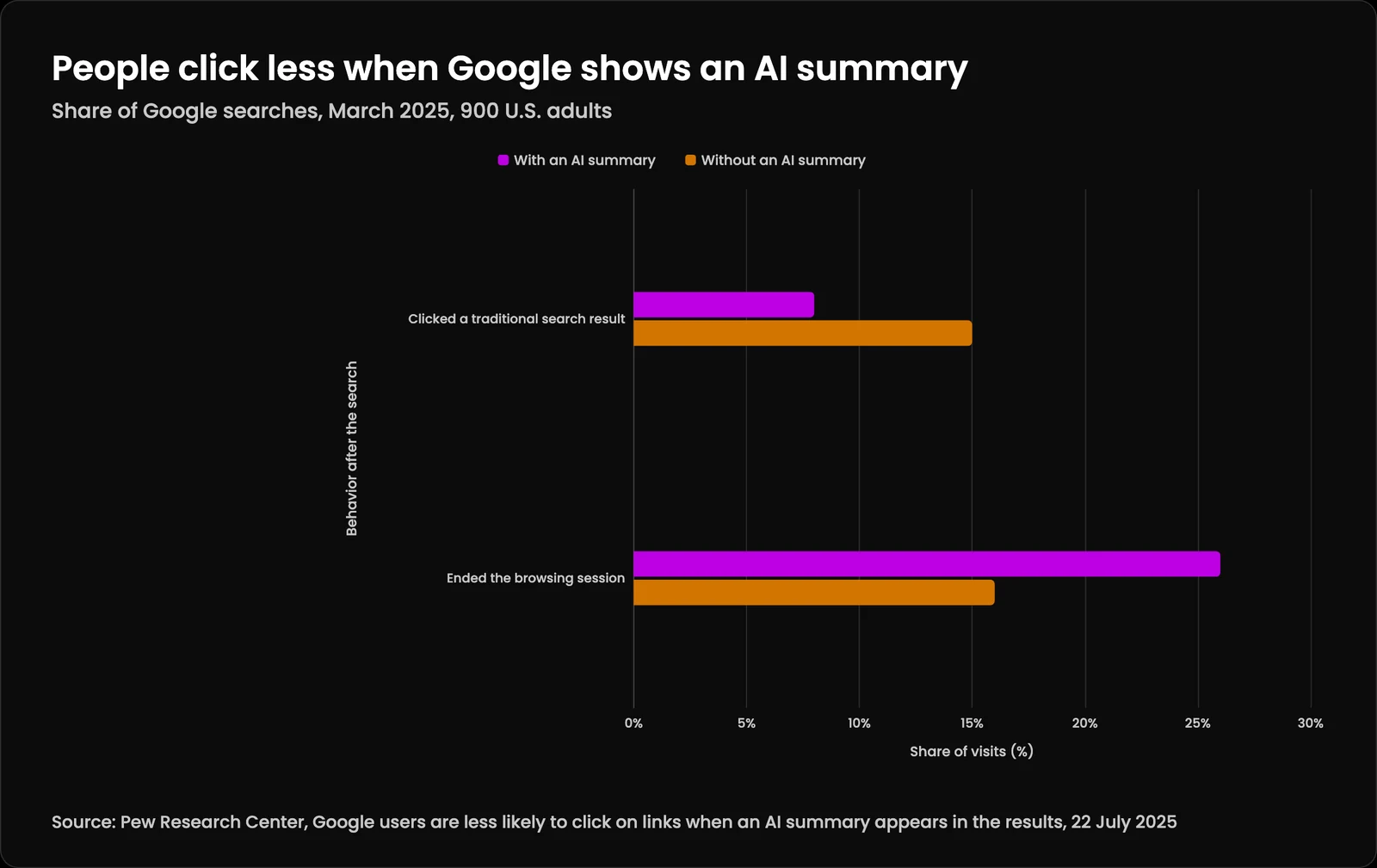
| What the person did next | With an AI summary | Without an AI summary |
|---|---|---|
| Clicked a traditional search result | 8% | 15% |
| Ended the browsing session | 26% | 16% |
Is GEO replacing SEO?
No. GEO depends on SEO. Every engine on this page builds its answers from a search index, and Google and Bing both say the same crawling and indexing foundation decides whether a page can appear in their AI features. What has changed is the last step: more answers are written for the reader, so the passage an engine quotes now matters as much as where the page ranks.
That shifts where a business should spend its effort, toward fewer and deeper pages that answer real questions with sources, and away from volume. Our note on how AEO and GEO build on SEO traces the shift, and our guide to SEO and content strategy covers planning the pages themselves.
How does Kief Studio do generative engine optimization?
We run it as part of our SEO, AEO, and GEO service, on sites we build and host and on sites other teams built. We start with a crawl and access check and a citation baseline, then write or rewrite the pages the questions call for, with the answer first and every claim sourced. Every page passes our AI quality gates before it ships, so nothing goes out with an invented figure.
We test all of it on kief.studio first. For step-by-step guides to the two engines most people ask about, read how to show up in Google AI Overviews and how to rank in ChatGPT. Amelia Gagne's checklist on how to get a small business cited by ChatGPT is a good companion. Agencies that want this work under their own brand can read about white label SEO services.
Also read
What is generative engine optimization (GEO)?: questions people ask
What is generative engine optimization?
How does generative engine optimization work?
An AI engine searches its index, often running several related searches for one question, then writes an answer from the passages it found and cites some of them. GEO makes sure your pages can be crawled and indexed, answer each question directly, name things consistently, and back every claim with a source the engine can trust.Is generative engine optimization a thing?
Yes. The term comes from a research paper first posted in November 2023 and accepted to KDD 2024, and Bing's Webmaster Guidelines now define GEO as focusing on content eligibility for grounding and reference in AI responses. Like SEO, it cannot promise a citation.Is GEO replacing SEO?
No. GEO depends on SEO. Google says its AI features have no requirements beyond a page being indexed and eligible for a snippet, and Bing says Copilot relies on the same crawling, indexing, and ranking foundation as its search results. What has changed is that the quoted passage matters more.What's the difference between SEO and GEO?
SEO earns a ranked position in a list of search results. GEO earns a place among the sources an AI cites when it writes an answer. SEO is measured in rankings and clicks, while GEO is measured by how often you are cited, and described correctly, across the questions your buyers ask.What is the difference between answer engine optimization and generative engine optimization?
Answer engine optimization shapes a page so an assistant can lift one direct answer from it, such as a featured snippet or a voice answer. GEO aims at longer answers an AI writes from several sources, where the goal is to be one of the cited sources and to be described accurately.Are AEO and GEO the same?
They overlap but are not the same. Both need crawlable, indexed pages with clear questions and answers. AEO targets a single extracted answer. GEO targets citations inside a composed answer, where entity names, sources, and passages that stand on their own carry more weight.How do you do AEO and GEO?
Allow the search crawlers in robots.txt, get your pages indexed in Google and Bing, give each real question its own page with the answer first, cite primary sources, keep entity names consistent, add structured data that matches the page, and check every month which sources the engines cite.What does GEO mean in SEO?
In SEO, GEO usually means generative engine optimization: getting a business cited in AI-written answers. It can also mean geographic targeting in local SEO, so check the context. On this page it always means the generative engine sense.Is GEO better than SEO?
Neither is better, because GEO needs SEO to work. An engine can only cite a page that is crawled and indexed. Spend effort on both together: technical health and indexing first, then pages that answer real questions with sources an engine can quote.How do you measure generative engine optimization?
Pick a fixed list of buyer questions, ask them in ChatGPT search, Perplexity, Google, and Copilot every month, and record which sources each engine cites and whether it describes you correctly. Add Search Console data, which Google says includes traffic from its AI features.When did generative engine optimization start?
The term was introduced in the paper GEO: Generative Engine Optimization by Aggarwal and colleagues, first posted to arXiv on 16 November 2023 and accepted to KDD 2024. Search engines had been adding AI-written answers around the same time.
Keep reading
More in Automate
- The LTFI Methodology
How the studio builds with AI. The product is at ltfi.ai.
- Multi-Agent Orchestration
Specialized AI agents coordinated as one system that does the work and hands the decisions to a person.
- Knowledge Systems
Search that understands meaning, not just keywords. Answers grounded in your actual data.