


Amelia GagneCo-founder and CEO, Kief Studio
- Published
- 13 min read

TL;DR: AI SEO means two different things. One is using AI tools to do SEO work faster. The other is making your business show up inside AI answers, such as Google's AI Overviews and ChatGPT. Most Worcester owners need the second, built on ordinary SEO. Cost depends on your site, your pages and your market, not on the label.
AI SEO is showing up in a lot of pitches to Worcester businesses this year. Two people can say "AI SEO" and mean opposite things, and the price, the risk and the result depend on which one you are buying.
What I notice is that the owner rarely gets a definition first. They get a dashboard, a monthly number and a promise about ChatGPT. So here is the definition, what the research says about how AI answers choose sources, and what drives the cost.
What is AI SEO?
AI SEO is an umbrella term, not a standard, and no standards body defines it. In practice it covers two separate jobs, and a good proposal says which one it means.

AI SEO as tools that do SEO work
The first meaning is AI doing parts of the SEO workload: drafting copy, writing meta descriptions, grouping keywords or checking a site for broken links. These are AI SEO tools. They save hours on repetitive work and make mistakes with confidence, so a person still reviews what they produce.
Google's guidance on AI-written content says it focuses "on the quality of content, rather than how content is produced," and that "AI can assist with and generate useful content in exciting new ways." The same post draws the line: using automation, "including AI," to generate content "with the primary purpose of manipulating ranking in search results" violates its spam policies. (Google Search Central, February 8, 2023 (opens in a new tab))
AI SEO as optimizing for AI answers
The second meaning is about where your business appears. Search now returns written answers above or instead of links: Google's AI Overviews and AI Mode, ChatGPT search, Perplexity, Copilot. Getting your pages read, trusted and cited in those answers is AI search optimization, and it is what most owners mean by AI SEO.
That job has several names. Answer engine optimization (AEO) shapes a page so an assistant can quote a direct answer from it. Generative engine optimization (GEO) helps your business get named in AI-written answers. People also say SEO for ChatGPT, LLM optimization or AIO. All of them sit on top of ordinary SEO. Our knowledge base has a plain explainer on answer engine optimization for a small business.
Is AI SEO different from regular SEO?
Less than the pitches suggest. Google says it directly: "The best practices for SEO remain relevant for AI features in Google Search (such as AI Overviews and AI Mode)." It goes further: "There are no additional requirements to appear in AI Overviews or AI Mode, nor other special optimizations necessary." It also says there is no special schema.org structured data you need to add for these features. (Google Search Central, AI features and your website, updated December 10, 2025 (opens in a new tab))
The same page sets the floor: to be shown as a supporting link in AI Overviews or AI Mode, "a page must be indexed and eligible to be shown in Google Search with a snippet." If Google cannot crawl and index the page, no amount of AI SEO puts it in an answer.
Both features may use a "query fan-out" technique, "issuing multiple related searches across subtopics and data sources." A page that answers one specific question clearly can be pulled into an answer for a broader question.
ChatGPT has its own crawler. OpenAI says "OAI-SearchBot is used to surface websites in search results in ChatGPT's search features," recommends allowing it in your robots.txt file if you want to appear there, and notes that its crawler settings are independent, so a site can allow search while blocking model training. (OpenAI, Overview of OpenAI crawlers (opens in a new tab)) That five minute check is a real part of SEO for ChatGPT.
So AI SEO is regular SEO done well, plus checks for the newer crawlers, plus writing an assistant can lift. I wrote about how ChatGPT and Perplexity decide which sources to cite (opens in a new tab) on my own site, and our note on how answer engines choose sources covers the same ground for owners.
How do AI answers choose which businesses to cite?
The best public research on this comes from a team led by researchers at Princeton University and IIT Delhi. Their paper, accepted to KDD 2024, named the field generative engine optimization. Testing page changes against a generative search engine, they report that GEO "can boost visibility by up to 40%" in generated answers. (Aggarwal et al., GEO: Generative Engine Optimization, KDD 2024 (opens in a new tab))

Which changes worked matters more. The top methods were adding citations to sources, adding quotations and adding statistics, which the authors say "achieved a relative improvement of 30-40%" on their main visibility measure. Keyword stuffing offered "little to no improvement," and in their test on Perplexity it did worse than leaving the page alone. (Aggarwal et al., full text, v3 (opens in a new tab))
One finding matters for small businesses: "lower-ranked websites, which typically struggle for visibility, benefit significantly more from GEO." The Cite Sources method raised visibility for sites ranked fifth in the search results by 115.1% in their tests. That is a lab result, not a promise for your site, but it agrees with Google's guidance: specific, sourced, quotable pages win.
For a Worcester business, AI SEO that follows the research means pages that state facts plainly, back them up and answer the exact question someone asked.
Why does AI SEO matter now for Worcester businesses?
Because AI answers change who gets the click. Pew Research Center analyzed the browsing of 900 U.S. adults who agreed to share it, covering their Google searches in March 2025. Users who saw an AI summary clicked a traditional search result in 8% of visits, against 15% for users who did not see one. They clicked a link inside the summary itself in just 1% of visits. (Pew Research Center, July 22, 2025 (opens in a new tab))
- No AI summary: clicked a search result
- 15%
- AI summary: clicked a search result
- 8%
- AI summary: clicked a link inside it
- 1%
People click search results about half as often when Google shows an AI summary (Pew Research Center, July 22, 2025)
Pew found that 18% of the searches in its study produced an AI summary, and 88% of those summaries cited three or more sources. Google, for its part, says that "when people click from search results pages with AI Overviews, these clicks are higher quality." (Google Search Central, AI features and your website, updated December 10, 2025 (opens in a new tab)) Both can be true. Fewer people click, the ones who do arrive further along, and being a cited source is the part you can work on.
Businesses are adopting AI more slowly than headlines suggest. In the U.S. Census Bureau's Business Trends and Outlook Survey, 19.8% of businesses nationally reported using AI in the period ending May 3, 2026, and use among firms with fewer than 20 employees did not change significantly between December 2025 and May 2026. (U.S. Census Bureau, May 26, 2026 (opens in a new tab)) The newest release, collected October 19 to November 1, 2026, puts the national rate at 24.2%. (U.S. Census Bureau, Business Trends and Outlook Survey, November 2026 (opens in a new tab))
Can AI do SEO by itself?
It can do parts of it, not all of it unsupervised. There are two places where unchecked AI SEO causes real harm.
The first is volume. Google's spam policies name "scaled content abuse," which it defines as "when many pages are generated for the primary purpose of manipulating search rankings and not helping users." Its first example is "using generative AI tools or other similar tools to generate many pages without adding value for users." (Google Search Central, spam policies, updated August 28, 2026 (opens in a new tab)) A tool that spits out 200 near-identical town pages for you is the textbook case.
The second is reviews. The Federal Trade Commission's rule on fake reviews, announced August 14, 2024, covers reviews that "misrepresent that they are by someone who does not exist, such as AI-generated fake reviews." (Federal Trade Commission, August 14, 2024 (opens in a new tab)) No legitimate AI SEO plan writes reviews for you.
AI earns its keep in the slow middle of the work: grouping search queries, finding pages that answer nothing, drafting a version a person corrects with real facts. Our notes on content automation without slop and quality gates for AI output cover keeping a person in that loop. I also wrote about where AI fits in an SEO workflow (opens in a new tab).
What should an AI SEO plan include?
Whatever a provider calls it, the work that moves a small business looks like this. Google's own advice for AI search lists the same themes: "unique, non-commodity content," a good page experience, structured data that "matches the visible content," and an up-to-date Business Profile. (Google Search Central Blog, May 21, 2025 (opens in a new tab))
The parts of AI SEO that do the work
- Crawl and index check. Can Google, Bing and the AI crawlers reach every page that matters?
- The questions your buyers ask. Real searches and the People Also Ask questions around them, not a keyword list someone bought.
- Pages that answer directly. One clear question per section, the answer in the first sentence or two, facts you can back with a source.
- Structured data that matches the page. Organization, LocalBusiness, Service and FAQ markup where they fit, telling the same story as the visible text.
- Your entity, consistent everywhere. Name, address, services and hours that match across your site, your Google Business Profile and the directories that matter. My piece on entity SEO (opens in a new tab) goes deeper.
- Speed and page experience. A page that loads fast on a phone. Our note on website speed for a small business has the numbers.
- Measurement. Google reports AI Overviews and AI Mode traffic inside the Search Console Performance report, under the Web search type. (Google Search Central, AI features and your website, updated December 10, 2025 (opens in a new tab))
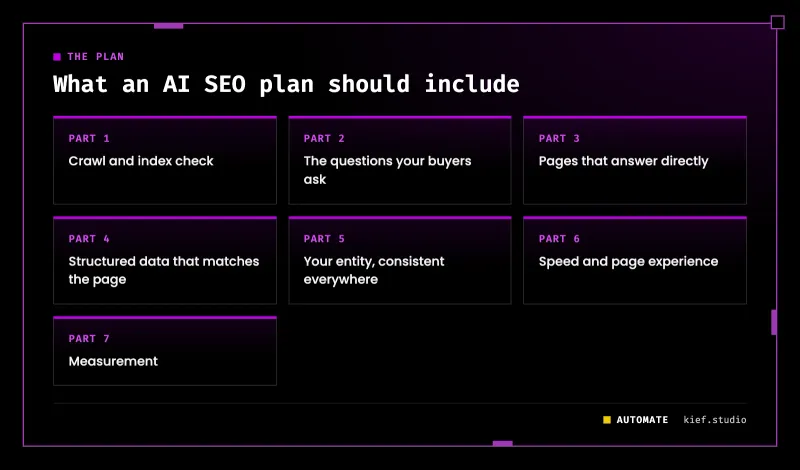
If a proposal for AI SEO covers none of these and talks mostly about a proprietary score, ask what the score measures.
How much does AI SEO cost in Worcester?
I will not give you a price range, because no neutral, reputable source publishes one for AI SEO. The numbers in circulation come from firms quoting their own packages. What I can give you is what moves the cost of AI SEO up or down.

What drives the cost of AI SEO
- The state of your site. A fast, sound site needs less work than one with broken pages or blocked crawlers.
- How many services and places you serve. A bakery with one location needs fewer pages than a contractor serving fifteen towns, each with its own questions.
- Who writes and checks the content. Pages built from your real expertise, with facts verified, take more hours than generated copy. They are also the pages that get cited.
- Competition for your searches. A common professional service in a city usually has more pages competing for the same answer than a specialty trade in a small town.
- One project or ongoing. A cleanup and a set of answer pages is a project. Keeping pages current and watching what gets cited is ongoing.
- Your existing stack. Whether your platform lets you edit structured data and robots.txt, or that needs a developer.
Kief Studio prices custom work around the use case, business size, needs and existing stack, after we have looked at the site. An AI SEO quote that arrives before anyone has looked at your site is priced for a package, not for your business.
Google is clear on one cost you should never pay: "There's no way to request or pay for a better local ranking on Google." (Google Business Profile Help (opens in a new tab))
What does AI SEO look like for a Worcester, Shrewsbury or Auburn business?
Most businesses here are small. In the 2nd Congressional District, which includes Worcester, Shrewsbury and Auburn (Massachusetts Secretary of the Commonwealth, 2022 results by town (opens in a new tab)), the SBA Office of Advocacy counts 14,442 small businesses with employees: 94.3% of the district's employers and 46.3% of its employees. (SBA Office of Advocacy, 2026 Congressional District Profiles, Statistics of U.S. Businesses 2022 (opens in a new tab))
So most local AI SEO is about being the clear, trusted answer for a handful of questions. Google says local results are "mainly based on relevance, distance, and popularity," and that "more reviews and positive ratings can help your business's local ranking." (Google Business Profile Help (opens in a new tab)) The maps side has its own fixes; our note on a business not showing up on Google Maps walks through them, and local SEO for Worcester service businesses covers which local tasks AI helps with.
Picture a question someone might ask ChatGPT, such as whether they need a referral to see a physical therapist. A clinic page that answers in its first two sentences, cites its source and matches its Google Business Profile is the kind of page the research above favors. A page that says "comprehensive care for the whole family" gives an assistant nothing to quote.
A good first step costs nothing. LTFI's free website grade (opens in a new tab) and Brian Gagne's write-up of what a free website check finds (opens in a new tab) show you where the basics stand before anyone sells you a plan.
How do you judge an AI SEO agency proposal?
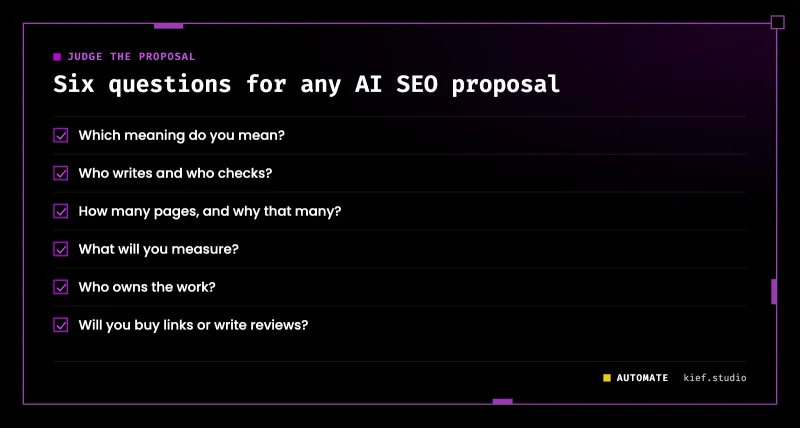
An AI SEO agency is a marketing or SEO firm selling work aimed at AI answers, AI tools for SEO tasks, or both. These questions sort a sound proposal from a weak one:
- Which meaning do you mean? Tools doing the work, visibility in AI answers, or both? Get it in writing.
- Who writes and who checks? If AI drafts pages, who verifies the facts before they go live?
- How many pages, and why that many? A plan to publish hundreds of town or service pages fast deserves a hard look against Google's scaled content rules.
- What will you measure? Search Console data you can see yourself beats a score only the vendor can read.
- Who owns the work? The pages, the accounts and the data should be yours if you leave. Our note on who owns your website, domain and logins lists what to check.
- Will you buy links or write reviews? The only good answer is no.
Frequently asked questions
How much does AI SEO cost?
No neutral source publishes a reliable AI SEO price range. Cost depends on the state of your site, how many services and towns you cover, who writes and checks the content, how competitive your searches are, and whether the work is a project or ongoing.
Can AI do SEO optimization?
AI can do parts of it well, such as grouping keywords, drafting copy and checking pages for errors. A person still verifies facts. Google allows AI-assisted content but treats mass-produced pages made to manipulate rankings as spam.
What is AI SEO called now?
The AI SEO work of showing up in AI answers also goes by answer engine optimization (AEO), generative engine optimization (GEO), AI search optimization, LLM optimization and AIO. All rest on ordinary SEO.
Is there an AI that can do SEO?
There are many AI SEO tools that handle single tasks, such as keyword research, content drafts or site audits. None of them replaces judgment about what your buyers ask and what is true about your business, which is what AI answers reward.
What is an AI SEO company?
Usually a marketing or SEO firm that offers work aimed at AI answers, uses AI tools in its own process, or both. Ask the firm which one it means and who checks the content.
Does SEO use AI?
Yes, on both sides. Search engines use AI to write answers, and AI SEO tools speed up research and drafting. Google says its SEO best practices still apply to AI Overviews and AI Mode.
Where we fit
Kief Studio offers SEO, AEO and GEO as one service, for businesses whose buyers search before they reach out, and for teams with good work that does not show up when someone looks for it. The work follows what this post laid out: find the questions and searches your buyers actually use, write pages that answer them directly with facts you can back, add structured data so search engines and assistants can read each page, then keep the site fast and crawlable and measure what gets found and cited.
What we do not do: link buying, keyword stuffing, or invented statistics written to win a featured snippet. If a number cannot be sourced, we leave it out. We are in Shrewsbury and work with businesses across Worcester, Shrewsbury, Auburn and the rest of Worcester County. See SEO, AEO and GEO for the details.
First conversation is free. No commitment.
Co-founder and CEO, Kief Studio
Related articles

Automate
Why Your Worcester Business Is Not Showing Up on Google Maps or in AI Answers
Why a business isn't on Google Maps in Worcester or in AI answers: eight fixable causes, from your Business Profile to indexing, with Google's guidance.
Amelia Gagne

Automate
Local SEO for Service Businesses in Worcester: How AI Helps
Local SEO for Worcester service businesses: where AI helps, what Google says about AI content and reviews, and a plan a small team can run this month.
Amelia Gagne

Build
Worcester Restaurant Technology: Ordering, Payments and Being Found in Massachusetts
Worcester restaurant technology for MA owners: payments and PCI, online ordering fees, Google menu and hours, tip rules, food cost, guest Wi-Fi and reviews.
Amelia Gagne